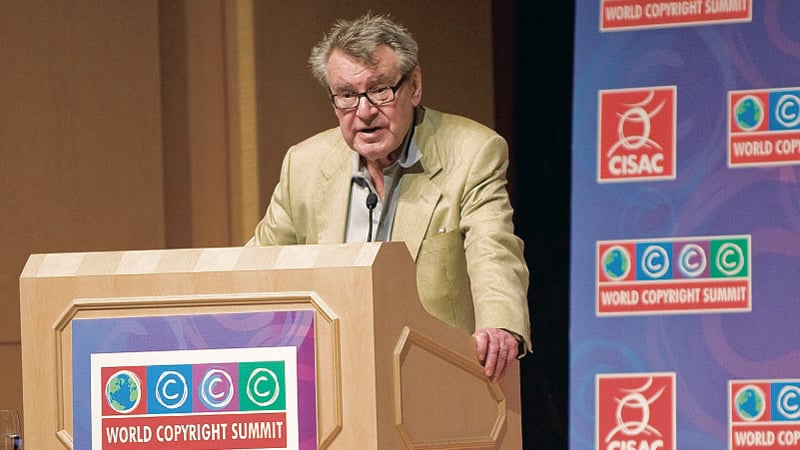
On June 10, 2009, DGA director-member Miloš Forman delivered the keynote address to the CISAC World Copyright Summit in Washington, DC. Below is the text of that speech.
I want to thank Eric Bapiste for that generous introduction and CISAC for inviting me.
I am honored to be here representing the Directors Guild of America, a CISAC member.
I have been a member of the Directors Guild of America for 29 years. DGA was founded in 1936 by the top film directors of that day. Their purpose was to create a guild that would unite filmmakers and protect their rights and visions.
Since then, whether it was the fight for a Director’s Cut, for directors’ creative control of the film, for payment of residuals, for secondary use of their work, or to prevent unauthorized editing, colorization, or the most recent battle to insure remuneration in the world of new media. The importance of these wars has not changed even in the face of global media conglomerates and numerous technological changes. If anything, it increased.
Now, we all know the reasons why we are here today. The most important one sounds very romantic: piracy. In my childhood games I always wanted to be a pirate. Not his victim. I’d prefer to call it what it really is: a theft. Internet thievery. When you think about it, Internet today is functioning as a dreamlike supermarket where you can go, take anything your heart desired without paying for it.
I will now entertain you, briefly, with an example of my personal experience in these fights. And I have some experience with this sort of battle. The first half of my life I lived in two different societies that had one thing in common. They both, the Nazis and the Communists, were obsessed in their effort to exercise total control over creative people.
I will not bore you with the ghosts from the distant past, although it is with them in mind that I have never weakened in my resolve to fight any effort to stifle the voice of authors and creative artists. But let me give you one more recent example.
In the seventies I directed a film One Flew Over The Cuckoo’s Nest. This film was being bought for television by NBC. My contract for this film guaranteed me the right to approve any changes that the Network might want to impose on my work.
So I requested a list of everything that the NBC censors consider to be objectionable for viewing on television. One page came in the mail. No letterhead, no signature. Just 10 or 15 points of their demands for change. I didn’t have any problem with most of these points. Changing a few four letter words or cutting a few frames of nudity wouldn’t significantly alter the meaning of the film or its narrative.
But I had a huge problem with 3 points on the list. Those of you who saw the film, or read the book, will know what I am talking about. They asked me to cut out Billy Bibbitt’s suicide, they suggested that McMurphy should not choke the Big Nurse and that Chief Bromden must not perform the mercy killing of McMurphy. The reason? These scenes might be too depressing for the television audiences.
I panicked. This would be a terrible mutilation of the story. So I asked for a meeting. The censors, two very nice gentlemen, came and I expressed my objection to these three points. The censors looked at each other and then one of them said: “Okay.” And the meeting was over.
But imagine if I didn’t have the right to object. The film could have been bastardized, stripped of its meaning.
But how many filmmakers have the final cut of their films, be it for the release in the theaters, or on television, DVD or for any other form of exhibition. Not many.
And first time directors practically never have that right. And they are especially vulnerable, because on the result of their first work often depends their future.
Now. The “free Internet” folks are trying to convince the public that only a few rich celebrities and powerful companies are crying “foul” about piracy because they want to get richer.
The pirates like to see themselves as modern day Robin Hoods. “We are stealing from the rich and giving the loot to the poor.” They say.
Doesn’t it occur to them that they are in fact stealing from thousands and thousands of regular, many of them poor, people around the world, who are mostly not even seen on the screen, but who depend, directly or indirectly, on the creative industries for their livelihood? These people badly need their paychecks, the residual payments and their pension and health plans coverage. Stealing from these people is not at all a noble undertaking. It is the most despicable aspect of the situation we are in.
Now imagine that anybody could go to a department store and, without paying for it, take home a pair of pants, or a skirt, and after they are tired of them, he or she returns to the store to take another pair, again without paying for it. As a result the country’s garment industry would collapse very quickly and their employees would be on the street.
And that is what could happen easily to our entertainment industries. Why should anybody pay for a movie or music if they can get them for free on the Internet?
And here our Odyssey begins.
The movies we make are the result of our work. Work that requires of us our time, weeks, sometime months, even years to create. And time is expensive to us and it takes a long time to create a film for the public to enjoy.
But even during that long process of creation the moviemakers, musicians, and composers need, like everyone else, to eat and support their families.
And if they can’t rely on being paid for their work then they can’t weather these periods of creation—in fact they can’t have them at all.
The pirates are saying: “We are not stealing from you. We are stealing from our convenience store.” They make it sound like nobody real is hurt—like it’s a victimless crime.
Well, it is not. The authors and many of their collaborators are the victims, because they will not be paid for their work.
Then how can creativity take place —how can it grow and flourish? It cannot.
And this is serious. As a matter of fact it is very serious. Because, metaphorically speaking, creativity is the mother’s milk for our culture and, as such, should be very carefully protected.
Our opponents believe that our work, once it leaves our hand, belongs to them. That copyright and authorship disappear in the face of their collective enjoyment and free possession of our work. And let’s not fool ourselves.
Their ideas, their catch-words and concepts are appealing not just to the public but also to politicians.
It is sad. Movements and politicians come and go, but culture, culture stays. Culture is here forever. And according to the culture we leave behind we will be judged.
I don’t admire Germans because of Hitler, or Italians because of Mussolini. I admire them enormously because of Mozart, Beethoven, Goethe, Da Vinci, Michelangelo.
I think I can say that culture is vital for a human spirit. If we cripple our culture we are crippling the heart and the soul of our society. That is why copyright protection for those who create is so important.
Also, our opponents like us to believe piracy is a problem only in the developed world. In a rich society which can afford to be robbed.
Another nonsense. Piracy is just, if not more destructive to fledgling film communities in the developing world—robbing them of a chance to build and grow and for individual filmmakers to flourish.
There is no question that the wonders of this digital era and the opportunities the Internet affords us are to be embraced—and none do it more readily than filmmakers.
By the very nature of our work we have always been at the intersection of technology and art. But as filmmakers we must also recognize that we are at a moment of great peril. It is now so easy, with the click of a button, at any time and anywhere in the world, to upload or download an entire film, musical composition, television program, or book.
So here we are, facing not only the ease by which our work, our property, can be copied and played, but also how our work can “be played with.” On their computers anybody can electronically alter any film, or music beyond recognition, and then disseminate the sophomoric result of their “creations” to others.
The Internet has laid open a mindset for this logic: “If the Internet is free it means that everything seen on the Internet is free too.”
Well, it is the same logic as if you go to a supermarket and say: “Because I got the plastic bag for free, everything I now have in it must be free too.” And the Internet is an extraordinary free bag, in which a countless amount of products can be delivered to your home.
Some politicians are saying that we already have recourse to protect our work… we can sue…. we can use the courts. This too may sound reasonable but it does not reflect reality. The notoriously cumbersome and long legal process is no remedy at all for this international and instantaneous problem.
Finally, we must not allow the debate to focus on the Internet as though we were frozen in time. We certainly know that technology is not static. Over the next 10 years the Internet as we see it now will be very different. And, as the technology develops and broadband penetration grows, and it is faster and cheaper to get, the scope of this “communal creativity” as they like to call it, will increase.
I don’t like to deal in abstractions, but the act of individual creation is always somehow abstract, personal, fragile, even ephemeral. It is a process that draws deeply on the imagination of the artist. At first it lives only in the mind and then it takes a director’s individual vision and the collaboration of many talented people to become real. It can be years in the making and each time we begin it is always a large risk we, and those who finance our work, undertake. Each film is its own unique creation and the authorship must not end when our work is finished and presented to the public.
Those who oppose our concerns and interests have focused on the importance of protecting the Internet users. But the rights of an individual artist are as natural and important as the rights of the Internet user.
We know this is an uphill fight, running counter to a popular mindset and well-funded opposition, but we can take comfort in one clear reality. Just as the Internet knows no geographic boundaries so too this problem is international in scope and, despite cultural differences, our fight is the same around the world.
France, the country which gave us the “droit moral,” and where the Lumiere brothers began to make films, just recently approved the “Creation and Internet” law.
Theirs was a hard fought effort, against great opposition. The DGA—as we publicly stated—was united in its solidarity with our colleagues in France. We believe their model, that did not degrade the consumer but stood up against a demagogic campaign, and made clear what was truly at stake, should be considered by all of us.
In Sweden a court, just recently, ruled against the operators of “Pirate Bay.” That’s their name. It is one of the best known Internet ports enabling the stealing of copyrighted movies and music.
These are the first important steps in the effort to protect the artist’s work from this Internet thievery. We applaud our French and Swedish colleagues.
The pirates are also claiming that the “Free Internet” is inseparable from democracy. Well, they might be surprised to learn that what they are promoting is in fact not democracy, but a communist ideology.
Karl Marx’s definition of communism is very clear: “To everybody everything according to his needs.” And, we all need to be entertained from time to time. And now in a modern day Internet world we’ll get it for free. “For free” are the important words here.
But don’t misunderstand us. We embrace the digital age. We are all well aware of its great possibilities to make our work visible to billions of people around the world.
There is a great future for the interaction between the filmmakers and the public. All we are asking for is the protection of an artist from the theft of his rights to be compensated for his work.
And this struggle to protect the artistic and economic rights of creators will only be successful if we are joined together in urgent and united international action.
Thank you.