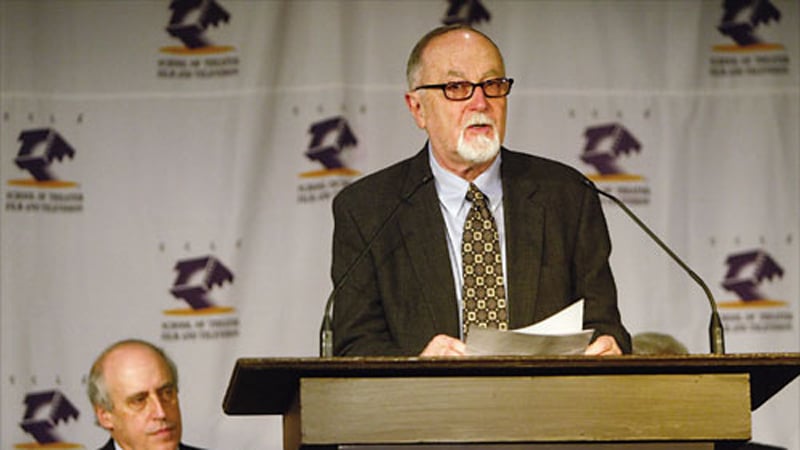
On November 4, 2004, at a press conference held at UCLA, the Motion Picture Association of America (MPAA) announced that it would adopt the music industry's tactic of suing individuals suspected of illegally distributing copyrighted works online. MPAA president and CEO Dan Glickman was joined by studio executives, legislators, educators, filmmakers and union leaders including DGA Secretary-Treasurer Gil Cates, who spoke on behalf of the 12,800 directors and members of the directorial team the Guild represents. The following is a transcript of Cates' statement.
"Film and television are indigenous American arts forms, and the work of filmmakers—as well as the other artists of our industry who are here today—has portrayed the American experience for almost 100 years. The DGA's goal is to ensure that this craft continues unimpaired for the benefit of millions of film and television viewer's worldwide and that our members continue to earn their living giving their talent to a craft they love.
"Films are not created by the snap of a finger nor do they materialize out of thin air. For directors, writers, actors and the many craftspeople we work with, it involves years of creative effort and hard work to put a vision on the screen. For the studios and investors it involves tens, if not hundreds, of millions of dollars to make that vision a reality.

"This is a basic question of what is fair and right. We wish there was a perfect solution to this problem. We wish everything was for free and that nobody had to pay anyone. But that is not the world in which films can be made. And if films are not made the loser will not only be those of us whose talent and hard work is the creative vision on the screen, but also the very public whose "love affair" with this most American of art forms began so many decades ago.
"To quote what Winston Churchill once said about democracy. 'Indeed, it has been said that democracy is the worst form of government except all those other forms that have been tried from time to time." What the MPAA announces today in an effort to protect our films may not the action many want to see or hear. But stealing is stealing. The "arrival" of the Internet and the digital age does not change that truth.'"