In 1939, when the Guild was still in its infancy, Directors and their teams were already making their mark in sports history with the very first broadcast of a professional football game in October 1939, when Director Burke Crotty captured the game in which the Brooklyn Dodgers defeated the Philadelphia Eagles for an audience of perhaps 1,000 people on NBC’s experimental station W2XBS in New York. Since then, football has consistently ranked among the most viewed broadcasts in television history, and of those, none rank higher than the crown jewel of sports, the Super Bowl.
The first Super Bowl in 1967 was a contest between the Green Bay Packers and the Kansas City Chiefs played at a neutral site: the Los Angeles Memorial Coliseum. It didn’t come close to selling out, even with tickets priced at $12, $10, and $6. CBS charged $85,000 for a one-minute commercial. Sixty years later, the cost of the most inexpensive ticket for 2026 was over $4,800 for upper-level seats and a 30-second commercial cost advertisers between $8 million and $10 million.
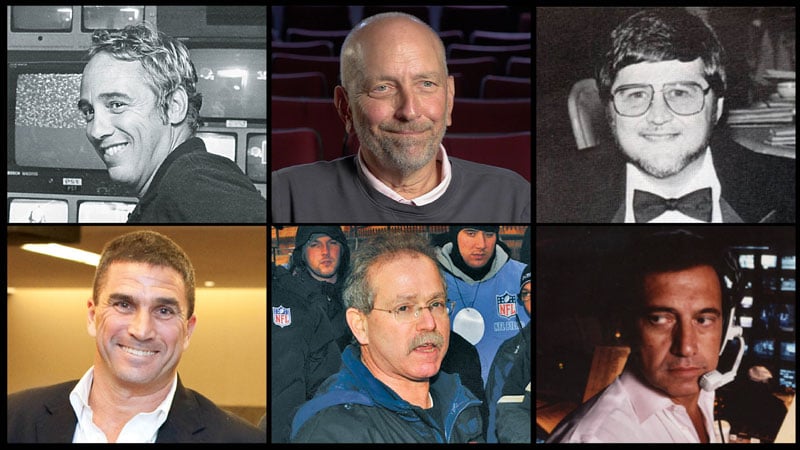
As we celebrate the 60th incarnation – where in his eighth Super Bowl, Director Drew Esocoff led a team of Associate Directors and Stage Managers — we look back at the DGA members who have called the plays in the booths to capture the action on the field.
The Super Bowl originated from the 1966 merger agreement between the rival NFL and AFL, creating a championship game in 1967 between the two league champions in a winner-take-all playoff. Called the “AFL-NFL World Championship Game,” and played at the Los Angeles Memorial Coliseum, the first game was simultaneously broadcast on both CBS and NBC. The NBC broadcast was directed by Ted Nathanson, who would later receive the DGA Lifetime Achievement Award in Sports Direction in 1991.
Nathanson would go on to direct more Super Bowl broadcasts than any other Director to date, with 11 games to his credit. For that first game, he arranged to have as big a television set as could be found mounted in the mobile production truck and trained a camera on the screen, occasionally zooming in and beaming that tighter shot over the air. Of the technique he recalled, “The CBS crew couldn’t figure out how NBC managed to get its ‘exclusives.’”
In alternate years from 1967–1975, CBS and NBC continued to have exclusive broadcasts of the game, which officially adopted the title “Super Bowl” in 1969 when AFL owner Lamar Hunt was inspired by a children’s toy with Roman numerals used from Super Bowl V. Nathanson continued directing for NBC until Super Bowl VIII in 1974.
That year, Tony Verna helmed the CBS broadcast. Verna, who received the DGA’s Lifetime Achievement Award in Sports Direction in 1995, was already legendary as the inventor of the feature that would revolutionize televised sports, instant replay. As a young Director, he was always searching for ways to make his broadcasts more exciting but recalled that in the early years NFL teams were reluctant to embrace television. “It was very difficult to do anything innovative because the climate was different,” said Verna. “The teams didn’t give our camera operators good positions on the field. We didn’t have the freedom to move around. Our cameras were on turrets that were bolted down.”
In 1976, Sanford “Sandy” Sanford Grossman made his Super Bowl debut, taking the baton to helm CBS’ broadcast of Super Bowl X. Grossman would go on to direct 10 Super Bowls — second only to Nathanson — and win the very first DGA Award for Sports Directing in 1985. He later helmed FOX’s first Super Bowl broadcast in 1997 when the network joined the rotation.
“He could just make magic,” NFL announcer John Madden said of Grossman, who began isolating a camera on linemen so analysts could delve into the nuances of the game. “I’ll see some old games he did, and they still hold up.”
When Grossman passed away in 2014, DGA 2023 Lifetime Achievement Award for Television Direction recipient Bob Fishman said of his mentor and friend, “Learning to choose the right camera shot for the moment was one of his great strengths, along with his desire to take chances. I learned those things from him as I made the transition from The NFL Today studio show to the remote and have applied them to everything I have covered.”
After nearly 20 years of exclusive broadcasts by CBS and NBC, ABC entered the Super Bowl rotation in 1985. Director Chet Forte guided the broadcast of Super Bowl XIX.
Forte, a DGA Lifetime Achievement in Sports Direction Award recipient in 2000, had already made waves as the Director of Monday Night Football by fighting the league for better access for handheld and sideline cameras and employing larger camera crews. In a 1972 interview, Forte recalled, “What I wanted to do was get away from the conformity of CBS — a wide shot to a tight shot, over and over. I wanted to gain impact with enormous close-ups. I wanted to see all the action bigger.”
At the start of the 21st century, Larry Cavolina made his Super Bowl debut in 2001 with CBS’ broadcast of Super Bowl XXXV. Cavolina introduced technological advancements including EyeVision and CableCam. He also directed Super Bowl XXXVIII in 2004, earning praise for the overall game broadcast despite the “wardrobe malfunction” controversy surrounding the halftime show directed by Beth McCarthy-Miller.
In 2003, a new generation emerged when Drew Esocoff shepherded his first Super Bowl with ABC’s broadcast of Super Bowl XXXVII. “Directing the NFL is all about servicing the viewer,” Esocoff once said. “The losers are sometimes a better visual than the winners.”
The 2000s also saw Mike Arnold take over directing duties for CBS beginning with Super Bowl XLI in 2007. That game included a halftime show headlined by Prince, which was directed by Don Mischer, where the viewership peaked at 140 million.
To date, Arnold has directed seven Super Bowls, working in close partnership with producer Lance Barrow to coordinate every facet of the broadcast.
A more recent inductee to the Super Bowl Directors’ club is Rich Russo, who made the first of his six Super Bowl broadcasts with Super Bowl XLV in 2011. “You can’t script a live event,” Russo has said. “Once they kick off, you have no control. You only get one shot to get it right.”
Directors and Super Bowl Years
- Bob Dailey — 2 Super Bowls I (1967 & 1968)
- Ted Nathanson — 11 Super Bowls (1967 –1991)
- Tony Verna — 1 Super Bowl (1974)
- Sanford “Sandy” Grossman — 10 Super Bowls (1976–1997)
- Chet Forte — 1 Super Bowl (1985)
- Larry Kamm — 1 Super Bowl (1988)
- Craig Janoff — 3 Super Bowls (1991, 1995, 2000)
- John Gonzalez — 3 Super Bowls (1993, 1994, 1996)
- Larry Cavolina — 2 Super Bowls 2001, 2004)
- Artie Kempner — 1 Super Bowl (2005)
- Drew Esocoff — 8 Super Bowls (2003–2026)
- Mike Arnold — 7 Super Bowls (2007–2024)
- Rich Russo — 6 Super Bowls (2011–2025)
Click here for a chronological list of Super Bowl Directors from 1967-present, including the teams that played, the final scores and other related facts of interest.