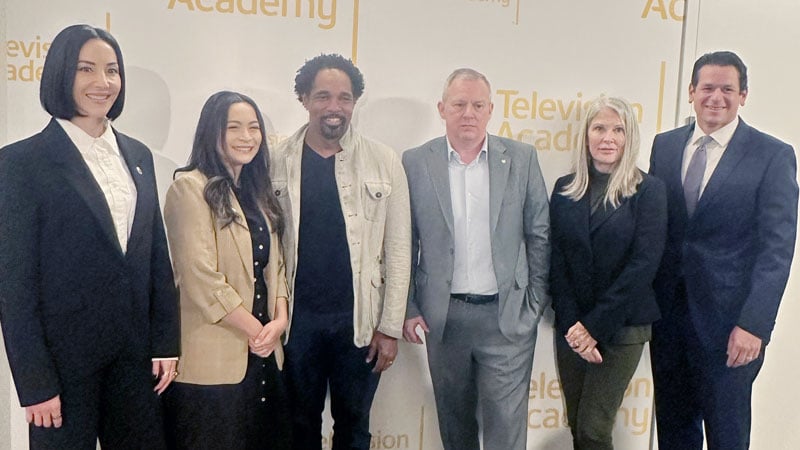
On October 29, DGA Associate Executive Director/Western Executive Director Rebecca Rhine, represented the Guild during a panel at the inaugural hearing in of the California State Assembly Select Committee on Growing and Retaining the Creative Economy in California.
Hosted by California State Assemblymember Rick Chavez Zbur, at the Television Academy’s Wolf Theater in North Hollywood, the discussion, Protecting California Jobs: Maintaining California’s Global Leadership in the Film & Television Industry, featured a trio of panels dedicated to that cause.
During the first panel, Maintaining and Growing the Creative Economy in California, Rhine was joined by Motion Picture Association (MPA) Vice President Arlen Valdivia, IATSE Executive Board member Michael F. Miller, Jr., SAG-AFTRA National Government Affairs and Public Policy Committee Co-Chair Jason George and Teamsters Vice President At-Large Lindsey Dougherty for a discussion about the importance of the Film and Television industry to the state.
After thanking Assemblymember Zbur and the Committee members there for their longstanding and continuing commitment to the 100-year relationship between California and the motion picture industry that provides thousands of middle-class jobs, Rhine noted, “As others have highlighted, the past does not guarantee the future. Complacency is not our friend in this fight. There is no coming back once the ecosystem of our industry is weakened beyond repair. I have represented workers in this industry for nearly 30 years and at this moment, we at a tipping point.”
Rhine shared that a recent EY study commissioned by the unions shows that over the past 25 years America’s share of global production for the 25 highest budgeted films dropped by 54%. For the same period TV production suffered a 32% decrease in domestic market share as U.S. spending on TV production migrated abroad. Work on the highest budgeted films has decreased from 74% to 34% – a precipitous drop in 25 years.
She added that California’s production incentive, AB 1138, has had a positive impact and is responsible for slightly over 40% of all permits for scripted production in Los Angeles during the last quarter. There are many more productions that wanted to stay but could not because of the cap on funding and the limited funding is further exacerbated by the statutory requirement to allocate money for recurring productions. All of this serves to reduce the amount available for new production.
Declaring the need for a path to making the program easier to navigate, as well as the need to avoid segmenting the various elements of production with multiple approaches and programs, Rhine recognized the important role neighborhoods, cities and counties must play in not just welcoming but facilitating production.
“We know this is difficult at a time when local government budgets are strained but it won’t help those budgets if the revenue generated by production and its workers disappears. The current California program is fundamentally inadequate because of what it cannot do – serve all eligible productions. The California Film Commission consistently turns productions away because the money runs out long before the demand does. Many of the challenges highlighted today go away if that basic problem is solved. California will never be competitive with a capped program when many states and most countries are uncapped.
“We recognize that this is a tall order. California has many challenges and we are not blind to the problems the state and its residents will face over the next few years. But losing the jobs, businesses, tax revenue, and tourism, film and television production drives will do nothing but damage the State. We want our industry to be part of the solution. The bottom line is that when our industry thrives, California thrives.”
Other panels of the day included Protecting and Growing Jobs through California’s Film & Television Tax Credit Program with panelists from SAG-AFTRA, CAPA, MPA and Laborers; and Evaluating the Budget Impacts of the California Film & Television Tax Credit Program with panelists from the LA Economic Development Corporation and Go-Biz. The hearing ended with a discussion on next steps and public commentary.
For more information about the DGA’s Production Incentive efforts, visit www.dga.org/Initiatives/Production-Incentives