SHOT TO REMEMBER
"Hit the Road"
DGA Past President Taylor Hackford’s 2004 DGA and Academy Award-nominated feature, Ray, tells the story of legendary musician Ray Charles who lost his vision as a child but went on to redefine soul music and inspire a generation. In this article, Hackford reveals how he created a pivotal scene for the film that encapsulates the complex nature of Ray’s life and how he channeled that into his art.
By Rob Feld
 Taylor Hackford’s conception of his Ray Charles biopic, Ray, was to track Charles’ (Jamie Foxx) attempts and ultimate failure to balance his competing priorities of heroin, music, women on the road, and his wife and family at home. When the chaos finally catches up with him, Charles had to make the ultimate choice: the dope or his music. He kicked heroin cold turkey, which is documented graphically in the film. Of the many women Charles had relationships with outside his marriage, his romantic and collaborative relationship with Raelettes backup singer Margie Hendricks (Regina King) was paramount.
To explore his visual storytelling approach to Ray, Hackford chose a sequence that shows the dissolution of this emotional and creative relationship with Margie. Holed up in the Hotel Theresa in Harlem, Charles is stoned but ready to start working on a new song, “Hit the Road Jack,” when Margie, informs him that she is pregnant. When he refuses to leave his family for her — which she argues he has effectively done already — Charles channels her fury into a raw performance of “Hit the Road Jack,” which made this record into a hit.
The sequence cuts from the dark hotel room to the glamor of a supper club performance, to RCA Records’ corporate office, and back to the Theresa Hotel. There, Charles tries to filter his thoughts through a heroin haze of memory that jumbles the many losses of the women in his life — from his mother onward — and, tragically, is too incapacitated to stop Margie from leaving him.
“One thing I was trying to accomplish with Ray,” Hackford says, “was to tell his story through the women in his life, beginning with his mother, whom he lost as a child but who he swore was still the most important person in his life. He gave her ‘tough love’ credit for the success he attained in his life because, when he lost his sight, she wouldn’t let him be dependent on anyone. This sequence appears to be just a scene in a hotel room between two fighting lovers, but it carries all the drama of Ray’s life and the people he really cared about. In its last moment, before we cut to a flashback of his mother, we see him relate his abandonment to all the women in his life. This scene carries all of it.”
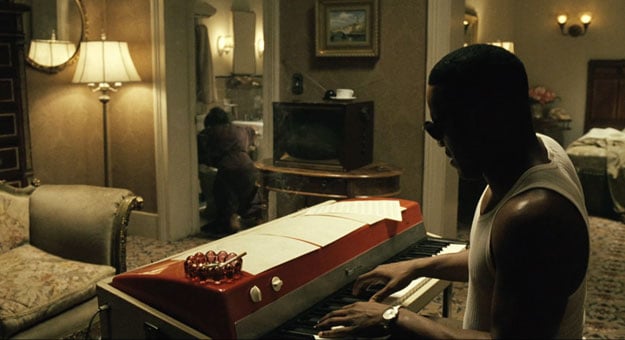
Away from his family, Ray has been living and working with Margie in the Hotel Theresa in Harlem, a set we built on a stage in New Orleans. In this master shot, he’s reading a new song in Braille, ready to work, as Margie jumps out of bed and runs to the bathroom to vomit. He accuses her of being drunk all the time. This sequence is all hand-held: When Ray was a child, he could see, so I started the film with fixed camera positions — I never moved the camera. As he started to lose his sight, I had the camera on a dolly or a crane. When he went blind — and, more importantly, when he started shooting heroin — I switched completely to handheld. What I wanted to communicate was that his life was untethered, that the dope was taking over, and that he was not rooted in anything.
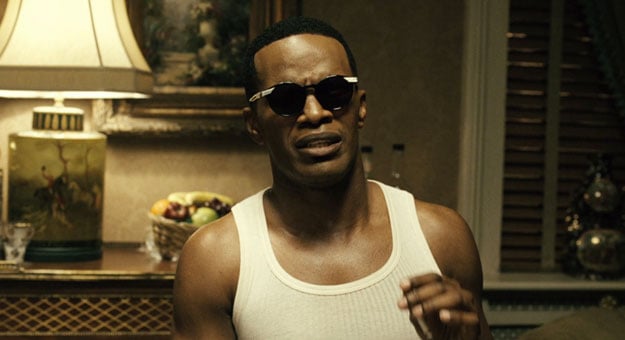
She tells Ray she’s not drunk, she’s pregnant. Ray’s reaction is immediate: he tells her they can’t keep the baby, and Margie erupts with emotion, slapping him. Regina really slapped Jamie hard — once in the master and once in a close-up. You have to understand Jamie’s commitment. An actor can’t really comprehend blindness by closing his eyes — he can always open them. So Jamie agreed to glue his eyelids shut. When you can no longer see and you just hear everything, it’s all confusion, and an actor can still panic. Jamie knew he was going to get slapped, but not when, so he couldn’t betray it. My technique here was just to focus on what these actors were delivering to the camera, so editor Paul Hirsch and I didn’t want to overcut. We cut to Ray’s silence to get his reaction to her being pregnant, but you know how he’s feeling. The handheld camera also delivers an immediacy to the subtleties these actors are delivering.
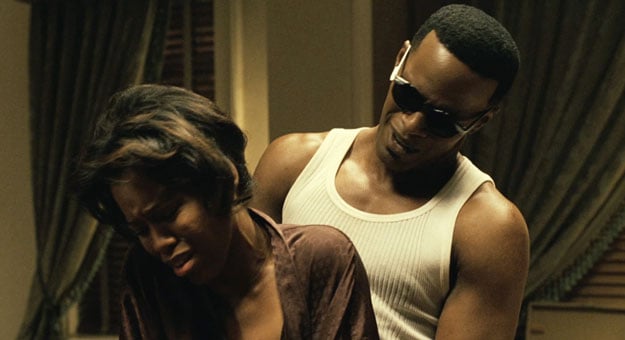
The handheld camera came around from the master, pulling Jamie up to get the emotion on their faces in a two-shot. He folds her into him, but she doesn’t want to be sweet-talked. She wants him to leave his family, which he won’t do. We’d run the scene through from each angle. My DP, Pawel Edelman, had to light for a 270-degree view with practical lights because of how we were moving the camera around the room. We were dancing in a limited space with a ceiling, and we were able to get a few lights behind the camera, but it was a subtle and challenging job. We accentuated colors when Ray could see as a child, but as the film evolved, we started desaturating. By this point, the color is bleach bypass, so that the blacks were very black and the colors were muted.
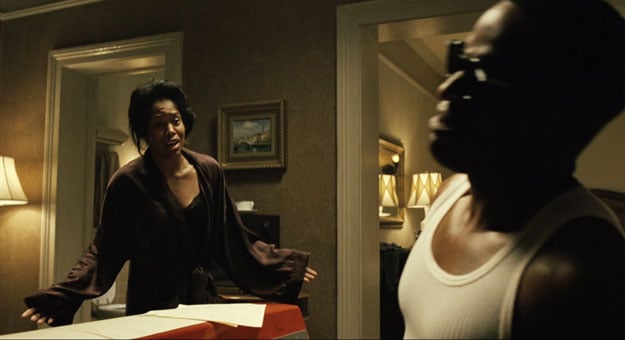
Ray returns to the piano, and we cut back to the master shot as Margie tells him that between the dope, his music, and her, he’s already left his family — he just doesn’t know it. You can see it’s desaturated here, but there’s an intensity to it. She’s become an alcoholic and he’s a junkie, so it has a moodiness. There is a low-down quality to the room that feels right for the psychology of the scene.
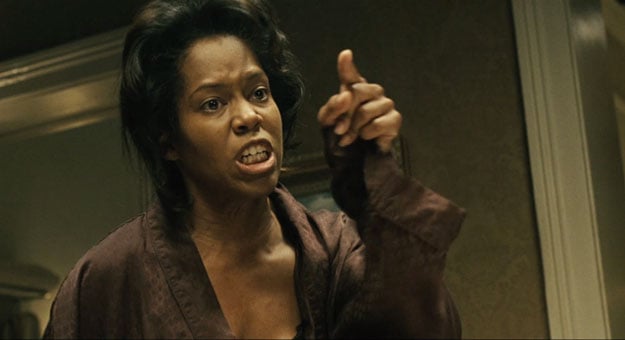
They’ve locked themselves in, the blinds are down, their life is turned inward and they’re fighting. There was a lot of love, a lot of passion and a huge amount of creativity that’s all going up in smoke. She says, “From now on, it’s strictly business between you and me.” He’s going to channel her anger into singing “Hit the Road, Jack.” I knew I was going to cut from this dark, personal scene to them singing the song in the big showroom, where she affects that same gesture. The camera is down low because Ray’s POV is from the piano, but I wanted to accentuate Margie’s power. Regina’s small, but she’s got a huge heart and incredible force as an actor. Here, she’s standing up to Ray and will no longer be dominated by him. Her point is accusatory, but he’s using it creatively to put the fire in her for this song.
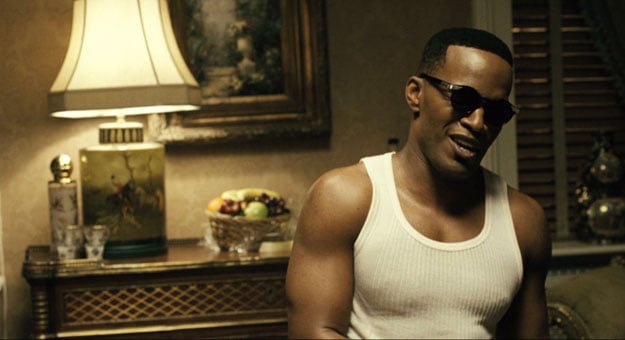
This is her POV, and you can see the smile on Ray’s face as he starts playing “Hit the Road Jack,” directing her to use her anger. Jamie is playing for real, and it’s their voices singing. She’s pouring her anger and pain into the song. We were shooting long days in the hot summer in New Orleans and Jamie would stay up until two in the morning practicing Ray’s fingering. You feel the rawness of their voices in this really bent environment, with them going down the drain together. The sound design is quite silent — just that electric piano and their two voices. It’s personal. It’s the dying of a relationship. I wanted that reality to be the soundtrack.
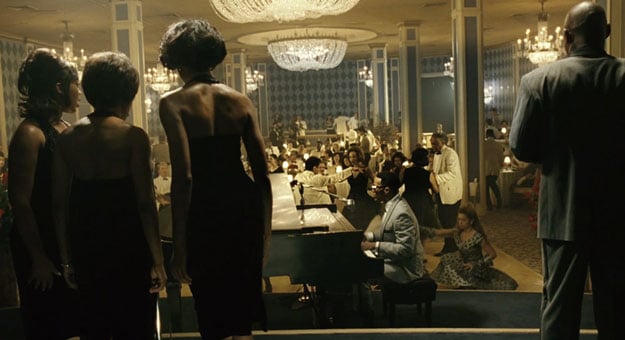
We do a hard sound cut from an intimate scene with two people coming apart in front of you to a live scene in a supper club, where the band is playing hot and they’re totally professional. I used the original Tom Dowd recording — the quality was so good it felt live. There’s fire between Ray and Margie in the hotel room, now translated into this performance as she expresses her incredible anger. Ray has progressed from playing roadhouses to elegant supper clubs like the Roosevelt Hotel’s Blue Room, so this sequence tracks both the trajectory of his career and his relationship with Margie. We shot in the real Blue Room in New Orleans. It’s still bleach-bypassed but the room had lights Pawel accentuated and it sparkles. Costume designer Sharen Davis designed and built a lot of the wardrobe. Her work was accurate to the period but expressed each character.
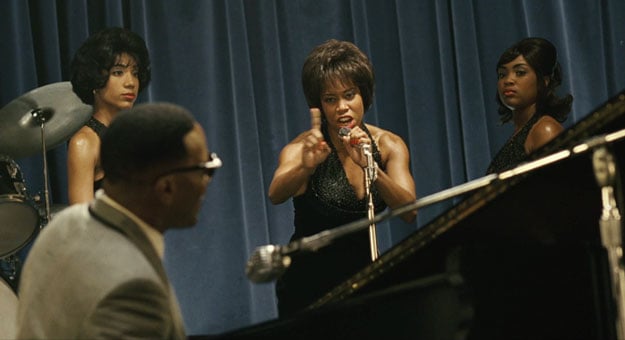
You see Margie singing the song, pointing the same recriminating finger at Ray. He’s translated it into a hit and she’s on fire. We shot single-camera except for the musical sequences. I knew Ray’s music better than my camera operators did, so with so much happening onstage, I’d say, “When I tap your shoulder, pan from the drums to the horns and then back when I tap you again,” because I had three cameras here but needed six shots. For the musical numbers, the cameras were in fixed positions — not handheld, but with a little movement, which is psychologically important. I always used fixed Panavision lenses because I wanted to shoot as wide open as I could. My lenses are usually between 25 and 75mm — this was probably a 50mm. We also shot anamorphic because the story felt epic to me.
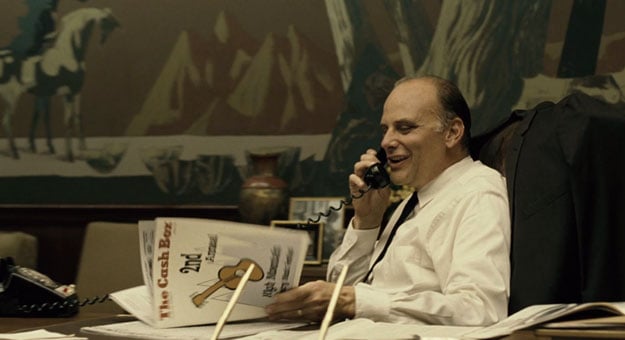
We cut to Sam Clark, the head of ABC-Paramount Records, with music from the club overlapping. He’s calling to tell Ray the song is number one. Sam is full of life and a big cheerleader for Ray. As he’s handed the trades, the camera dollies around his desk from a wide shot into a close-up. Ray may be a junkie in the Hotel Theresa, locked in with the shades pulled, but there are still a lot of people making money on his art. We’re telling the story pictorially, so you understand the different levels of his life. We shot this corporate office in the Masonic Lodge on Wilshire Boulevard in Los Angeles. That mural behind Sam felt 1950s to me, so we used it. It gives a sense of differentiation. That’s production designer Stephen Altman and me trying to make the most of the little money we had.
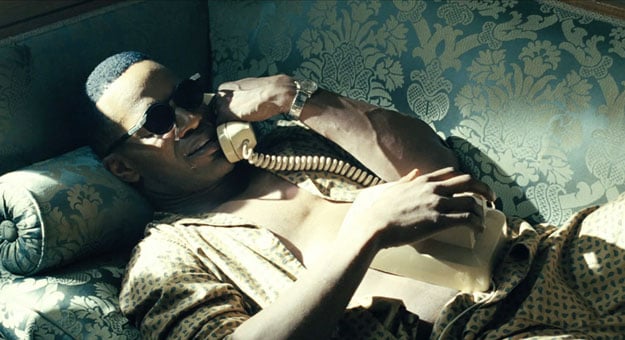
Now we’re back in the hotel room with Ray, stoned out of his mind, mumbling on the phone to Sam. The bleach bypass makes it almost black-and-white. This is Ray at his lowest. You can hear his dialogue, but Jamie isn’t articulating or projecting his voice at all. Production sound mixer Steve Cantamessa was crucial — he had both boom and lavalier mics on Jamie to capture it. Ray won the Oscar for Best Sound Mixing not for its musical numbers, but for its subtlety. Results like this, from collaborations with talented people using subtlety instead of waving flags, make me so proud of Ray.
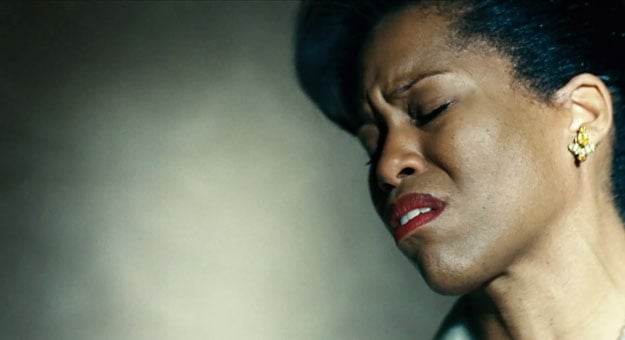
As he gets off the phone, Margie has her bags packed and tells him she’s leaving to pursue a solo career. When Ray is stoned, his past and the various women in his life — especially his mother — become a mixed-up mélange of experience. So he mumbles that he doesn’t want her to leave, but confuses her with his wife, calling her “Bea.” It wasn’t in the script, and Regina wasn’t prepared for it, so you can see the actual pain of the betrayal we captured on her face. I believe you can capture reality on film when you give actors surprises. Craig Armstrong’s string score starts here. The film is filled with R&B and jazz, so I wanted the score to be in contrast. It’s the last straw for Margie. She’s devastated, and she walks out.
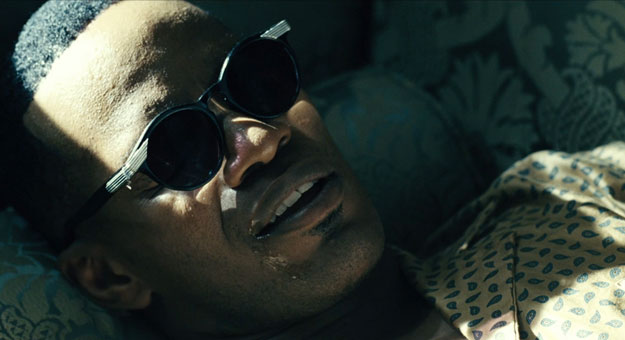
Ray says, “I don’t want you to go,” which is the connective tissue to the next scene of him as a boy, telling his mother he doesn’t want to be sent away from home to a school for the blind — which is the last time he saw his mother before she died. We understand that Ray is alone in the dark. This shot is dark — look at the quotient of the shadow. A close-up can say so much, subtly. We next cut to northern Florida, where his mother is standing ramrod straight, her heart breaking because she’s sending her baby away on a bus. In the continuum of his dream life, this is his sense of constantly being separated from the women in his life. I shot pretty much in sequence, and you watch his relationship with Margie evolve and then die in this scene, the painful end to a beautiful relationship.
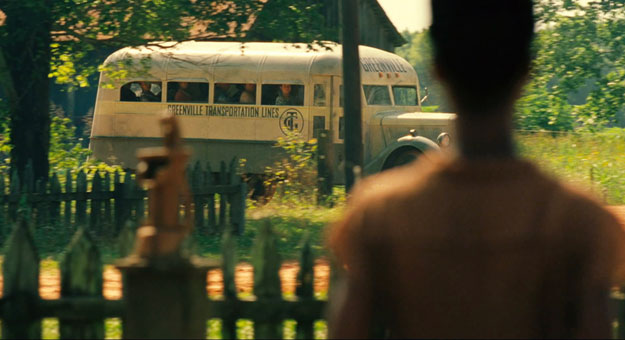
One of my favorite transitions in the film is the cut from the close-up of a smacked-out Ray saying, “I don’t want you to go,” to Margie as she walks out the door, and then to the flashback master shot of the old bus arriving in their little rural village to take young Ray away. This was the first of Ray’s traumatic separations from the women in his life. His mother, Aretha, who died at 28, was sick and realized she wouldn’t be able to care for her blind son, so she was sending him to the Florida School for the Blind, in hopes he’d make something of his life. She succeeded beyond her wildest dreams. Ray told me that he lived “alone in the dark,” but I used flashbacks throughout the film of his mother in an attempt to represent his inner life. As a 75-year-old man, Ray Charles told me, “I talk to my Mama every day.” And I believed him.
Screenpulls: Universal Studios.
Hackford portrait by Marc Bryan Brown.