SHOT TO REMEMBER
Date Night
In his DGA award-nominated film Sideways, Alexander Payne faced the challenges of keeping his audience’s eye refreshed with variety during a nine-minute date scene he calls “the centerpiece of this modest little picture.”
By Rob Feld
 In Alexander Payne’s comedy Sideways, struggling author and wine aficionado, Miles (Paul Giamatti), road-trips with his soon-to-be-married friend, Jack (Thomas Haden Church) to California wine country for a celebratory getaway. Miles’s life has been circling the drain since he sabotaged his marriage, and his appreciation for fine wine has devolved into an untenable drinking habit. He was hoping for a lowkey excursion of wine and golf, but Jack has far more debaucherous intentions before tying the knot. Jack picks up a vineyard wine-pourer, Stephanie (Sandra Oh), and corners Miles into double dating with Maya (Virginia Madsen), who waitresses at a restaurant Miles frequents.
The nine-minute date scene—mostly over a dining table—evolves over a series of bottles into a subjective representation of Miles’s troubled and increasingly inebriated mind. He’s interested in Maya, who shares his sensitivities and interests, but Miles is too much of a mess to follow through—especially after learning of his ex-wife’s recent marriage. As Jack and Stephanie flirt on one side of the table, Miles floats in and out of engaged conversation with Maya, ultimately losing to his depression and fixation on his ex-wife’s marriage until he leaves the table to call her from a pay phone.
Payne faced the challenges of keeping his audience’s eye refreshed with variety, while bringing it deep into Miles’s abstracted experience. The camera floats naturally with a succession of lengthening lenses, and shots dissolve fluidly into each other as Miles’s own mind swims. “I can do all the cinematic tricks I want,” says Payne, “but it’s Giamatti’s performance that anchors the audience and anchored me as a Director. All you need to make a movie is a camera, a tape recorder, and the right Actor. Even twenty years later, when we did The Holdovers, my respect for his talent continued to skyrocket.”
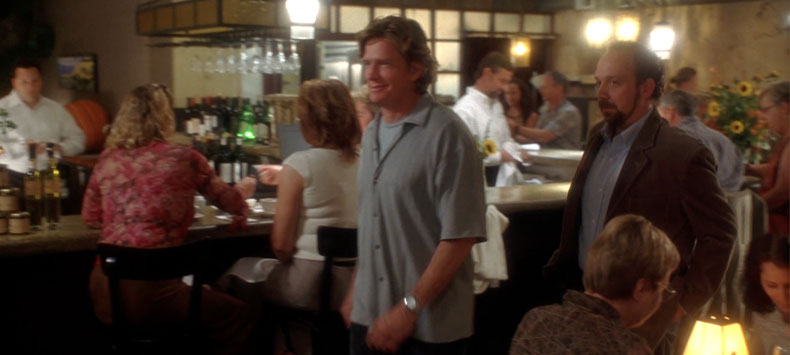
Miles is going on a double date against his better judgment, and you can see it in him. He’s still smarting from a divorce he didn’t want and simply wants to be spending time with his friend. This was my fourth feature with Production Designer Jane Ann Stewart, and we spent months scouting in Santa Barbara County. I’m all about shooting locations—I hate sound stages. So, this is the Los Olivos Café, in Los Olivos, California. I like to have something of a documentary approach to fiction filmmaking—as much as possible, I want to show reality, or a version of reality, and what you see in Sideways is very accurate to Santa Barbara County in 2003. My idea for the movie was to replicate the rhythm and energy of an early-’60s Italian comedy but with the visual language of a ‘70s American film. We shot on 35mm and used Pearl Mist filters, which gave a blossoming to the highlights and a softness to the warmth of all that sunshine in a beautiful autumn in South-Central California.
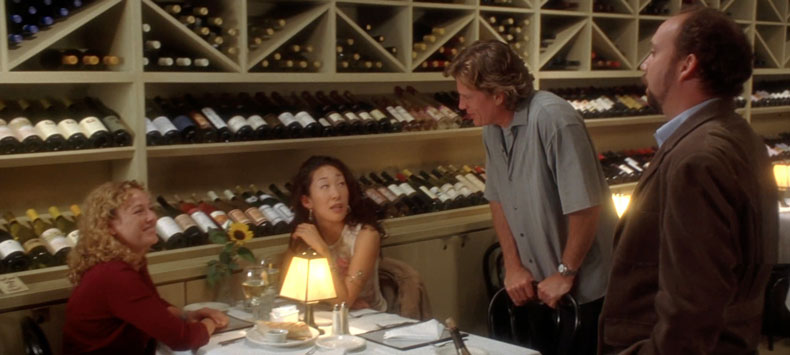
We changed very little in the restaurant but put up the wall of wines behind them—the movie’s about wine, after all. As we shot the intimacy of the double-date in one direction, we could spice up the frame a little with all those bottles and later reveal the cafe in the other direction. We located the table such that, when Miles later rises to make a drunken phone call to his ex-wife, we can still feel the table in the background down the long chute of the room. Miles is conflicted in that he has harbored a suppressed interest in Maya. She is farther along in repairing herself after a difficult divorce and is more open. She doesn’t necessarily have a romantic idea about Miles, but she wouldn’t dismiss it either. Meanwhile, the other two across the table are hot to trot. It was pretty improv-y. The dialogue between Maya and Miles about their shared interest in wine was loosely scripted, while the banalities between Jack and Stephanie were largely improvised.
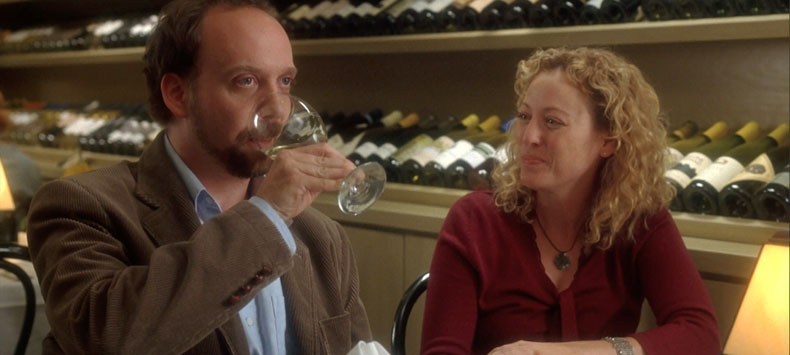
There are ‘let’s-make-life-easy-on-ourselves’ lighting tricks which I often buck against—like always wanting to stick little lamps on restaurant tables—but here it kind of works. How the light blossoms on their faces is nice. There were movie lights behind us, of course, and—lighting 101—the white tablecloth also bounces light on the faces. The task of the scene was, how do you efficiently and effectively depict a long date with two couples who don’t know one another very well? We shot single-camera, covering both sides over two days. In general, I dislike the contemporary shaky handheld-thing, so when DP/Operator Phedon Papamichael was fishing around with increasingly longer lenses, we had the camera on a dolly with the head loose so he could move or slide with ease. We start the scene on wide lenses, simply establishing the two sides of the table. As the night progresses and the sloppy-drunk inside Miles emerges in full glory, the lenses grow longer and the frames get sloppier as we drill deeper, more subjectively, into Miles’s head.
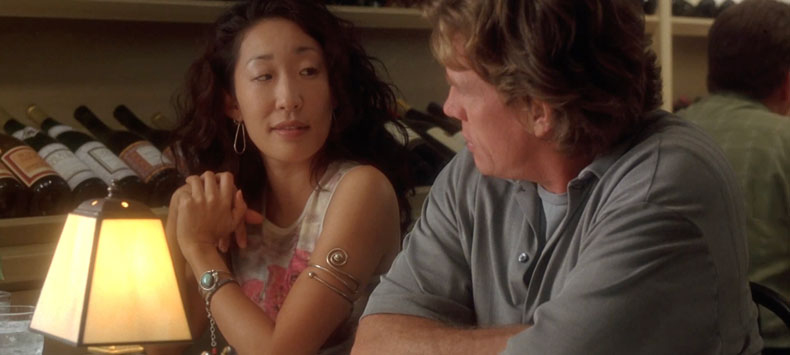
The sequence goes back and forth between Miles’s and Maya’s more substantial conversation and the superficialities Jack and Stephanie are saying, because all they’re thinking about is hooking up at the end of the night. Neither of them has read a book in years. We probably shot both sides of what the first fifteen minutes of the date would be, then paused. Then said, it’s thirty minutes later, you’re tipsy but not drunk yet. We’d shoot that, change up the lens and the camera placement. Take a pause. Okay, now it’s an hour later and you’re on your third course, etc. That simple approach made sense. Costume Designer Wendy Chuck understands the banal reality with which I often like to costume characters, but which still of course very much reveals character. Miles wears, for example, a corduroy jacket, emblematic of the writer he is. Stephanie is clad a bit provocatively, while Maya is no-nonsense, earthy. She’s sexy in her honesty and would never force or flaunt anything.
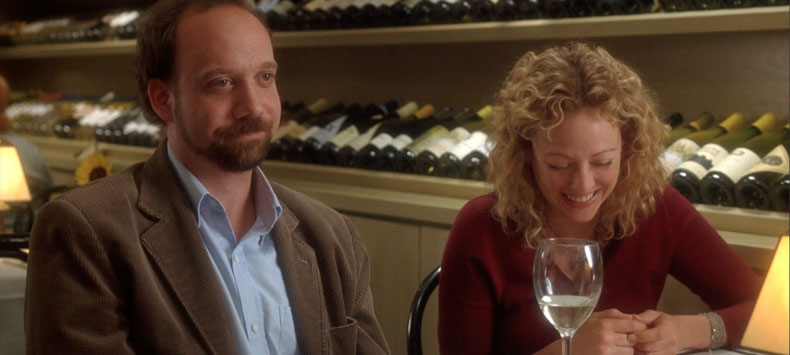
I rely a lot on auditions and audition a ton of Actors. When nobody reads a scene right for a long time, you start to think there must be something wrong with the script. Then somebody walks in who totally nails it—and that was Paul Giamatti. He can make even bad dialogue work. One day, Casting Director John Jackson showed me a picture of Virginia Madsen and said, “Look at her eyes. Don’t her eyes say she’s really been through it?” We brought her in, and she read beautifully. Virginia’s a person of substance who impressed me with the depth in her face and eyes, and with her approach to acting—which is my favorite: hit your marks and say your dialogue simply and truthfully. The best film Actors simply surrender themselves to the camera and know they don’t have to do very much else. Just be that person, say those lines and you’ll be fine. If you just hire the right Actors, they get it. They are it. When an Actor is cast, he or she is already 90 percent the part, and we need to tinker with only 10 percent.
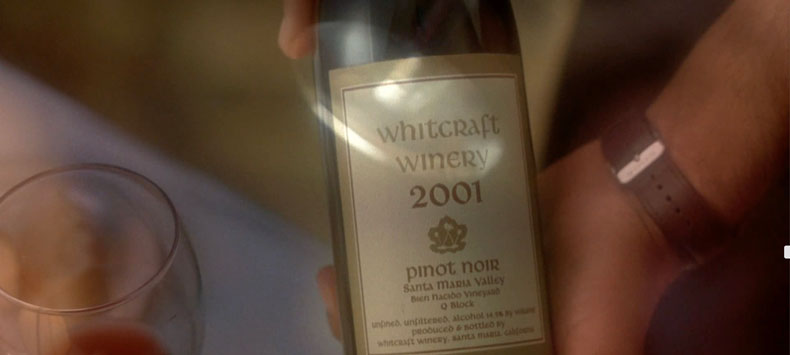
On the Miles/Maya side of the table, you have the characters with a bit more heft and in whom the audience is more invested. The two share an overwhelming interest in wine, but we also have the awful knowledge that Miles is somehow going to blow it. The scene starts by covering a four-person date, from beginning to end, but it funnels increasingly into Miles’s subjectivity—Miles is getting drunk and morose and will recklessly telephone his ex-wife. So, the camera, editing, score, and sound design all have one purpose: start broad then keep funneling us into a complete cinema of subjectivity. Sure, it goes in and out of that subjectivity a bit, but it’s very, very much about Miles’s experience. We were also shooting an ongoing succession of beautiful bottles of pinot noir, to show off to the wine buffs in the audience that we knew what the hell we were doing.
The conversation bounces back and forth, but as the sequence progresses, you hear less of what they’re saying—maybe just snippets—and the score and sound design take over. They’re the same musical motifs introduced earlier in the picture in a bouncy, upbeat way, but now rendered more hauntingly, increasingly in a minor key. Composer Rolfe Kent and I spent a very long time getting this cue just right, especially since Editor Kevin Tent and I kept monkeying with the timing. It could have been cut a million different ways, and we spent weeks on this sequence to really nail what we thought was a good progression for the date: Miles’s drunkenness, Jack’s concern for him while also trying to get laid, and then really burrowing into Miles’s brain to get him out of his chair to call his ex-wife.
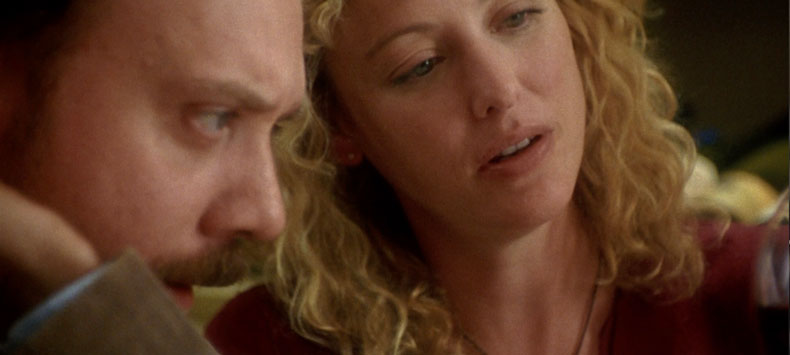
Miles is the reluctant participant in this evening’s proceedings, but he musters a bit of enthusiasm to converse with a woman who is interesting and whom we know he likes. That Paul Giamatti is able to sell both that interest as well as the character’s inevitable self-sabotage is a testament to his talent. His technical ability while being fully in the emotion of a scene is astounding. There was a moment when he was about to cry and I said, “Keep the emotion going, now please rotate your head seven degrees to the left,” so he could pick up the light. No sweat. Even in a scene like this, there are still focus marks and lights to hit. That’s what film acting requires—emotion and technical awareness. Giamatti is a remarkable Actor in both respects, and his performance makes this scene. Acting is primus inter pares—first among equals—of all cinematic components.
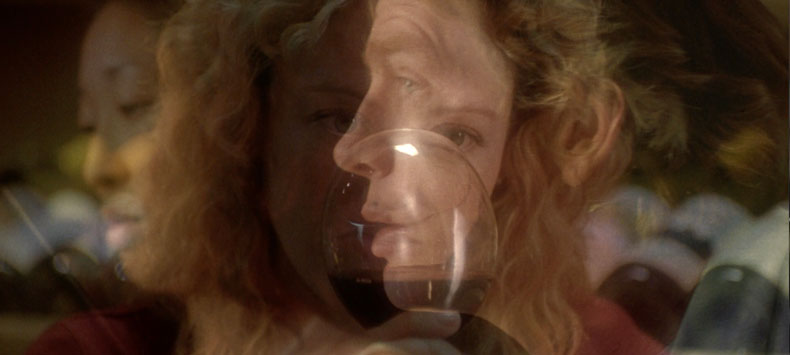
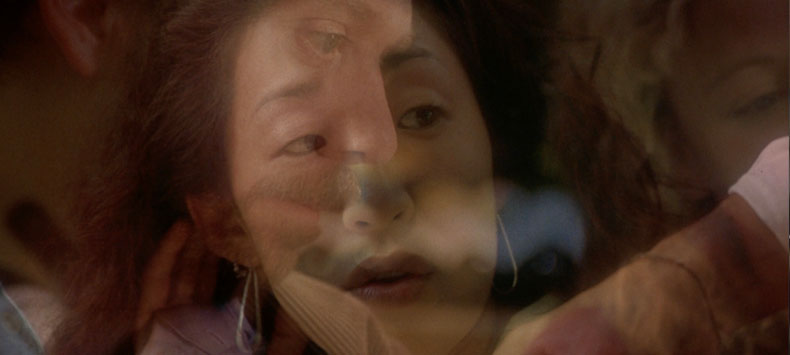
Editor Kevin Tent and I are big fans of dissolves—here, very long ones. We’ve used them in all our pictures. They allow you to blend images together just as images in real life kind of blend into one another. There’s beauty as one image evanesces and the other one achieves full potency, like life and death. As a child of the ‘70s and someone who has spent his career trying to make ‘70s movies, I adore dissolves and scratch my head at their absence in most contemporary movies. It’s a technique that precedes the cinema itself—it existed with magic lanterns. Here, they function to suggest both the passage of time and Miles’s descent into a drunken stupor. I had figured a priori that we would be using them in cutting since we always do. Here we needed them to help suggest a four-hour evening in only twelve minutes. Kevin and I spent a very long time calibrating these dissolves.
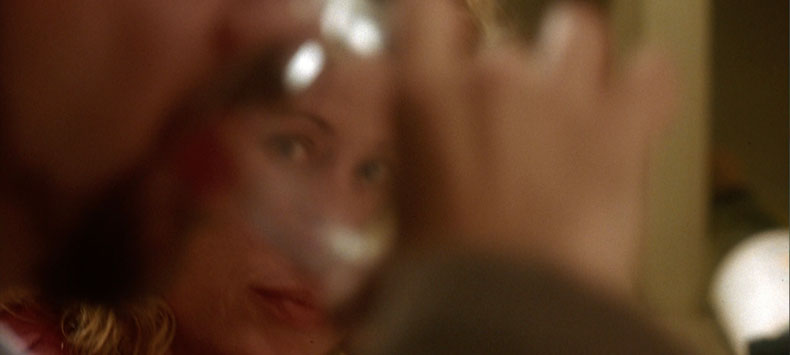
As you shoot a scene with the camera able to float around and snatch bits of performance out of the air, the Actors do wonderful things, and you hope the camera will be at the right place at the right time. Here, Miles lifts his glass to drink, and you can see Maya looking at him through it, her concern growing. You can’t design that. It just happened. This was still in the era when we would shoot on film, edit digitally, then cut negative. This scene was so intricate in its editing and use of dissolves that we had, of course, to print it as a separate piece of film and stick that into the negative, picking up a little bit of grain in the process, but who cares? Kevin and I like cinematic elegance. We never want technique to call attention to itself, or to us. You simply want to tell the story as effectively as possible. So, using techniques like dissolves—which are nothing new—was appropriate. But this sequence is probably the most abstract, experiential and subjective in any film I’ve made so far.
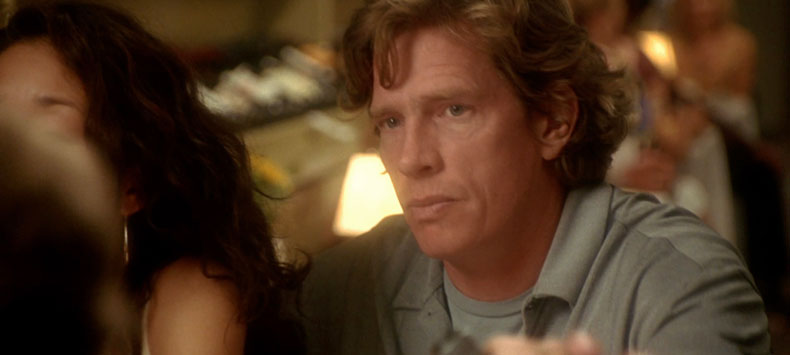
The sequence is a four-hander but the primary relationship is between Jack and Miles. Jack’s goal is to allow the evening to go so well so that he and Stephanie can wind up in bed. He even warns Miles outside—don’t sabotage me and don’t go to the dark side. But Miles gets drunk and sprints to the dark side, which is when Jack reaches out his hand to prevent Miles from pouring himself another glass of wine, and shoots him a withering, scolding look. Thomas Haden Church was extremely good in this scene, I feel. He was really on those two days. This may be my favorite shot in the whole sequence. As he reproaches Miles later, we learn that it was Miles himself who sabotaged his own marriage with an affair, and that fact is the source of much of Miles’s self-hatred.
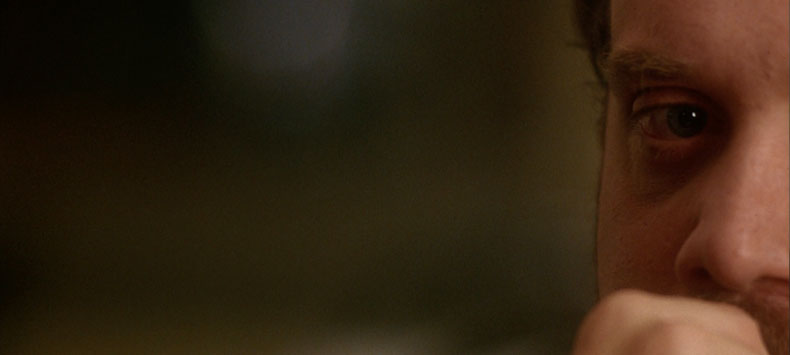
Before the audience knows Miles will get up to drunk-dial his ex-wife, Kevin and I thought we’d seed into his brain an interior phone ring that grows and grows until it becomes unbearable. It’s a long pre-lap that suggests the temptation that Miles tries unsuccessfully to combat. We kept saying, what if we started even earlier? At first you think it’s almost part of the music, and then little by little it emerges as a sound on its own. We spent quite a long time on the entire sound design—deceptively complex—getting those techniques of sonic subjectivity just right. How long do you keep the real dialogue live, and how do you imperceptibly make it disappear to venture exclusively into where that internal ringing sound is drilling a hole in Miles’s brain? These techniques are not new, of course, but they are fun and effective to deploy.
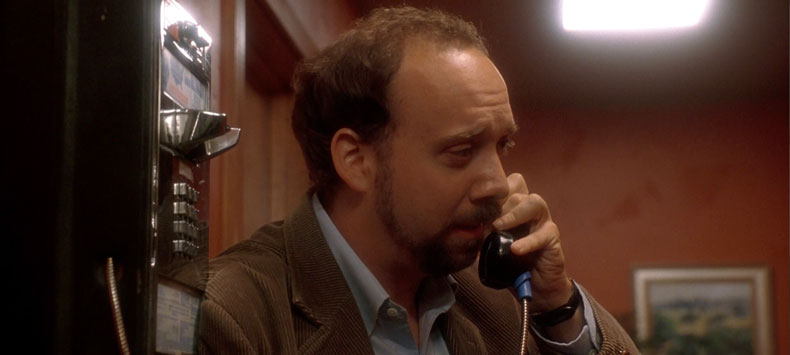
The moment Miles’s ex-wife says hello, we snap out of his subjectivity. The score stops, and we’re teleported back inside the cafe, where we hear the background music and restaurant walla and all that. Yet the fact that we’ve been increasingly lengthening the lenses hits its apex during this phone conversation—most of it shot in closeup with a 150 mm lens. We wanted Paul to have complete freedom, but in this sequence, if the First AC couldn’t keep up with him and we went out of focus, it was fine. That’s the forgiving part of shooting a drunk guy with a long lens. That pay phone didn’t exist there. We put it there so that we could get a shot over him and be able to see the length of the restaurant.
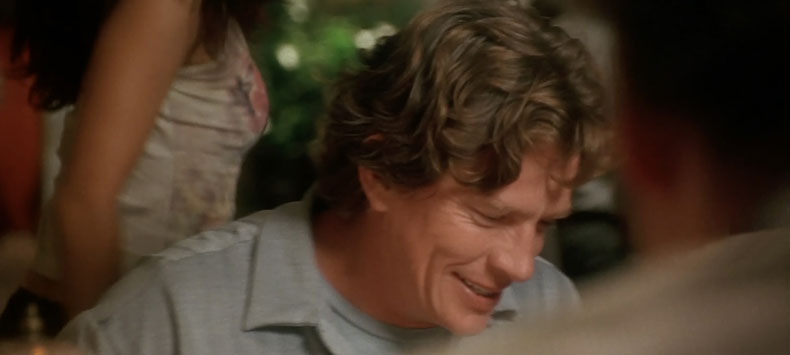
After the ill-advised phone conversation, Miles staggers back to the table and plops into the chair. The girls get the cue that something fishy is going on and politely excuse themselves to go to the powder room. The camera slides over to change the axis, both to show the restaurant and more importantly to imply the complicity between Miles and Jack—this is a different, separate section of the evening. Whenever you shoot a long sequence, particularly locked in one fixed location, you obviously want to think about it in zones and how to break it up visually, psychologically, so it’s not just the same damn shots over and over. It worked out nicely that when Jack and Miles are alone, we could change the axis into a section of the sequence belonging just to them. When the girls return, the camera slides back over to the initial, “we’re-on-a-date” axis. In the entire movie, I think I’m proudest of this sequence. All the departments put a lot of time into making sure it went just right. In a way, it’s the centerpiece of this modest little picture.
SCREENPULLS: Twentieth Century Fox Home Entertainment