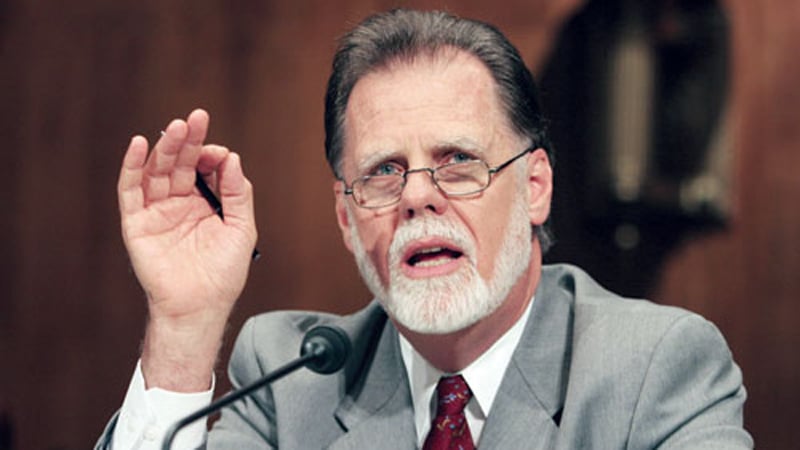
DGA Third Vice President Taylor Hackford testified at a hearing held by the full Federal Communications Commission in Los Angeles on October 3, 2006. The first half of hearing was dedicated to impact of media consolidation on independent programming for television.
The event, held at USC, is the first of six public hearings that FCC Chairman Kevin Martin, along with Commissioners Michael J. Copps, Jonathan Adelstein, Deborah Taylor Tate and Robert McDowell are holding around the country as part of the Commission’s 2006 Quadrennial Broadcast Media Ownership Review. The hearing drew more than 500 people, most of whom voiced serious concern about further consolidation.
Hackford joined a panel of other entertainment industry leaders and representatives who brought various perspectives on the impact of media consolidation on television programming and the creative community as a whole. He cited the FCC’s elimination of the Financial Interest and Syndication Rules (FinSyn) in the mid ‘90s as the source of the situation we face today. “We predicted back in the early 1990s that the elimination of FinSyn would enable the networks once they were free to produce and own programming to swallow up or drive out of business smaller or independent producers,” Hackford said. “We wish we were wrong, but unfortunately we were right.”
Hackford noted that today each of the major networks is a sister company to a producer or studio that was formerly an independent supplier of programming. He shared with the Commissioners some of DGA’s extensive research on this issue for the televisions seasons beginning in 1992 to the present. That study found that 66% of network primetime television was created by independent producers during the 1992/93 season, with the networks accounting for the remaining 34%. Once FinSyn was eliminated, those numbers quickly reversed and went into a downward trend as seen in the 2006/07 season, where the independents’ share has fallen to 24% while the networks and their affiliates own and control 76% of the primetime television aired on the four major networks. The current reality is that the 23 independent production companies producing for television that existed in the early 1990s are now down to just two – Warner Bros. and Sony – and they are part of media conglomerates, rather different from what has historically been defined as an independent producer.
As a result, Hackford said, directors no longer have the independent producers to join with in fighting to sell a series to a network, or to protect the integrity of the material over network objection, or to fight for its success. Hackford noted that DGA was not there simply to decry the situation and we had a proposal we would be making in our October FCC filing. That proposal (first presented to the FCC by DGA and others in 2003) would require each of the 4 major networks to use programming from fully independent sources on 25% of their primetime schedule. “We believe this is enough incentive to encourage those who want to invest independent capital in television programming to get back into the game.”
Others testifying on the needs to address the impact of media consolidation on the entertainment industry included Stephen J. Cannell, a member of the Caucus of Television Producers, Writers & Directors, SAG First Vice President Anne-Marie Johnson, WGA West President Patric Verrone, Producers Guild of America President Marshall Herskovitz and AFTRA President John Connolly.