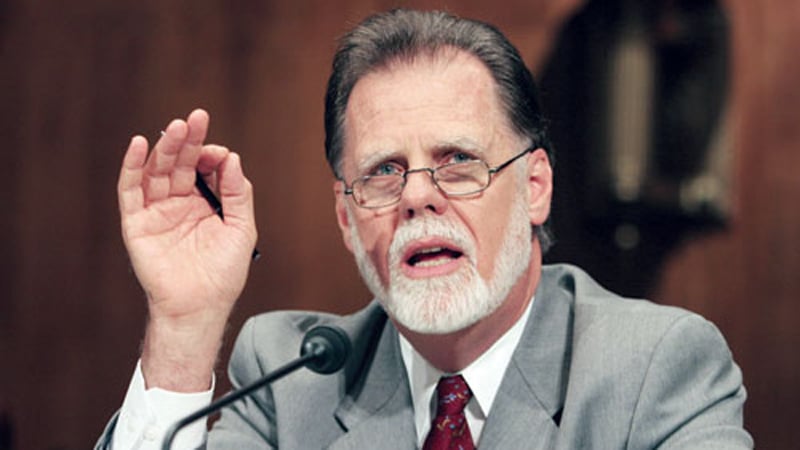
DGA Board Member Taylor Hackford visited Capitol Hill last month to express the Guild’s deep and growing concern about the proliferation of film and television piracy at a hearing before the Judiciary Committee’s Subcommittee on Intellectual Property. Senator Orrin Hatch (R-UT), Chairman of the Subcommittee and ranking Republican on the Finance Committee, presided and was joined by Subcommittee ranking minority member Sen. Patrick Leahy (D-VT). The purpose of the hearing was to discuss the impact of international piracy, with a close look at areas such as Russia and China. Representing the DGA, Hackford gave voice to a critical and often overlooked perspective on this issue – that of the filmmaker.
Below are excerpts from the May 25 hearing:
TAYLOR HACKFORD: … I want to try to put a personal face on the piracy issue and talk about a project like Ray, which I was personally involved in. It took 15 years to make the film and it was not easy. You’ve seen the film, you liked the film, but it was very hard in Hollywood to find anybody who would finance it. I had a passion for this film; I believed in it. I’d made the commitment to Ray Charles himself, worked with him for 13 years, and in the process I finally came to the point where I did find somebody to make the film …
Luckily for me I convinced an individual to actually finance the movie. He was advised by everyone not to do it. Luckily for him the film has done very well. Luckily we had a distributor, Universal, that picked the film up and did a very good job. So, in reality everybody made out. But we had no way of knowing this ahead of time. You should realize that only four out of every ten films ever makes its money back. And I think it’s something like only one in ten films ever makes its money back just from theatrical receipts. So, it’s a hugely risky thing.
When Universal released the film, it was the end of October. The same week it opened, I walked down Canal Street in New York City and pirated DVDs of Ray were on sale. Complete with the artwork and everything — these people had done all the work ahead of time, so when they got the disk all they did was put it out.
Now, we happen to know from research that Universal has done that it was camcorded at the Raceway 10 Westbury Theater, the Lowes Raceway 10 in New York, and the Lowes Jersey Garden Theater in Elizabeth, New Jersey. Immediately, [pirates] took that copy and put it on the web. They sent it to Russia, China and elsewhere, and immediately started the process of duplicating it …
SENATOR HATCH: Because the real DVD came out three months later.
HACKFORD: Three months later. And here’s the important thing: the DVD was on sale in Europe, but we didn’t release the film theatrically in Europe for another two months.
HATCH: What you’re saying is you had the film in the U.S. theaters, but you hadn’t yet hit theaters in Europe, and you hadn’t done your own DVD of it … and a day or two after the film was released, you had DVDs on the street at a very discounted price.
HACKFORD: Absolutely … Then, three months later, in the beginning of February, we released the DVD. When this high quality DVD came out, it immediately went on the web for downloads. And just to give you an idea, last week, on one day, May 19th, on the peer-to-peer networks there were more than 476,000 requests for Ray. Since the film was released and first pirated in October there have been 42 million requests to download Ray —
HATCH: That’s without any payment of royalties or any —
HACKFORD: None, nothing.
HATCH: — copyright?
HACKFORD: Nothing. I think that kind of tells you what we’re facing … The future is clear. The DVD is going to be the profit leader in this industry. So, when I go to an investor and try to raise money for a film, and that person who already knows it’s a big risk, now knows that before the film even plays in the theater it could be on the street — it’s going to be devastating to our business, devastating. And that means a devastating loss of jobs, and a devastating impact on our economy. Obviously something needs to be done …
SENATOR LEAHY: Mr. Hackford, I think I can probably speak for both us in saying that if you work hard to create something, you ought to have the satisfaction knowing it’s your creation. Now, if you do a bad job and it doesn’t sell, fine, that’s a risk you take, as well as somebody who paints a picture, photographs, writes a song, writes a book, sells computer software or anything else. But if you’ve done something good, you ought to get rewarded for it, I mean it ought to be yours. …
HATCH: … You’re raising issues that should affect everybody in America. This committee is going to do everything it can, but we need more help from the intellectual property community as to how we might domestically pass some laws that might be of aid to you. And we’ve been trying to do that but they haven’t exactly worked as well as we would like them to work … So we need your help. We need the best thinkers in all the aspects of the intellectual property community and high tech community to assist us, and as you know, there’s a real divide between someone in the high tech world and someone in the intellectual property world, or should I say the copyright world. We’ve got to bridge those gaps and try to be fair to everybody.
Let me just also that I’m also first ranking on the Senate Finance Committee, and will takeover as Chairman sometime, if I’m fortunate enough to be re-elected, and I guarantee you that we handle the trade issues. And I can guarantee you, I’m not going to be very open to China and Russia if they’re not going to clamp down and do something about it. And I might as well warn the administration right now, that unless they’re willing to start demanding that they abide by international norms, they’re going to lose a very good advocate for free trade in me. I don’t think it’s a question of free trade as much as it is a question of thievery.
HACKFORD: … We appreciate that and the Directors Guild is here to help you in any way we possibly can in the future, because we share your concern and understand the vital nature of this epidemic problem.