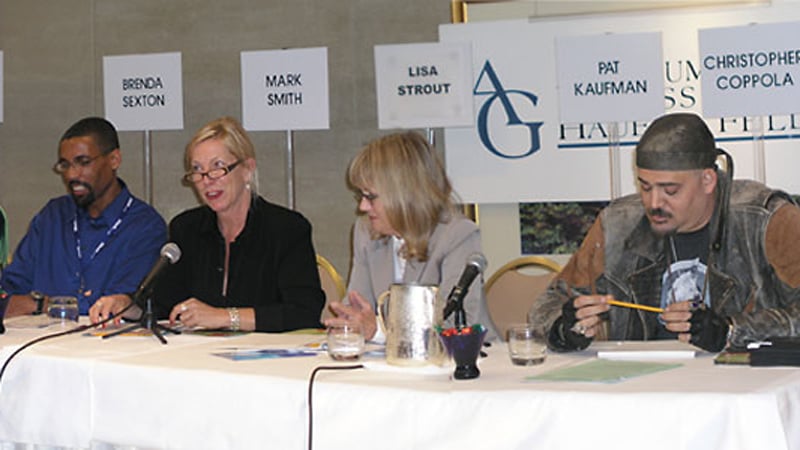
"For the last five years, the DGA has been leading the fight against the spectre of runaway production, on behalf of not only our members, but the entire industry," said Kathy Garmezy, DGA Assistant Executive Director/Government and International Affairs in introducing the panel. "We've worked on this with a broad alliance that includes most of the major players in the industry and you'll see from this panel that we've accomplished a good bit of what we set out to do. That's why we thought this panel was so important today."
"It's no secret that US Film production in the last few years has done a really lousy job of competing in the global economy," said DGA director-member Dennis Bishop, the moderator of the panel. "Today the landscape is changing yet again. We have federal legislation that just passed which will greatly effect runaway production, keeping productions here. Innovative programs such as the incentive packages of Louisiana and New Mexico have turned things on their ear. You can now make films in Louisiana for less money than in Canada. We are determined to be more competitive in the global market. The DGA has led the charge in getting Federal legislation passed. Directors for the most part, can follow any production around the world, but the DGA has chosen to fight to keep productions here that effects below-the-line personnel such as assistant directors and UPMs. "
"I was extremely angry wondering 'Why aren't we helping American films in this way?'" said DGA director-member Christopher Coppola, speaking as a member of the Independent Directors Committee West. "What I learned was that there are more possibilities here than just these incentives. I see this as a chance to work with all these states to try to do something to keep film here."
State Examples:
"We have legislation that took effect January 1st of this year. It's essentially a 25% tax credit on Illinois wages," said Brenda Sexton, managing director of the Illinois Film Office. "The net effect is about a 10% savings below the line. If you spend $4 million dollars on wages in Illinois on your production, the film office will issue you a $1 million dollar tax credit. There is no auditing beyond the film office auditing so it's very secure. The film office is very personally involved in making this tax credit work for you. And the governor is absolutely passionate about supporting this business. We've created 12,000 jobs so far this year so it's been a wonderful success story."
"Our program has been in effect since July of 2002," said Mark Smith, director of the Louisiana Governor's Office of Film and Television. "In Louisiana we have a history of using tax credits as a way of reducing tax liability. If your production is over $8 million dollars, you're going to receive a 15% tax credit on your budget and a 20% tax credit on the total aggregate payroll of Louisiana hires. One production we're very proud of is Taylor Hackford's Ray, which was the first production with a $40 million dollar budget that came to Louisiana. Taylor Hackford had a love for Louisiana and New Orleans, so his line producer, Stuart Benjamin, came in and we sat down to determine how we could make the program work for them."
"In New Mexico we have three major incentives," said Lisa Strout, director of the New Mexico Film Office. "One is a 15% tax rebate. It is not a credit, but a check that the state writes to you. It's based upon all the expenditures your production has within New Mexico that have a state tax attached. For the rebate you just register with the state through my office, then start collecting your receipts. After you hand in your general ledger, it takes about a month to get your money back. The more you spend, the more you get back, there's no cap on it. The second program we have is called the Film Investment Program. It's an interest free loan up to $7.5 million dollars per project. This is for features and for television. To qualify, at least 60% of your below-the-line payroll has to be going to New Mexicans and the movie has to be wholly or substantially (about 85%) shot in New Mexico. The third program we have is our Workforce Training Program. It tantalizes the producer to give our folks a leg up. If you move a New Mexican crewmember up in category, you get 50% of their salary back. On top of that you're still getting the 15%, so that person is 65% less than they would be. That's been working very, very well. Because of these incentives we went through a 1,000% increase in one year."
"It's about jobs, jobs, jobs and more jobs," said Pat Swinney Kaufman, Executive Director of the New York State Governor's office for Motion Picture and Television Development, and Deputy Commissioner of Empire State Development; and President of the Association of Film Commissioners International. "New York's situation was somewhat different from my colleagues. Our question was how could we create an incentive program and not sink the ship? The part of the industry we could prove that we were losing was [sound] stage work, so the bill that got passed in New York targeted stage work. If you do 75% of your stage work at a qualified facility, you'll get back 10% of all the below-the-line costs that are associated with that stage work. That's the partial benefit. To get the full benefit, which is 10% of all of your below-the-line costs on everything you do in New York, you have to either spend $3 million at the stage, or do 75% of your location work in New York. This includes pre-production, production and post-production. You can bring crew in from anywhere — as long as they're working in New York you still get the credit. Our motto is 'You know you want to be here ... And now you can be.'"
Other States:
"It's not only the people up here, but other states have recently passed legislation, including Hawaii, Utah, Mississippi, and South Carolina," said Bishop. "Plus there are states that are working on legislation, such as Texas, and Vermont. We're researching every possible program and incentive to see how we can adjust them to work in California. Obviously we have a governor who is very supportive, but in states like California and New York, it's hard to prove to non-film industry industries that this is needed. But we're working very hard to make this happen."