

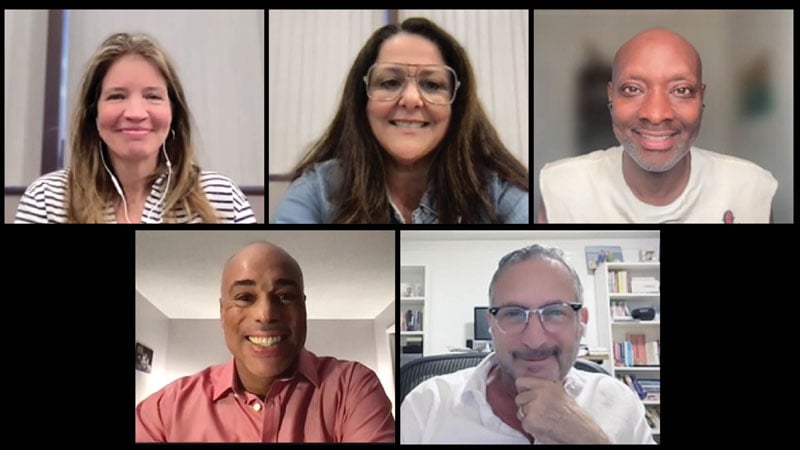
From cast and crew relations, to budgeting and scheduling, there are so many things that can go wrong. On September 15, DGA members seeking ideas on how to get it all right received information during the LGBTQ+ Committee meeting discussion, How to Make Your Day and Get Hired Back, co-presented by the Proposals Subcommittee and Career Advancement Subcommittee.
In a conversation moderated by Proposals Subcommittee Co-Chair Jamie Babbit, newly elected LGBTQ+ Committee Co-Chair Jennifer Arnold, Producing Director Patrik-Ian Polk, Proposals Subcommittee Co-Chair Alan Poul and 1st AD Paul Lindsay shared tips and divulged the inside story on how to execute your episode while staying on schedule and on budget so that you can get hired back next season. In addition to these pointers, the panelists also revealed what they’re looking for when it comes to making the hard decisions on who is hired back.
“I think in terms of the main objectives you want to achieve as a new episodic Director, is make your days, said Poul. “It’s the biggest single factor in whether you’ll get asked back or not. And in fact, I think in some ways the hardest job to get in episodic is your second episode. When you do your first one there’s so much scrutiny on you and so it’s very understandable that you want to do the best job possible. But it’s more important that you make your days. There’s kind of a sliding scale in terms of values as you move forward as an episodic Director. On the one hand, getting creative satisfaction and being proud of your name being on the show, and on the other hand being asked back, being liked, and having people want to work for you again. Early in your career it’s much more focused on the latter, and then the more episodes you get under your belt, you can begin to focus more on creative satisfaction and finding your way to excellence within the parameters.”
“A big one for me is there’s this weird thing when you come onto a show that’s not a new show, and you’re not in from the ground building it up, then it’s an engine that’s already been built, it’s a car that’s already running and you’re going to come in and get a chance to drive it, said Polk. “Don’t come in and try to be Evil Knievel doing a bunch of tricks. You’ve got to figure out the flow of the river and move with it. And that doesn’t mean there’s no room for creativity or for you to bring your style, but the time to do that is in the planning, in the tone meetings, and when you’re figuring it out, and then you can get permission for those special little out-of-the-box things you want to do. Don’t wait until you’re shooting and spring it on people.”
“I think for newer Directors coming in for television, being able to read the room is just as important of a skill as being a good Director,” said Arnold. “A lot of times whether you’re in a tough situation where you’ve got more pages then are actually accomplishable on your day, and the showrunner does not want to cut something, if you have the skillset to read the room early and understand, ‘No one is coming to my rescue. My budget is not increased, my hours are not increased, and my pages are not going to get cut.’ Then you’re reading the room one way to figure out how you’re going to block this scene with either reusing marks, or going handheld, or whatever the show is going to call for. And on the flip side, reading the room to understand the times that no one wants you to solve the problem. You’re just there to make sure it runs as smoothly as it’s always run. To me being able to understand what the job is, is one of those key skills that you don’t know until you screw it up.”
Coming at the subject from an AD’s perspective, Lindsay declared, “The day is made not on the day, but in prep. When the Director comes in — maybe coming in hot off another show — you want to lay the ground as straight for them as you possibly can, saying, ‘This is what the show is. These are the hiccups,’ and just be that awesome sounding board and advice column for them. You form that symbiotic relationship so when you’re on set everyone is following the plan. And even if hiccups happen, no one is panicking because it’s already been thought of in prep.”
See video from this event in the gallery below.
ABOUT THE PANELISTS:
|
|
|
|
|
|
|
|
|
|
 Director Jennifer Arnold
 Director Patrik-Ian Polk
 Director Alan Poul
 1st AD Paul Lindsay
 Director Jamie Babbit (moderator)
About the Committee:
The LGBTQ+ Committee was founded in 2021 as a provisional committee to explore ways to educate, inform, address the concerns of and create opportunities for members who identify in these categories. At the DGA National Board meeting on January 8, 2022, the Board voted make the LGBTQ+ Committee an official standing committee.The Committee is dedicated to empowering and advancing the professional interests of LGBTQ+ and to promoting and working for employment equity throughout the entertainment industry. The recently elected Committee Co-Chairs are Directors Jennifer Arnold and Jessica Lowrey and UPM Mark Hansson The Co-Chairs of the Proposals Subcommittee are Directors Jamie Babbit and Alan Poul. The Co-Chairs of the Career Advancement Subcommittee are Director Jennifer Arnold and 2nd AD TJ Hallett.