 Director Monica Raymund (moderator)
 Actor Belissa Escobedo
 Actor Jesse Garcia
 Actor Justina Machado
 Director Eli Gonda (moderator)
 Production Designer Franco-Giacomo Carbone
 Editor Jessica Hernández
 Cinematographer Hilda Mercado
 Casting Director Tricia Wood
 Director Kyle Patrick Alvarez
 Director Linda Mendoza
photos by Quintin Lundy
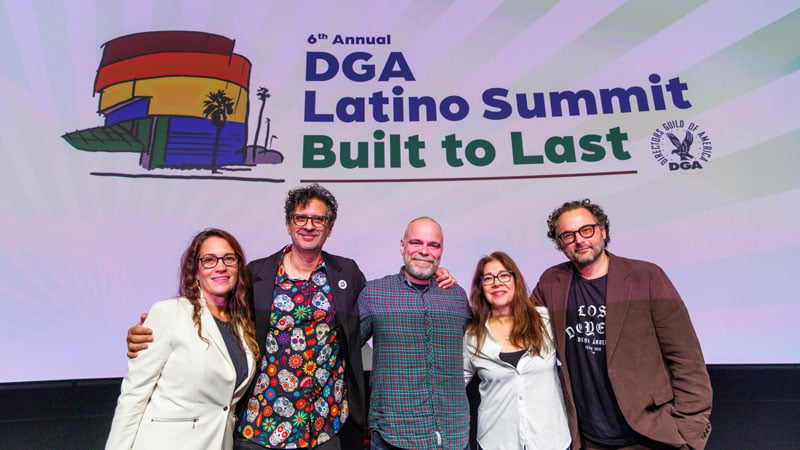
In celebration of Latin Heritage Month, on October 3, attendees gathered in the Guild’s Los Angeles Theater for Built to Last, the sixth annual DGA Latino Summit. Hosted by the Latino Committee’s (LC) Latino Summit Subcommittee and the Latino Summit Direct Connects Subcommittee — both dedicated to empowering Latinos in all Guild categories — the event provided attendees with an opportunity to connect and learn from their successful peers during an inspiring day of community, career development, and celebrating Latino excellence in the arts. The Summit also sought to reaffirm the Guild’s commitment to inclusion, representation and amplifying diverse voices across the entertainment industry.
Following a welcome from DGA National Board Member Kabir Akhtar, Latino Summit Subcommittee Co-Chairs Alejandro Brugués, Eli Gonda and SJ Main Muñoz — all of whom have served as current or former LC Co-Chairs — spoke about the work of the Committee and the importance of events such as this before introducing the first panel of the day that dealt with working with Actors.
 Built on Trust: Actors on What Makes a Director Worth Following
In a candid conversation moderated by Director Monica Raymund, Actors Belissa Escobedo, Jesse Garcia and Justina Machado shared what actually earns an Actor’s trust and loyalty.
During this unfiltered playbook for building collaborations that liberate great performances Escobedo recalled Director Ángel Manuel Soto’s approach to working with Actors on his feature Blue Beetle was all about sharing the full story with the cast before filming began and guiding them through the process.
“Doing a superhero movie is scary,” said Escobedo. “But doing the first Latino superhero movie is even scarier. So, to know he had this whole world built already was a relief. To have someone at the helm of the ship saying, ‘I got this, this is what we’re going to do, just stick behind me.’” She also noted that the Directors she wants to follow are always the ones who treat Actors like peers collaborating on a shared project, where there is no display of hierarchy in their approach to the work.
Machado confessed that what makes her follow great Directors is trust. “You ask us to trust you, and we ask you to trust us,” said Machado. “I love it when a Director is immediately trusting every Actor. Directors that don’t play the hierarchy game; no one on set is more important than another person.” Machado also noted that the Directors she loves have a clear vision, know what’s going on, and know how to handle different personalities on set. “A great Director is almost like a great psychologist,” she said. “You can’t act one way with all Actors. You have to see what they’re like, what their personality is, what gets to them, and what helps them understand you. It’s so helpful when a Director knows how to read a room of different personalities and can handle it accordingly. “
Asked for one piece of advice for Directors, Garcia stated, “Take an acting class. If you know how to talk to us, it’s so much easier for everyone. I think most department heads, including the writers, should take an acting class. It gives everyone on the crew a level of understanding that you wouldn’t have otherwise. Like for example, when an Actor needs a brief moment, they aren’t trying to waste time or control a set, it’s because it’s necessary, and understanding that process helps us all do our best work.”
Having approached the process from both sides, Raymund noted how important it is for Directors to hear feedback from Actors and learn to improve their communication methods, and that Actors and Directors use very different parts of the brain and how having the experience as a Director has changed her experience as an Actor on the stage.
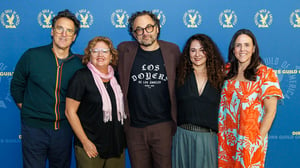 Built on Craft: Turning Vision Into the Work
Noting that your vision is only as strong as the team executing it, the Summit’s second panel featured Production Designer Franco-Giacomo Carbone, Editor Jessica Hernández, Cinematographer Hilda Mercado and Casting Director/Disney’s EVP & Head of Casting Tricia Wood in a conversation moderated by LC Co-Chair Eli Gonda about what makes for a fluid and inspiring process, and what turns a crew into your crew.
Asked what Directors often don’t use in the edit, versus what they forget to shoot, Hernández noted that, particularly in television, Directors will often place a camera setup so close to a previous one that the two can’t be edited together and the result can look like a mistake. She noted that some of this comes down to Producers who sometimes require both cameras to be used, even though the footage will never make the final cut. The shots Directors forget, by contrast, are often elements that are integral to the story. “If the story requires that we see that they have a gun, I’ll ask them in prep to please somehow capture the gun,” said Hernández. “It doesn’t have to be an insert, they can capture it however they’d like to, but please capture it. Often the forgotten shots are these important story elements that the audience just won’t catch in the master.”
Another common issue Hernández highlighted, is Directors will watch a scene and say “try something else” without any direction or point of view for the adjustment. When asking for clarity trying to understand what they’re looking for, they’ll continue with, “‘I don’t know, just show me something else.’ That’s a good indication that I have a Director who doesn’t really have a vision for what we are doing,” said Hernández. “The Director is the leader and should have an answer, even if it’s ‘I wish the scene was more like this, or I wish it looked like this.’ Then tell me that. Tell me your dream, and I’ll try to make it happen. Or if you really don’t know, say that and then be open to discussing it rather than just saying ‘just do something different.’ If the leader is lost in the desert, then the rest of us are too.”
Carbone spoke about the balance between openness and decisiveness. “There’s a time to be open and play in the early stages of prep and build that trust, and there are times where it’s vital to be decisive,” said Carbone. “When we get to principal photography and indecision begins to creep in, it’s maddening. It can be paralyzing to everyone.”
On a low-budget project especially, Carbone said, it’s essential that Directors know and communicate which elements to them are structurally most important to making the film work. He also stressed the importance of play and being imaginative and generative with ideas in early creative meetings. “It shouldn’t feel heavy or detached. It’s very liberating to work with a Director who is open in that way, and I wish that was the case with every Director I worked with,” said Carbone. “I expect some element of that because if there’s none, it feels very draining.”
Giving her opinion on what makes a good Director, Mercado said a good Director comes prepared with a clear intention, preps as much as possible, and communicates clearly with their team. “Fake your confidence until you make it, and own your mistakes,” Mercado advised. “What keeps the day moving is clarity, intention, and the fact that everyone on set wants to make a great project. In the end, we all have the same goal, to make it the best possible work.” Mercado also highlighted the importance of listening to your Script Supervisor, especially when they say you’re missing a shot. They are on it the entire day to make sure you got what you needed and it’s unwise for the edit to simply dismiss their concern.
Wood added to the conversation by noting how vitally important it is for Directors to have an open mind and open heart in the casting process. In her view, if a Director has too much rigidity in thinking everything has to be exactly how they imagined it, they can often miss the magic and creative ideas that Actors reveal when bringing the script to life. Asked about the difference between an indecisive Director and a collaborative one, Wood said it’s important that Directors speak the language of performance. “I can notice the notes they give and the adjustments they ask for, and I’ll know if we’re in trouble or not,” Wood said. “I’ll know if I have a very technical Director who won’t direct the Actors at all and in that case, I will need to cast Actors that can work without needing much direction.”
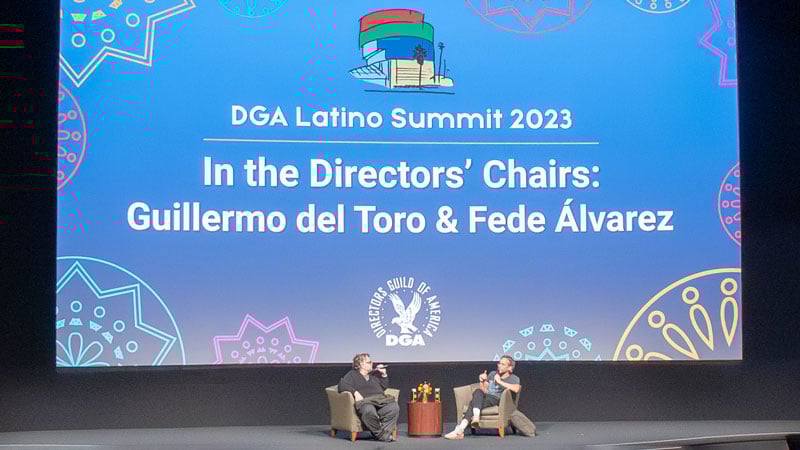
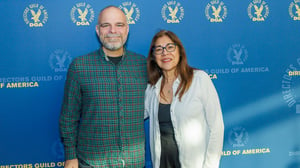 Built to Last: In the Directors’ Chairs
DGA Latino Summit 2026’s final panel featured a thought-provoking conversation between Directors Linda Mendoza and Kyle Patrick Alvarez where they dissected the technical rigor and singular vision required to build a career that remains vital at the highest level.
Sharing their blueprint for creative authority and longevity, forged through uncompromising excellence, Mendoza described her career as being built over many years and many baby steps. Starting in variety television as a PA, Mendoza worked her way up through many roles such as script coordinator, production supervisor, and AD, spending eight years working on the Video Music Awards and also working on the Billboard Music Awards. At one point Mendoza had to decide whether she was an AD or a Director. After committing to directing, she went five to six months without work until a friend gave her a variety show to direct.
“The move from variety to narrative was the hardest transition. They [Studios/Producers] worry ‘does she know how to work with Writers? Does she know how to work with Actors?’ When you’re shooting something like the VMAs, you’re worried about where your wide shot is and whether the next speaker is coming out stage left or stage right. It’s more technical as opposed to emotional. That’s a really honest problem for people coming from variety, so when I knew I was ready to go into narrative, I took acting classes and scene study classes to learn the language of Actors” which she noted served her tremendously having not gone to film school.
Alvarez recalled how he had always dreamed of being a feature film Director as a naïve kid who mostly grew up on movies but learned that building a career that lasts required him to expand that dream and grew to deeply respect and love the craft of television and commercial directing. “I really respect the different shapes directing can take. My transition from a 20-year-old film snob to a 40-year-old TV Director really comes down to that,” said Alvarez. “Expanding your dream and finding a love for the specific challenges that come with working in television and finding an appreciation for things like bringing your voice to an episode of a show that isn’t yours.
Alvarez also highlighted that his journey has taught him that the most valuable thing in this town is someone believing in you. He pointed to The Stanford Prison Experiment, where an Actor brought the project to him and took a chance on him to direct it. That project was low budget but still a tremendously more complicated job compared to the smaller films he had made previously. And that project, with its incredibly high page counts, later helped him book his first episode of television.
DGA Latino Summit 2026 ended with closing remarks from the Summit Subcommittee Co-Chairs Brugués, Gonda, and Muñoz who discussed the overall work of the Latino Committee and encouraged DGA members to get involved.
Latino Committee Direct Connects
DGA Latino Summit 2026 also featured Latino Committee Direct Connects (LC/DC), an in-person speed networking event themed on the process of pitching. Led by LC/DC Co-Chairs Regina Ainsworth and Antonio Negret, the session matched DGA members with well-developed projects that are packaged and needed further momentum with other members who could offer guidance or assistance.
Videos from this event coming soon to the gallery below.
ABOUT THE PANELISTS:
|
Built on Trust: Actors on What Makes a Director Worth Following |
|
|
|
|
|
|
|
|
| |
|
Built on Craft: Turning Vision Into the Work |
|
|
|
|
|
|
|
|
|
|
| |
|
Built to Last: In the Directors’ Chairs |
|
|
|
|
About the Committee:
The Latino Committee was created as a networking group to advance career and job opportunities for Latino DGA members by improving craft skills, networking, and making Latinos better known to the Hollywood creative community.
Click here to visit the Latino Committee webpage.