Q&A photos by Quintin Lundy – Print courtesy of ESPN Films
The story of women’s sports could not be told without legendary tennis icon Billie Jean King, who transformed both sports and society. She prioritized changing the world over self-preservation and in fighting for equity for herself and others, was uncompromising to the point of subordinating her personal well-being by hiding her sexual orientation and eating disorders.
Through rare archival material and candid interviews with King and her inner circle, Directors Liz Garbus and Elizabeth Wolff's new documentary, Give Me the Ball!, presents King in her own words and traces her groundbreaking impact on sports and culture with a particular focus on 1973 — a pivotal year when she was at the apex of both her tennis career and the women's movement. The film had its world premiere at the 2026 Sundance Film Festival.
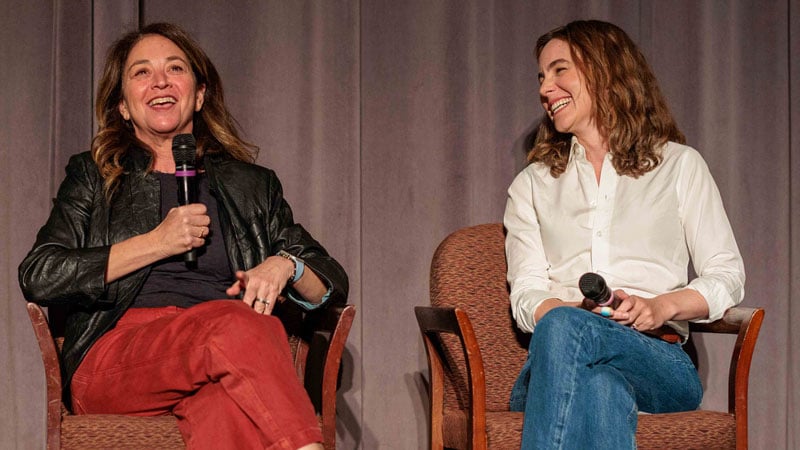
On May 11, during a Q&A moderated by Special Projects Documentary Series Subcommittee Chair Ondi Timoner, Garbus & Wolff explained their collaborative strategy of encouraging King to share the more intimate, uncomfortable moments of her life.
“It’s like good cop, bad cop,” said Wolff. “Billie is very compartmentalized. She’s very optimistic and positive, and she’s forgiven people, and worked through it. So, it’s a lot of teasing it and trying to go back and explain, 'We want to go back to the hard stuff.' That looks like one interview, but it was shot over many days. Every single time we interviewed her, we were trying to get at that a little bit more. There were a lot of hard questions and a lot of Liz pushing for many hours in the interview chair.”
“But, no, she doesn’t want to live in painful moments,” added Garbus. “She pushes through them. And that’s, I think, how she’s been so successful and such a champion because she’s relentlessly so. It’s also a film about liberation and to experience the joy of liberation, you have to experience the struggle. So, it was about sharing that perspective with her. Like we are asking you to relive your pain in some ways, but it’s for a reason. It’s not gratuitous. It was about trust at the end of the day.”
Garbus’ other directorial credits include the documentary features Becoming Cousteau, Bobby Fischer Against the World, Girlhood, The Nazi Officer’s Wife, Different Moms and The Execution of Wanda Jean; the scripted feature Lost Girls; the TV documentary mini-series The Fourth Estate; and episodes of The Handmaid’s Tale and I’ll Be Gone in the Dark. In 1999 she and Jonathan Stack earned an Academy Award nomination for “Best Documentary, Features” for their film The Farm: Angola, USA. In 2016, she received another Oscar nomination plus a DGA Award Nomination for Outstanding Directorial Achievement in Documentary for her film, What Happened, Miss Simone? Garbus has been a DGA member since 2013 and serves on the Eastern Directors Council.
Wolff's other directorial credits include the upcoming documentary feature The Feminist Tapes and episodes of I’ll Be Gone in the Dark. Wolff has been a DGA member since 2018.