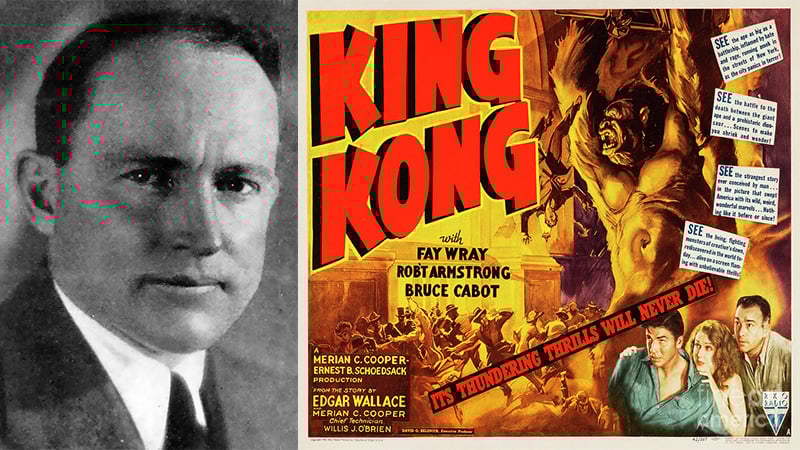
On December 3, the Special Projects Committee hosted the latest installment of their Classic Film Series with Merian C. Cooper’s 1933 classic, King Kong. The series screens iconic movies, often followed by a discussion about the Director’s contribution to the world of cinema.
The evening in the Guild’s Los Angeles Theater began with a welcome from Classic Film Series Subcommittee member Luc OuYang, followed by an introduction of the film by Subcommittee Chair Arthur Allan Seidelman.
After the screening, Seidelman moderated a discussion on Cooper and the film’s legacy with special guests Directors Gareth Edwards (Jurassic World Rebirth) and Jon Turteltaub (The Meg).
“I first saw the film on TV when I was a kid and I thought, ‘This is horrible!’ admitted Turteltaub. “Then I saw it again in film school and I couldn't believe how great it was. It was not anything like that I remembered, and I couldn't believe how riveted I was to the story.” Marveling at the craftsmanship of the technical elements of the film, he said, “They didn’t just wing anything! It was so detailed and planned because it’s layer upon layer in the shot. With the animatronic characters, there’s always people in the foreground which keeps you aware of the scale. So, what do you do for background? So, there’s rear screen projection going on. You know, when the islanders are on the top of that wall, no they’re not! That’s a miniature wall. And then a perfect perspective of actors way high up… how do you even know how to do these things the first time? And they nailed it with layer after layer. And when you’re doing stop motion, it’s not like there’s a couple takes. You’re doing it that way. That’s it.”
During a discussion about the fact that Max Steiner’s score was the first ever written for a specific film and how important it was in pushing the scenes forward and enhancing the audience’s emotion, Edwards revealed, “I had heard that at the end, with the airplane attack, the score goes away for a moment. There are great examples of that with things like the Jurassic Park T-Rex attack. There’s no score. It just stops for that moment, and you don’t notice and it’s one of the great moments of cinema. And even the attack run on the Death Star in Star Wars, there’s no score until halfway through. I was planning to watch for that, but I just got too lost in the story.”
After opening the evening by calling King Kong “Hollywood’s first true blockbuster,” Seidelman shared his thoughts on reasons why the film has continued to gain audience appreciation nearly 100 years after it was first released due to the humanity imbued upon the monster.
“The fascinating thing about the film — and I think the reason it has not only lasted but triumphed — is the fact that even though he kills hundreds of people, when he’s on the Empire State Building being fired at your emotions though with him. It’s a monumental feat.” Later, continuing on that thought he added, “I think the first thing a Director needs to do is to make the audience care. You can fascinate the audience for a while, but they will lose their interest if their emotions aren't involved.”
 About Cooper:
Merian Caldwell Cooper (1893-1973) was born in Jacksonville, FL. Before entering the movie business, he fought in World War I as a pilot in the United States Army Air Service and later in the Polish Air Force. He got his start in film as part of the Explorers Club, traveling the world and documenting adventures. During his career, he worked for companies such as Pioneer Pictures, RKO Pictures, and Metro-Goldwyn-Mayer. In 1925, he and Ernest B. Schoedsack went to Iran and made Grass: A Nation's Battle for Life, a documentary about the Bakhtiari people.
A DGA member since 1946, Cooper's other directorial credits include The Four Feathers, The Last Days of Pompeii, Mighty Joe Young and he co-directed This Is Cinerama where he is credited as co-inventor of the Cinerama film projection process.
Cooper said that he thought of King Kong after he had a dream that a giant gorilla was terrorizing New York City. When he awoke, he recorded the idea and used it for the film. He was going to have a giant gorilla fight a Komodo dragon or other animal but found that the technique of interlacing that he wanted to use would not provide realistic results. He officially pitched the idea for King Kong to David Selznick at RKO Pictures in December 1931.
 About King Kong:
A film crew goes on a location shoot to a tropical island that turns out to be the stomping ground of a colossal ape who becomes smitten with their blonde starlet. Disaster strikes when they capture him and bring him back to New York City. Upon his escape, Kong wreaks havoc upon the city as he searches for his diminutive would-be girlfriend.
King Kong's stop motion effects by Willis H. O'Brien left a lasting impact on the film industry worldwide and inspired other genre films such as Mighty Joe Young, The Beast from 20,000 Fathoms, Creature from the Black Lagoon, Mothra and Jurassic Park.
In 1975, King Kong was named one of the 50 best American films by the American Film Institute and in 1991, the film was deemed "culturally, historically and aesthetically significant" by the Library of Congress and selected for preservation in the United States National Film Registry.