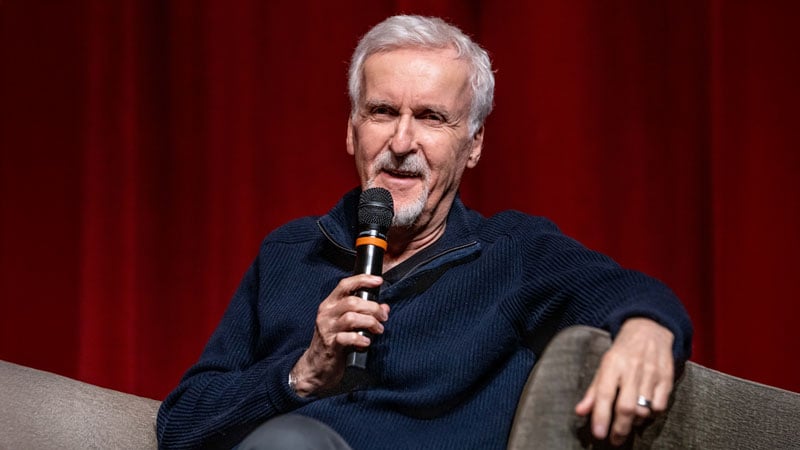
Q&A photos by Howard Wise – Print courtesy of Walt Disney Studios Motion Pictures
Marine turned Na’vi leader Jake Sully, Na’vi warrior Neytiri and their family must deal with adversaries, both old and new in Director James Cameron’s sci-fi epic, Avatar: Fire and Ash.
Cameron’s film returns us to Pandora, a lush habitable moon in the Alpha Centauri star system first encountered in his 2009 DGA Award-nominated 3-D feature Avatar, and revisited in his 2022 second chapter, Avatar: The Way of Water. In this third chapter, Jake and Neytiri’s family encounter a new, aggressive Na’vi tribe, the Ash People, led by the fiery Varang, who has allied with Jake’s enemy, Colonel Miles Quaritch, as the conflict on Pandora escalates to devastating consequences.
On November 30, after the DGA membership screening in Los Angeles, Cameron discussed the making of the film during a Q&A moderated by Director Guillermo del Toro (Frankenstein).
During the conversation, Cameron shared why he is attracted to his current performance capture-based filmmaking approach.“I think it’s fair to ask, a Director with 30 years of live action experience, why would I be attracted to a performance capture with CG characters? The answer is not obvious; it’s not just about being a tech guy and being in love with the innovation. As a Writer-Director and thinking about these characters so much and so deeply, it’s this weird thing that happens which is that we completely bifurcate the normal film process into two sequential stages. When you’re shooting live action, you’ve gotta get that great performance and you’ve gotta stamp the entire image with all the lighting, and all the production design, and all the extras, and all the other stuff onto that sensor or that piece of film complete more less, right? Camera moves and everything else – and I love all that stuff. But it’s distracting to be thinking about, ‘The sun’s on the move. The shadow is going to be there. I’ve got 15 minutes before the thing is going to get shadowed. I’m behind two set-ups,’ you know? The attraction for me with performance capture is I do all that later. The actors aren’t even around. It’s like a quantum theory thing. I’m imagining an uncollapsed superposition where the camera could be there, or it could be there, and I don’t have to worry about it right now because the observer comes along later. Right now, all I care about is the human truth of the performances. So, I take my performance brain, my writer brain, my storytelling brain and I give one hundred percent of that to the actors. Then I give one hundred percent of my geek-techno brain to the cinematography, the camera moves, and all the downstream processes.”
In addition to the DGA Award-nominated feature, Avatar, and Avatar: The Way of Water. Cameron’s other directorial credits include directorial credits include the feature films, The Terminator, Aliens, The Abyss, Terminator 2: Judgment Day and True Lies; as well as the documentaries, Secrets of the Whales and Game Changers. His 1997 film, Titanic, garnered a record 14 Academy Award nominations and took home a record 11 Oscars and earned Cameron the DGA Award for Outstanding Directorial Achievement in Theatrical Feature Film. He has been a DGA member since 1985.