

Photos by Elisa Haber
“You can’t have resilience without understanding the necessity of collaboration, friendship, and humor, to have people to laugh with about how hard things are,” said Director Ira Sachs. “My longtime manager, Adam Kersh, and my wonderful agent, Craig Kestel, have been those people for me. They’re my friends, my comrades, and they care about gay work so that’s been very meaningful.”
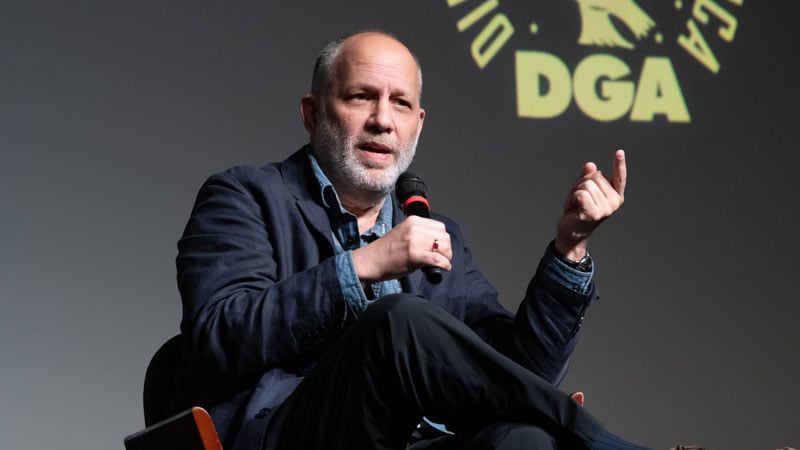
On October 24, Sachs shared those personal and professional experiences in the industry during the DGA LGBTQ+ Committee’s event, Resilience and Resistance: A Celebration of Director Ira Sachs. Held in the Guild’s Los Angeles Theater, the evening featured a rare, focused conversation moderated by Director Lisa Cholodenko that celebrated Sachs and his fearless LGBTQ+ voice in film and explored his creative resilience, resistance to convention and groundbreaking body of work, which has expanded what is possible both on screen and throughout our industry.
Following welcoming statements by DGA Past President/Secretary Treasurer and former LGBTQ+ Committee Co-Chair Paris Barclay and LGBTQ+ Events Subcommittee Co-Chairs C. Fitz, John Krokidas and Jessica Lowrey the audience viewed a reel of clips from Sachs’ work including Vaudeville, Forty Shades of Blue, Passages and Love is Strange.
Sachs and Cholodenko then came to the stage to speak about his career.
Speaking about his journey of both developing as a filmmaker and coming to terms with his sexuality, Sachs shared, “It goes back to when I was 13, when both those things happened at the same time. I discovered my sexuality as a very young person and that describes the first 15 years of my filmmaking, that I was getting over that in a lot of ways. I think of my films in various stages. Until I was 40, all my films were about people hiding things and living double lives. I found double lives very familiar and very intriguing, and somehow when I was 40, well, not ‘somehow,’ I barely survived. Other people of my generation might know that feeling of somehow getting out alive; that was about AIDS and it was about shame, and the habits we formed within that. I feel like that was what all my filmmaking was about at that time.”
On the subject of his resilience, Sachs disclosed that he applied to five film schools and two art schools and was rejected by all of them. “So, having travelled with a queer theatre community, I made that first black and white film, Vaudeville, a film about a queer theatre community. Basically, I became a filmmaker as a cinephile; someone who was self-taught. In 1986 I lived in Paris for three months and I went to 200 films in a three-month period and decided that filmmaking was what I was going to do with my life.”
Revealing how he kept moving forward Sachs said, “For me when I think about resilience, I think about the 2008 recession when I was fired by my manager. I realized that the city had very little to offer me, and it was the end of the Golden Age. Part of what I was shaken up to do was to make a film like Keep the Lights On, which I made for $750k from a lot of proverbial ‘bake sales’ with 250 people involved in financing the film. So, at that moment I kind of reinvented the economic ways I was going to make films, and the films were also about something very different. Suddenly hiding and secrets were repellent to me at that moment in my life and so the films changed, and they became about other kinds of conflicts.”
After the discussion the audience was treated to a screening of Sachs’ new film, The Man I Love. Set in the vibrant era of late ‘80s New York, the film follows Jimmy George, a charismatic performance artist navigating an AIDS diagnosis while trying to stage a play. The film explores a precious window between severe illness and mortality where beauty, art, and love remain possible. The Man I Love earned Sachs nominations for the Queer Palm and the Palme d’Or awards at the 2026 Cannes Film Festival.
After the screening, Sachs and Cholodenko returned to the stage for a conversation about the making of the film and to take questions from the audience.
In addition to The Man I Love and the other films previously mentioned, Sachs’ directorial credits also include the feature films Peter Hujar’s Day, Frankie, Little Men, Married Life, The Delta, and Boy-Girl, Boy-Girl. He has been a DGA member since 2006 and has served on the Eastern Directors Council.
Video from this event coming soon to the gallery below.
About the Committee:
The LGBTQ+ Committee was founded in 2021 as a provisional committee to explore ways to educate, inform, address the concerns of and create opportunities for members who identify in these categories. At the DGA National Board meeting on January 8, 2022, the Board voted make the LGBTQ+ Committee an official standing committee.The Committee is dedicated to empowering and advancing the professional interests of LGBTQ+ and to promoting and working for employment equity throughout the entertainment industry. The Committee’s current Co-Chairs are Directors Jennifer Arnold and Jessica Lowrey and UPM Mark Hansson.