

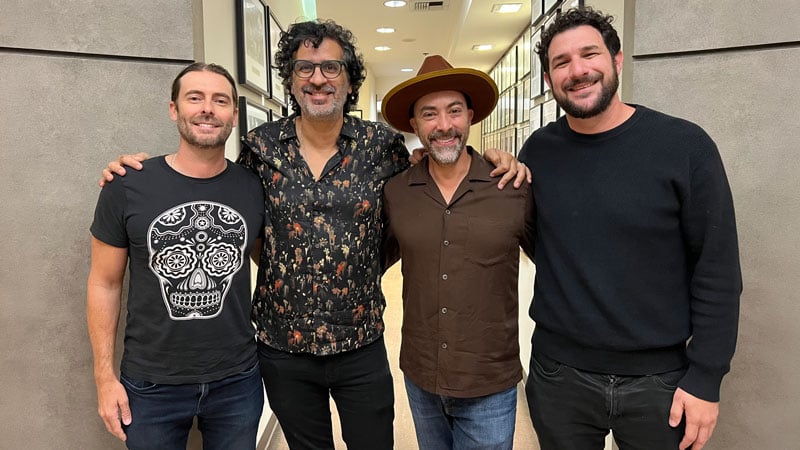
On June 24, the Latino Committee’s (LC) meeting featured the discussion, Rolling in Any Language: Directors on Working in Latin America.
During a conversation moderated by Director Antonio Negret, Directors Diego Velasco and Joel Novoa spoke on the craft and challenges of leading sets across languages and cultures and navigating production markets in Latin America.
He noted the differences between cash rebates and transferable tax credits and shared the benefits of shooting in each respective Latin American country featured in his breakdown, saying, “There are so many diverse ecosystems in Latin America, whether you’re shooting a story set in Latin America or the U.S., there are so many elements in Latin America that are cinematic. You have beaches, you have Amazon rainforests, high snow-covered peaks, modern cities that look and feel like parts of New York and Miami. You have colonial dilapidated beautiful palaces that feel more like Cuba, or a Casco Antiguo period piece where there’s roads that have been there since Spanish colonization. There’s a tremendous amount of variety available.”
On working across language gaps in production, Velasco shared, “Two producers I worked with came from Nashville, Tennessee, and didn’t speak Spanish at all, but they learned it while they were there and had a great time. I find that a lot of crews who you’d be hiring speak English, and if they don’t speak English, their local production company will have somebody who does. You just learn as you go. A lot of production meetings we’d have on Zoom were in Spanish and would be translated in subtitles. And if they spoke in English, everyone who only spoke Spanish could see the subtitles automatically translating the conversation to Spanish. So don’t let language hold you back, in fact, it makes it even more fun when you have that extra challenge. So just have a smile and don’t let it hold you back.”
Further discussing Latin American production ecosystems, Novoa recalled, “One of the things that surprised me was every time you walked into a new market, there were a lot of production companies interested in working with us. The way it often works for them – which I learned with time – is that they have a credit that they get from their government once a movie premieres. And if the movie does well, they get an extra incentive because overall they’re incentivized to keep the production pipeline going. The big thing in Latin America is the differentiation between co-production funds and incentives, because there are city incentives and country incentives and for me, that was a hard thing to learn. What I know is that a lot of the time it will depend on what the story is. Does the story adapt well to the market? Is the market open to stories that are not based in that country? For example, the Dominican Republic is very much open to stories that happen anywhere in the world, so it’s a very interesting market there right now.”
ABOUT THE PANELISTS:
|
|
|
|
|
|
 Joel Novoa
 Diego Velasco
 Antonio Negret (moderator)
ABOUT THE COMMITTEE:
The Latino Committee was created as a networking group to advance career and job opportunities for Latino DGA members by improving craft skills, networking, and making Latinos better known to the Hollywood creative community.