Discussion photos by Elisa Haber
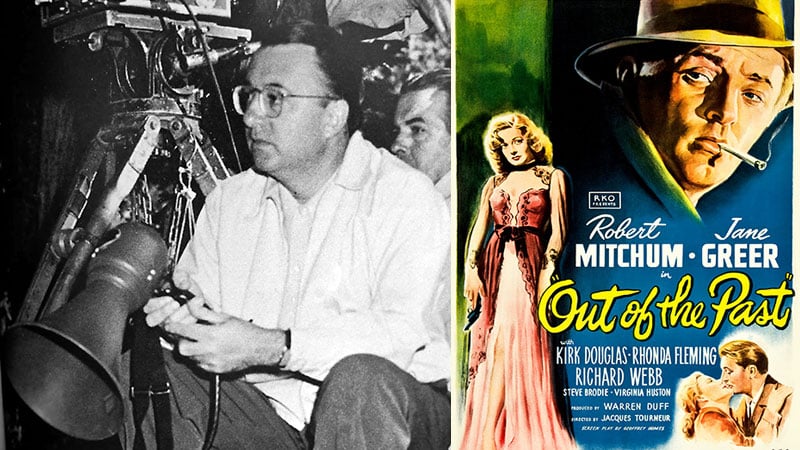
On June 30, the Special Projects Committee hosted the latest installment of their Classic Film Series with Director Jacques Tourneur’s 1947 classic noir drama, Out of the Past, in the Guild’s Los Angeles Theater. The series screens iconic movies, followed by a discussion about their legacy.
Tourneur’s Out of the Past unveils how the quiet life of small-town gas station owner is interrupted when a figure from his shady former life recognizes him. Now he must return to the big city world of danger, corruption, double crosses and duplicitous dames. Widely considered to be one of the very best film noirs of the ‘40s, Out of the Past launched Robert Mitchum’s career and achieved critical acclaim and cult status through its complex, fatalistic storyline, dark cinematography and inclusion of the classic noir archetype, the femme fatale. In 1991, the Library of Congress added Out of the Past to the United States National Film Registry for being “culturally, historically, or aesthetically significant.”
The evening opened with a welcome from Classic Film Series Subcommittee member Luc OuYang and Special Projects Committee Co-Chair Michael Goi. Following the screening, Goi served as the moderator of a conversation with special guest, Director Lawrence Kasdan.
“What I love about film noir especially is the women characters are so incredibly strong and so incredibly smart, certainly smarter than the men.” said Goi. “I've heard people argue that noir has to be in black and white, it can’t be in color. But there are so many films that demonstrate that it can be. In those stylistic choices, the darkness comes out of the characters, and you find visual representations of that character in the way that you light it and shoot it.”
Admitting how he ‘borrowed’ from the femme fatale’s introduction in Out of the Past for Kathleen Turner’s entry in his debut feature, Body Heat, Kasdan said, “[In Out of the Past] she walks into the cantina in her white dress, out of the shadows. He's been waiting for her show up and she comes out of the darkness and enters the room and turns out to be the force that drives the movie. I wanted to have that feeling and I had no shame about stealing anything I could. My movie’s kind of a remake of Double Indemnity and Out of the Past. You can be embarrassed about that, or you can say, ‘Double Indemnity is one of my favorite movies. If I could get close to that feeling in this movie, that’ll be enough.’ I was able to get close to it in certain moments and that was heaven.”
 About the Director:
Jacques Tourneur — (1904-1977) was born in Paris, then went to Hollywood with his father, Director Maurice Tourneur, in the early 1900s. He started out as a script clerk and editor for his father before graduating to directing shorts (often with the pseudonym Jack Turner). He was hired to run second unit for Jack Conway's A Tale of Two Cities (1935) where he first met Val Lewton. In 1942, when Lewton was named to head the new horror unit at RKO, he asked Tourneur to be his first Director. The result was the highly artistic and commercially successful Cat People (1942). Tourneur went on to direct masterpieces in many different genres, all showing a great command of mood and atmosphere.
A DGA member since 1939, Tourneur's other directorial credits include the features Northwest Passage (1958), Curse of the Demon (1957), Anne of the Indies (1951), The Flame and the Arrow (1950), Berlin Express (1948), The Leopard Man (1943) and I Walked with a Zombie (1943); as well as episodes of The Twilight Zone, Bonanza, T.H.E. Cat and General Electric Theater.