photos by Quintin Lundy
“You know when you make a list when you’re 12, and then another one at 25, and then 45? Well, I’m still working through the 12-year-old list,” confessed Director Reginald Hudlin as he spoke about his career to the DGA Los Angeles Theater audience. “I still have a lot of stuff to do and there was a point halfway through my career where I had to stop and see what was working and what was not working. And I realized the things that worked were the ones I was super passionate about and the things that weren’t working were the ‘smart move’ – the super passionate things were the things that people thought were terrible ideas. I was 110% about that and those always succeeded and advanced my career. So, this is a very simple filter, just do what you want to do.”
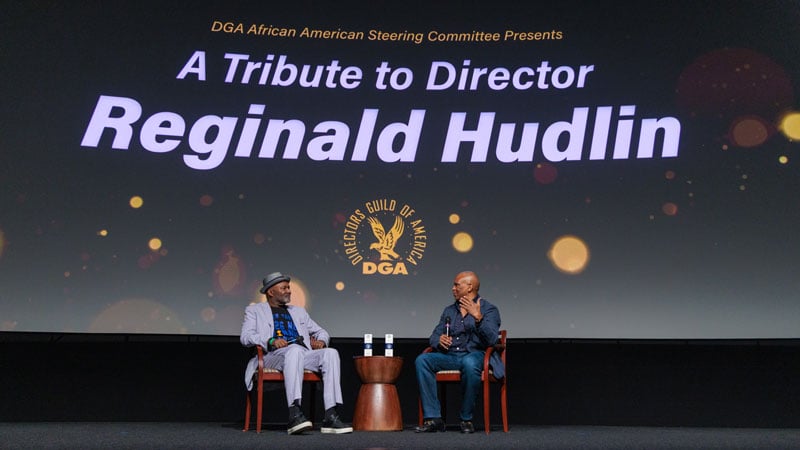
On June 13, the audience in the DGA’s Los Angeles theater gathered for an evening in Hudlin’s honor as the African American Steering Committee (AASC) hosted special event to celebrate the Oscar and Emmy-nominated Director and Producer. The show — directed by Fay Hauser-Price with Stage Manager Anthony Kinniebrew — featured notable industry guest speakers who have worked with Hudlin and have been influenced by his extensive body of work.
An active DGA member since 1991, Hudlin has more than 50 directorial credits including the features House Party, Boomerang, Serving Sara, Marshall; the movies for television Wifey and Last Days of Russell; television specials such as Richard Pryor: The Funniest Man Dead or Alive; and episodes of Everybody Hates Chris, The Bernie Mac Show, The Office, Modern Family, Murder in the First and The Fall and Rise of Reggie Dinkins. He also served on the Guild’s Theatrical Creative Rights Committee from 2018-2021 and his resume boasts nearly 50 Producer credits including features such as Calmatic’s remake of House Party, Quentin Tarantino’s Django Unchained and Millicent Shelton’s Ride; the anthology movie for television Cosmic Slop; and he was the second African American to executive produce The Academy Awards (2016) and the first to executive produce The Emmy Awards (2020, 2021, 2022) and for over a decade, has been the Executive Producer of the NAACP Image Awards.
The festivities began with a welcome from AASC Co-Chairs Pete Chatmon, Crystle Roberson Dorsey and Eric Dean Seaton and Alternate Co-Chair Kelly Park, who saluted Hudlin and spoke about the Committee’s rich history and its mission to address the specific needs of the African American members of the Guild.
Hudlin’s career was illustrated through a retrospective reel, helmed by AASC Events Subcommittee Co-Chair Abdul Malik Abbott. The reel followed his journey from his early days as a film student at Harvard, though his first feature successes with House Party and Boomerang and other accomplishments beyond. The video also and featured an interview with Hudlin conducted by Seaton.
The audience then heard from guest speakers who took the stage to share personal anecdotes and professional insights all centering on the impact Hudlin has had on them personally, as well as the industry at large. The notable group included Director Jonathan Mostow, who first met Hudlin as a fellow Harvard film student; former Academy of Motion Picture Arts and Sciences President, Professor Cheryl Boone Isaacs who has worked with Hudlin on the Academy Awards shows and more; Actors Terry Crews who starred in Hudlin’s pilot for the series, Everybody Hates Chris and Sterling K. Brown from his feature, Marshall; and Composer Marcus Miller who has collaborated with Hudlin on multiple projects for the screen and beyond.
The audience also viewed a series of heartfelt video tributes from Hudlin’s colleagues and collaborators including industry talents such as Director Nandi Bowe, who first worked with Hudlin as a 2nd AD on House Party; Actor/Director Chris Rock who appeared in Boomerang, Producer Nicole Avant from Hudlin’s documentary feature, The Black Godfather; Professor Henry Louis Gates Jr. who has collaborated with Hudlin on television projects such as episodes of Independent Lens and Tavis Smiley; Producer/Actor/Writer D.L. Hughley who worked with Hudlin on projects such as See It Loud: The History of Black Television; and Actor/Producer/Director Tichina Arnold who also starred in Hudlin’s pilot for the series Everybody Hates Chris.
After the live and taped accolades, Hudlin was invited to the stage by his longtime friend, Director Nelson George, who served as moderator for a lively conversation about his career.
Asked about the range and versatility of his career trajectory, Hudlin said, “If I love every kind of movie, why can’t I make every kind of movie? People would be like, ‘I don’t know what he does.’ Then I started doing documentaries, and then I was an executive, and people would be like, ‘Pick a lane,’ and I would say ‘This is my lane and it’s everything I want to do.”
Revealing how he continuously fuels his creative energy throughout his career, he said, “If you’re expressing yourself – not just working – but you’re expressing yourself and envisioning your ideas, then someone who is tasteful will see your vision and say, ‘hey, he’s got something to say.’ There is an opportunity because you can make an opportunity. If you make an opportunity, you can make a difference. Don’t give people power that they don’t have, just take your own power and do what you want.”
His parting advice to those who would follow in his footsteps was, “When people come to me and say they don’t have a script and can’t make a movie, I say, ‘Well make it a play. You can do something, you have a phone in your pocket, and you can make a movie on that phone. So, please don’t tell me what you can’t do. Show me what you’re doing!’ That applies to me. There is never a reason to stop making stuff.”
See video from this event in the gallery below.
About the Committee:
The African American Steering Committee (AASC) was born of a desire to address the specific needs of the African-American members of the Directors Guild. One of the primary goals of the Committee is to establish a productive line of communication between African-American members and the creative community. The Committee meets monthly to plan events throughout the year celebrating the achievements of African-Americans, as well as forums with industry executives to proactively address what can be done to hire more African-Americans.