Discussion photos by Elisa Haber
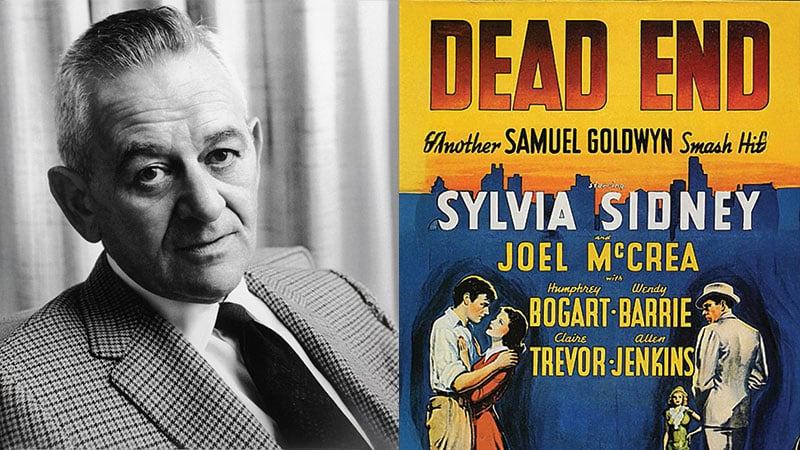
On March 5, the Special Projects Committee hosted the latest installment of their Classic Film Series with William Wyler’s 1937 crime drama, Dead End, in the Guild’s Los Angeles Theater. The series screens iconic movies, followed by a discussion about their legacy.
Dead End tells the story of the lives of a young man, a young woman, a notorious gangster and a group of street kids that converge one day in a volatile New York City slum. The film garnered Academy Award nominations for Best Picture, Best Art Direction (Richard Day), Best Cinematography (Gregg Toland) and Best Supporting Actress (Claire Trevor) and launched the start of a series of movies with the youngsters from the film known as the “Dead End Kids,” who later evolved into the “East Side Kids” and, later, the “Bowery Boys.”
Following a welcome from Classic Film Series Subcommittee member Luc OuYang, Special Projects Committee Co-Chair Director Michael Goi introduced the film and later served as the moderator of a discussion with special guests Directors Ernest Dickerson and John Hillcoat after the screening.
Calling Wyler “one of the legendary members of the DGA,” Goi noted that he was dedicated to authentic storytelling in Dead End, even when that meant butting heads with the studio. “William Wyler fought studio head Sam Goldwyn all through the production of this movie because Goldwyn thought that the set looked shabby. So, Goldwyn would be going around and ordering that set dressers clean up the streets in the set, and then William Wyler would be right behind him throwing garbage everywhere to make it look realistic!”
Dickerson, who began his career as a cinematographer, recalled, “I first saw this movie on television when I was much younger and I was always impressed with the look of it. It was one of those movies that I was always interested in ‘why does it look that way?’ This is before I even discovered what cinematography was. Later on I got hipped to Gregg Toland and his amazing work. The set in this movie is absolutely amazing. What the Art Director gave him was like gold because Gregg was not only a master, but he was also a master of shadows and shadow placement. I think it even had an effect on the first film I directed, Juice, because we did a lot of shooting in Harlem alleyways. We didn’t have harsh shadows like Mr. Toland was able to get because most of our days were overcast. But just that landscape, the vertical landscape inside the city, was definitely a big influence on me.”
Goi, who also began his career as a cinematographer added, “Yeah, and the specificity of the lighting, I mean, where those shadows are placed were equally, if not more, important than where the light was placed. It's really quite remarkable.” Goi then read a quote about Toland from Wyler who called him, ‘a great and happy influence on my work.’ “Usually, photography doesn't influence direction,” said Wyler. “But Toland's deep focus work did, because we were able to let the audience do its own cutting. But if the photography allows you to see all four actors in one shot and in sharp focus, reacting to each other within the same shot, you've gained the opportunity to use a big close-up at the most important point. In this way, Toland improved my direction.”
Comparing Dead End to the emergence of the film noir genre in the ‘40s, Hillcoat noted, “This is a precursor to noir. The way it deals with class in America, that’s something that in such a bold way the ‘30s films did delve into. There was the Depression. You can see how all the ingredients in this film, in terms of doomed characters that were like the Bogart character. The idea that he had plastic surgery — he tried to burn his fingers off three times. He comes back and his mother rejects him and then he’s clearly deluded about time and what’s happened. And then you get into those shadows, the way he walks under in the alleyways and the shadows. I actually read James Baldwin’s review of the film, and I have to agree with him. I struggle with McCrae’s turning on that neighborhood figure, turning on Bogart in that way still troubles me. There’s a part of me that thinks, maybe he should have had ‘the mark of the squealer.’”
 About William Wyler:
William Wyler (1902-1981) was born "Willi Wyler" in what was once Mülhausen in the German Empire. Wyler emigrated to the United States in 1921 where he worked for Universal Studios in New York and later Los Angeles. By 1925, he was the youngest Director at Universal, and in 1929 he directed Hell's Heroes, Universal's first sound production filmed entirely on location. Wyler went on to win the Academy Award for Best Director three times: for Mrs. Miniver (1942), The Best Years of Our Lives (1946), and Ben-Hur (1959), all of which also won for Best Picture. He was the Feature Film winner at the 12th Annual DGA Awards for Ben-Hur.
A DGA member since 1937, Wyler's other directorial credits include Dodsworth, Wuthering Heights, The Letter, The Little Foxes, The Heiress, Detective Story, Roman Holiday, Friendly Persuasion, The Big Country, The Children’s Hour and Funny Girl. He holds the record of twelve nominations for the Academy Award for Best Director. Wyler was also awarded the Directors Guild of America Lifetime Achievement Award in 1965.