

photos by Robert Hale
On March 6, DGA members and industry guests gathered at the Guild’s Los Angeles headquarters for the three-part discussion, Behind the Chair: Representation and the Business of Filmmaking. In a partnership between the DGA, IWG and the industry newsletter, The Ankler, the event was designed to highlight the unique challenges experienced by feature filmmakers from underrepresented groups.
Following a welcome from DGA Associate Western Executive Director Cynthia Tollett and The Ankler’s founder and CEO Janice Min, the morning began with the first panel, High Risk, High Reward: Directors Changing the Narrative One Film at a Time.
In a conversation moderated by entertainment columnist Richard Rushfield from The Ankler, Directors Lee Isaac Chung (Twisters, Minari), Carlos Lopez Estrada (DED, Blindspotting), Rachel Morrison (Love of Your Life, The Fire Inside), Patricia Riggen (G20, The 33) and Boots Riley (I Love Boosters, Sorry to Bother You) spoke about perceptions and economic environment that impact the opportunities extended to Directors from underrepresented groups and the challenges it creates in maintaining a thriving career.
Riley started the discussion by noting that he doesn’t want to just make films but has a particular film he wants to make. He’s not worried about the risk because he needs to be excited about the project. He noted that the things considered risky are often new and unexplored areas – the type of things that get him excited. He recalled that when he made his DGA First-Time Feature Film Award-nominated feature, Sorry to Bother You, people were calling it “ambitious” code for something he shouldn’t do as opposed to the compliment he initially received it as.
Estrada explained how in the indie film world “risk” is embraced – and noted that Directors struggle more with staying in the system and navigating, rather than the traditional perception that getting in is the challenge. He mentioned how the current industry crisis is going to force change that impacts the landscape of featuring directing and who is trusted at the helm.
Morrison observed how crossing certain financial thresholds, in terms of film budget, becomes an immediate barrier particularly for women. She shared how her experience as a cinematographer on projects like Ryan Coogler’s Black Panther helped manage that concern for her first project as a Director but noted that as budgets get bigger the filmmakers attached often are less likely to be people from underrepresented groups. She also discussed how the increasing affordability of high-quality technology creates opportunity for filmmakers to shoot at lower costs.
Chung spoke his unlikely path from his breakout, DGA Award-nominated feature, Minari, to Twisters and how important his understanding of rural America became in ultimately being chosen to direct the story of storm chasers in rural Oklahoma. He shared how supportive Steven Spielberg was as a Producer and how his vision was embraced through that support. He also mentioned the audiences’ enthusiasm for projects like Sinners and K-Pop Demon Hunters.
Riggen commented on how little industry representation has changed for women Directors since she began her career. She discussed her experience helming a breakout hit that made over 20x the budget in box office returns only to still struggle with securing her next opportunity – and the prevalence of agents being unwilling to push for certain clients based on their perceptions of who is viable for a given job.
Riley summed things up when he said, “it’s always important to remember that no one knows what the fuck they are doing – it’s fine if I’m figuring it out because so is everyone else.”
In the second panel discussion, Changing the Game: Turning the Industry on Its Head Through Cutting-Edge Partnerships & Initiatives, Producers Franklin Leonard from The Black List, Kamala Avila-Salmon from Kas Kas Productions and Aditya Sood from Lord Miller Productions examined the industry engine and what it will take to change how Hollywood functions during an exploration moderated by staff writer Elaine Low from The Ankler.
Leonard observed that the industry relies on the entrepreneurial spirit of filmmakers surviving unrealistic expectations and noted how the NBA’s path to discovering talent and investing in that discovery process has yielded better results for their system. “This [filmmaker discovery and investment] is a colossal market failure – and the industry is losing lots of money as a consequence.”
Sood divulged that the question of how you stand out in an exceptional way continues to drive filmmaker discovery. He also noted how this industry is being impacted by a scarcity mindset and the impact that has on creative decision-making. Underscoring the need to make more things because it’s good for the studio and its good for the audience, he said. “We are trying to fix two things; how do we fix the economics of this business and how do we increase the number of people who are being allowed to speak?”
Avila-Salmon highlighted how in evaluating bridging the gap between the economic problems and the representation problems at the core lies a misalignment of incentives. She discussed how at Lionsgate, “you were much more likely to lose your job on the 5 million dollar risk than you were on the 75 million dollar risk.” She discussed the program she built while at Lionsgate to assemble allies and advocates within the studio willing to take risks in service to trying something different – while noting that even within that framework it took years to get a single project off the ground.
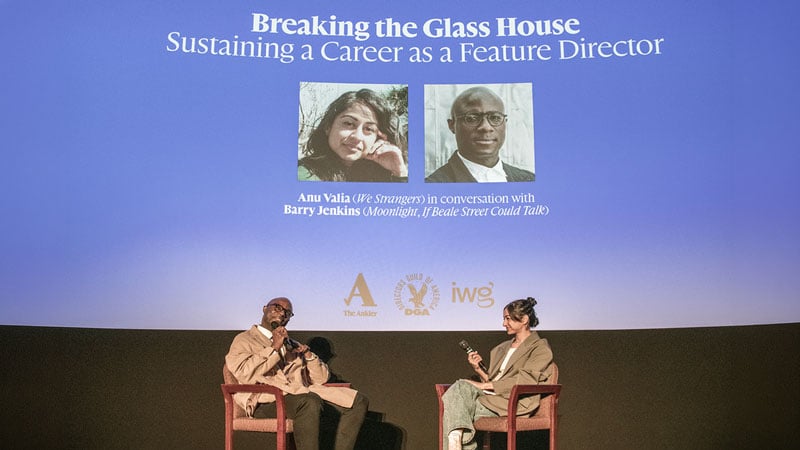
In the final discussion of the day, Breaking the Glass House: Sustaining a Career as a Feature Director, DGA Award-nominated Director Barry Jenkins (Moonlight) engaged in a one-on-one discourse with Director Anu Valia (We Strangers) where they covered topics such as the impact of joining the DGA, the distinction between having a career versus working as a feature film Director, and the reality of navigating the industry volatility.
Jenkins began the dialogue by quoting his film school dean who noted filmmaking as a blue-collar profession; people who are constantly developing a skill and refining that skill to get better. He noted how both he and Anu getting into the DGA working in television is also a reflection of the important ways Directors need to constantly make and create to build skills and sustain themselves in this profession. Jenkins emphasized the specific challenge facing all creatives of all backgrounds trying to make art in this strained entertainment environment. He also noted the unintentional impact that he has had in greenlighting projects through his production company Pastel, telling stories others may not because he is now able to apply his lens to that level of decision-making.
Valia, while leading an engaging dialogue, underlined how television has given her the opportunity to make a living as a Director while still keeping her feature film aspirations alive and how that allows her to foster her love of the craft while sharpening her skills.