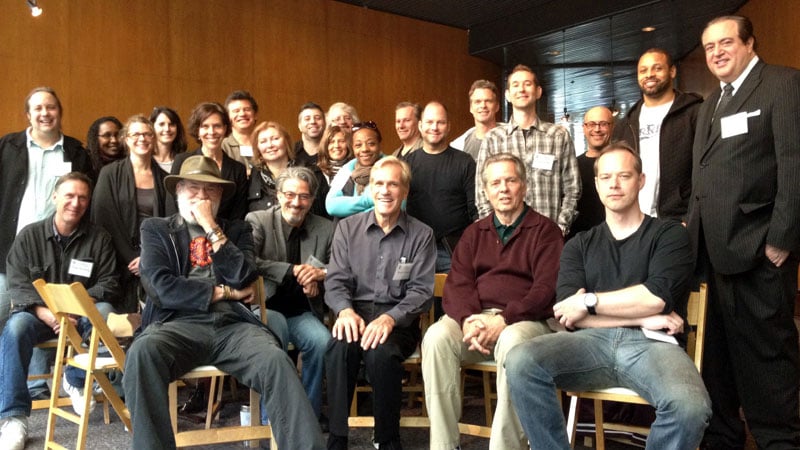
photos by Byron Gamarro, Krista Kennell and Tonya Wise
DGA members got the opportunity to learn valuable directing techniques and put them into practice through a series of workshops presented by the Special Projects Committee. The classes offered the participants a variety of powerful tools and effective strategies for working with actors, staging scenes for the camera, and interpreting dramatic texts to express the director’s creative vision. All sessions took place at DGA headquarters in Los Angeles on eight consecutive Saturdays from February 11 through March 31.
The introductory session on February 11 was led by director and Special Projects Committee chair Jeremy Kagan (The Big Fix, The Chosen), who is also a professor in the Directing Track at USC School of Cinematic Arts. Kagan opened the workshop by introducing the other directors serving as instructors: Jon Amiel, Randal Kleiser and Mark Travis. He also set the tone for the series with a presentation about the principles of directing styles and techniques.
“As Special Projects is devoted to increasing the knowledge of all of our members, we discussed providing a workshop offering this rare encounter with some excellent directing teachers,” said Kagan “This was an opportunity for our members to learn skills to motivate powerful performances and actually work with actors on a scene with the creative criticisms of the various workshop leaders. Those who attended heard a variety of directing techniques and were exposed to some excellent tools to achieve successful performances from actors.”
Session Number Two on February 18 was led by Mark Travis. Travis, whose credits include episodes of the classic sitcoms Three’s Company and Family Ties, is the author of The Film Director’s Bag of Tricks and The Director’s Journey: The Creative Collaboration between Directors, Writers & Actors. With the assistance of actors Kate Del Castillo and Abbott Alexander, he demonstrated his “Travis Technique” for generating authentic performances.
“I had no expectations about Mr. Travis, but I left feeling extremely inspired,” said participant Paige Morrow Kimball. “I especially liked the subtext tool, the interrogator technique and the separation of left brain and right brain/actor and character when directing an actor.”
On February 25, Randal Kleiser, director of the feature films Grease and The Blue Lagoon, provided highlights of The Nina Foch Course for Filmmakers & Actors, which he and other directors credit with giving them important fundamentals on working with actors. With actor Bruce Davison, Kleiser demonstrated techniques based on the legendary class Foch taught at USC for over 40 years.
“I’m so glad Randal introduced us to Nina Foch,” said Scott Young. “That woman is a gold mine!”
Jon Amiel, who has served as a Creative Advisor for the Sundance Institute’s Feature Film Director’s Lab, demonstrated his "I am the Camera" technique on March 3. The technique ties the core intention of a scene to the requirements of shooting. Amiel, who directed the feature films Sommersby and Creation, demonstrated the method by running actors David Call, Ajarae Coleman, Louis Karim Nebati, and Brett Kelley through a rehearsal which he shot with a mobile camera to establish each shot from the director’s POV and vision for the scene.
“Jon’s approach to meeting the actor on an even plane, making the process more humane, and finding truth through techniques of substitution and staying connected to the original instincts of the story were great,” said Stewart Schill.
The final four sessions of the series were devoted to live scene work by 12 of the workshop participants who were selected on the basis of material they submitted for review by the instructors. During each week of the final four sessions, three of these participants had to cast, rehearse and stage a brief scene with two to three actors. Each scene was then viewed and discussed by the rest of the workshop members and the guiding instructor. The participants found these live exercises invaluable as they not only allowed them to try new techniques hands-on, but also to explore additional methods during the presentations and discussions.
“One of the biggest problems I face as an independent director is the amount of time between projects when I am doing everything else but directing,” said participant Noel Olken in his assessment of the workshop series. “I love the writing, and the producing, the editing and even find the challenging hunt for financing fun; but nothing beats actual directing and working on a set with actors. This workshop made me think like a director, see like a director, listen like a director. It was only three hours a week, but I carried it with me from week to week. I can’t wait till I get back on set and start directing again.”