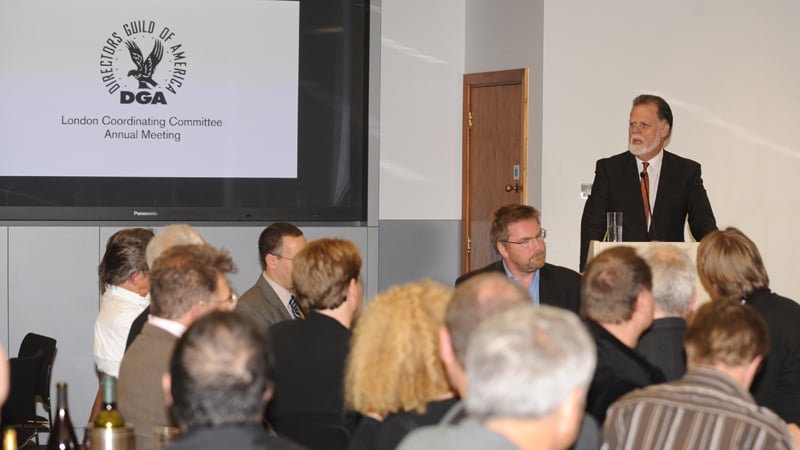
"Our companies and the films we make know no borders - nor should the protection of directors' rights," declared President Taylor Hackford in his remarks to the directors assembled at the DGA London Coordinating Committee's third annual general membership meeting in London on October 2.
Open to the more than 250 DGA members living in the UK and Ireland, the annual meeting offered the opportunity to socialize while getting an update about the Guild's activities and efforts to improve the economic and creative rights of members who reside and work outside of North America.
Hackford's remarks touched on a number of topics that affect all DGA members: the worldwide recession; the downturn in home video; and the decline in advertising dollars due to audience fragmentation caused by piracy, an increase in the number of available channels, the TiVo/DVR effect and the growth of Internet sites such as Hulu. He noted that only time will tell how much of these economic pressures are cyclical and related to the economic crisis, or secular and representative of a true change in consumer behavior.
The majority of the discussion focused on the Guild's top public policy priority - the fight against Internet piracy - which Hackford called "perhaps the gravest threat ever to the health of our art and our livelihoods." Hackford laid out the economic impact of piracy on downstream revenue (the revenue generated after a film's theatrical release or a television show's first run) and how this will impact members' residuals and pension plans as well as producers' ability to continue financing films. He stressed the need for international cooperation and noted that the DGA was the only organization in Hollywood to take a public stance in support of the French "Creation & Internet" anti-piracy law.
Concluding his remarks, Hackford affirmed, "We are ready to be public and visible. We are ready to state very clearly what we want - an Internet structure that permits illegal content to be found and identified - and one that has meaningful sanctions against those who steal and steal repeatedly. And we are now prepared to put considerable time and resources into this fight and into educating our members so they are knowledgeable and battle ready."
LCC Co-Chair Michael Caton-Jones shared the activities of the LCC which included hosting events such as Under the Influence screenings and consecutive nightly screenings of the five feature films nominated for the DGA Award, a practice that will be repeated this year. "Of course, the Committee's priority has been working to make sure that directors who live here enjoy the protections of a DGA agreement when directing films for a worldwide audience," he noted. "We are committed to continuing our efforts in this area. If you're working on a film that's not covered by the DGA Basic Agreement, let us know as soon as possible and we'll try to get it covered."
Also in attendance at the meeting were Secretary-Treasurer Gil Cates, National Executive Director Jay D. Roth, Eastern Executive Director Russell Hollander and Assistant Executive Director for Government & International Affairs Kathy Garmezy as well as the leadership of the directors organizations that make up IAESDO: the Directors Guild of Canada, the Screen Directors Guild of Ireland, the Screen Directors Guild of New Zealand, the Australian Directors Guild, Directors UK and BECTU.
The London Coordinating Committee was established two years ago by the National Board which recognized the need to create a coordinating committee in the same way it already has with similarly-sized populations of DGA members in San Francisco and Chicago. In addition to Chair Michael Caton-Jones and Jim Gillespie, the committee’s members include Antonia Bird, Tom Hooper, Richard Loncraine, Roger Michell, Mike Newell, Chris Newman, Jim Sheridan and David Yates.