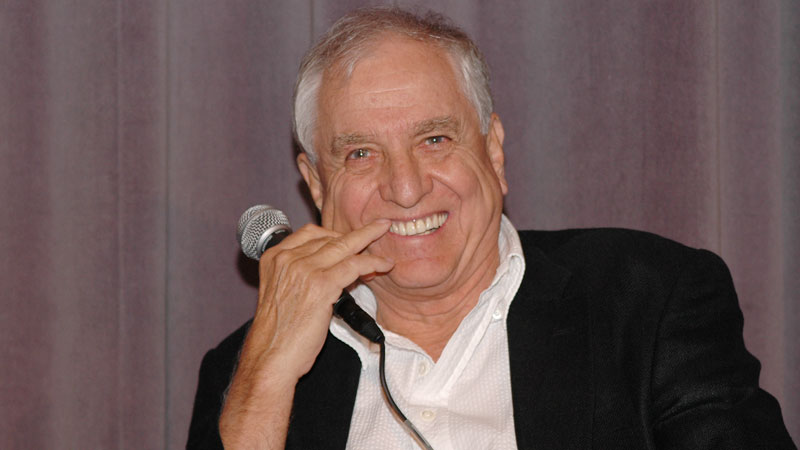
On Saturday, September 16, 2006, DGA members and their guests gathered in Theatre 2 of the Los Angeles headquarters to explore the universals that make us laugh at the 9th Annual Directors Retreat. The title of this year's retreat was "What's So Funny? A Day of Comedy at the DGA," presenting directors expert at "mining the humor," whether it be for a studio feature, independent feature, or a multi-camera or single-camera television series.
"The three greatest words in the English language are 'ha, ha, ha,'" said Special Projects Retreat Sub-Committee member Victoria Hochberg in her introduction. "Those of us whose job it is to elicit these words from an audience are the luckiest workers in the world."
Kicking off the morning was keynote speaker Garry Marshall, director of the features Pretty Woman, Overboard, The Princess Diaries; creator of the sitcoms Happy Days, Laverne & Shirley, The Odd Couple and Mork & Mindy; and recipient of the 1990 American Comedy Awards Lifetime Achievement Award. Marshall, a DGA member since 1967, performed a mini stand-up comedy routine that offered a brief history of humor from cave drawings to the Internet. It also covered television comedy directing, from the live days of The Tonight Show, through Desi Arnaz' innovative three-camera format and the "Sheldon's Alley" technique perfected by Sheldon Leonard to teaching talented stand-up comedians how to translate their skills to television. "A director's job is not to say to an actor, 'Here, I'll make you funny,' but to get the best out them," said Marshall who advocated using humor as a tool for maintaining control of the set. "If you can find the funnybone of a person as a director, I think that's part of the job even if it's a drama you're working on."
Following the keynote speech, director Michael Lembeck (Friends, Mad About You, Everybody Loves Raymond) moderated a discussion with director James Burrows, the recipient of ten Emmys and the most nominated television director in the history of the Guild. Burrows' resume includes 21 nominations and four DGA Awards for directing such acclaimed series as Cheers, Frasier, Friends, and Will & Grace. He remembered his first sitcom directing gig — an episode of the Mary Tyler Moore Show — where the script wasn't as good as usual so he had to use his imagination to compensate via blocking and creative stage business. "I tried to invent things to make the show funnier," said Burrows. "Right before the show started Mary came up to me and said, 'We believe our investment in you has worked out.' If you want to become a sitcom director, die with your boots on. Don't worry about your next job, just worry about the show you're doing and try to make the show better. No show is perfect, but it can always get better. Try to do that. It will only lead to being more respected."
Marshall returned to the stage to serve as moderator for a discussion with director Robert Weide about his innovative show Curb Your Enthusiasm. Weide described the difficulties of directing a show where the situations are outlined, but the dialogue is improvised and the production is akin to the verité filmmaking style of documentaries. "It's a weird combination of being very spontaneous but in a controlled sort of chaos," said Weide. "Actors sometimes get nervous because they're improvising and think, 'what if I say something stupid?' I tell them, 'It doesn't matter if you say something stupid because we're going to do a lot of takes and perfect it as we go and in editing, we're only going to use the good stuff and make you look good. I just have to make sure I have all kinds of coverage which allows me to switch around between takes a lot."
In the afternoon, Weide occupied the moderator's chair in a discussion about feature comedy directing in the independent film world. The panelists were husband and wife team, Jonathan Dayton and Valerie Faris, directors of the critically acclaimed Little Miss Sunshine, made under the DGA Low Budget Agreement. Asked how they were able to cross over from commercials and music videos into independent feature directing, "I think we just loved it the most," answered Dayton. "We had our 'day jobs' and decided that if we couldn't direct this, then we wouldn't do features. It took a long time to get this film made and we were able to stick with it much longer than a lot people who had to move on." Faris answered a question about directing as a team, stating "We liken it to parenting, as if you were trying to describe what a mother does, versus what a father does. We're just constantly discussing everything that's going on and dealing with everything at the same time. It's always an issue with actors on how to deal with two directors. But from the first day of rehearsal they could see that we were on the same page. We've done it for twenty years together so we don't even think about it anymore."
In the final panel of the day panelists Jonathan Lynn (My Cousin Vinny, The Whole Nine Yards), Donald Petrie (Grumpy Old Men, Miss Congeniality) and Betty Thomas (The Brady Bunch Movie, Private Parts) revealed the triumphs and travails of shooting a big studio-backed comedy with moderator Randal Kleiser (Grease; Honey, I Blew up the Kid).
On the practice of studio-mandated previews and focus groups, Lynn said, "I think that previews can help a comedy, but they're dangerous. The problem with the process is it's based on the assumption that whatever the audience in a preview session or focus group wants is what they must be given. I don't think that's necessarily true. There's always pressure from the studios to have a feel-good ending and previews aren't helpful in that regard. But they're very useful in finding out what makes people laugh. When the film is shown to an audience of three of four, or five hundred people, if they don't laugh, it's not funny."
Thomas fielded an audience question about how to deal with big stars who won't rehearse. "Really great stand-ins are the key to diva comedy," laughed Thomas. "You can block the whole thing and when the divas come back to the stage, there will be marks on the floor and they'll say, 'Oh, do I come over here now and then go over there?' And you say, 'Yes, and here you pick up the gun and shoot that guy.' When they ask 'Why can't I pick up the gun and put it back here?' you say 'Because in rehearsal your stand-in didn't do that so we're not lit for that. But if you show up for rehearsal, you can do anything you want.'"
Petrie explained that it is the job of the director to let the audience know it's okay to laugh. Recalling his experience on Grumpy Old Men, he said, "Originally the script starts outside a church and the children of Lemmon and Matthau are reminiscing about their fathers in such somber tones, that you believe it's a funeral. Then we go into Lemmon and Matthau and at the end, the film bookends back at the church and you learn that it's not a funeral but a wedding. But when we showed that to an audience, the beginning was so somber that people thought they were there to see a drama starring Lemmon and Matthau, so even when the funny bits started, they did not laugh. I had to go back and cut out that beginning and start right into the comedy. The power of cinema is being able to set the rules and guide the audience."
With so many talented directors offering the benefit of their experience, the audience learned that there are many avenues to creating film comedy. But the spirit of the day seemed best summed up by Marshall who ended his keynote speech with a quote from the poet W. H. Auden. "He said 'Of all the people I like, there is no common denominator, but everyone I love makes me laugh.' Go out and make somebody love you."