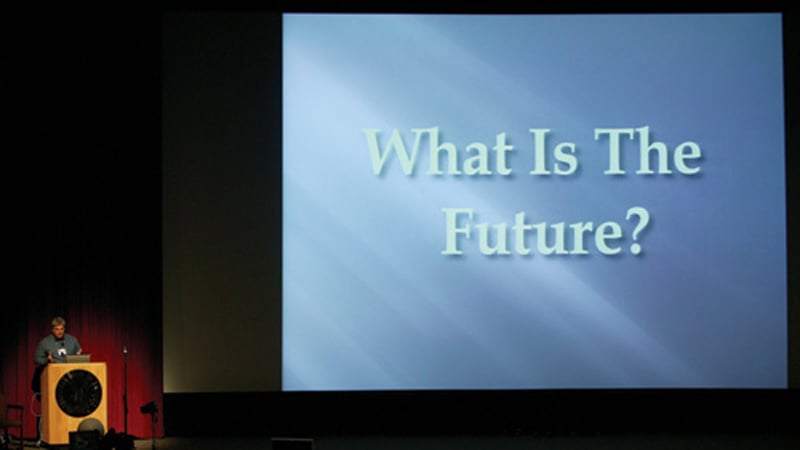
If knowledge is power, directors and industry pros left Digital Day 2006 amply armed for the digital revolution sweeping Hollywood. Presented by the DGA Special Projects Committee at the Los Angeles headquarters on Saturday, July 29, the fourth annual event offered an extensive range of demonstrations, panel discussions and seminars in Theatres 1 and 2, with overflow audiences participating via live feeds to Theatre 3.
Digital’s impact on every phase of production and delivery was addressed, from Virtual Sets and Motion Capture to Digital Cinema and Viral Video. This year’s theme was “Leave Your Film At The Door” and for the 450 guests, it was easy to see why. They were greeted in the lobby by a Dalsa Origin 4K digital camera sharing floor space with a state-of-the-art Panavision Genesis and Thompson Grass Valley Viper FilmStream cameras. Other equipment and techniques were demonstrated throughout the day, but if there was one common theme, it was that digital tools find their ultimate value in serving the craft of storytelling.
The event opened with two popular panels. In the “Digital Delivery Systems” seminar in Theater 1, Wired Magazine Editor-in-Chief Chris Anderson explained the theories of his best-selling book, The Long Tail: Why The Future of Business Is Selling Less of More. Anderson, in exploring the rise of niche markets in the digital age, insisted that the YouTube generation still enjoys the movie theater as a high-value “experience” even when reducing television and all other forms of video programming to the indistinguishable commodity of “content.” Tech culture journalist Xeni Jardin then demonstrated several popular viral video internet sites, followed by Neovision Labs President Michael Mehrle, who compared handheld devices including mobile phones and PDAs currently used to stream entertainment content. Sony Digital Systems Group Manager Andrew Stucker drew gasps with clips from The Sound of Music and other films screened with the new Sony 4K projector.
At the same time, an overflow crowd filled both Theatres 2 and 3 for a series of presentations on “Previsualization” techniques and the latest Previs software. Moderated by director John Badham, the experts included storyboard artist David Lowrey, production designer Alex McDowell and visual effects supervisor Mat Beck, as well as Lucasfilm Ltd. Chief Technology Officer Cliff Plumer demonstrating ILM’s new 3D Previs tools with Animatics and Innoventive Software President Ken Schafer, with his desktop software FrameForge 3D Studio 2. Digital Day also provided a demonstration of Badham’s own ShotMaster software for directors.
Security issues for producers and studios on projects requiring long-distance collaboration were tackled in a mid-morning panel moderated in Theatre 2 by MPA Executive Vice President and Chief Strategy Officer Dean Garfield who has led many of the MPA’s efforts against worldwide piracy. Warner Bros. Technology Vice President Wendy Aylsworth discussed the pros and cons of web collaboration and on-going efforts to establish standards and protocols for security, followed by Network International Solutions President/CEO Stan Badowski, who examined the security problems facing companies transmitting digital media using the public internet, and why utilizing a private network would offer better performance. MESoft co-founder and Vice President of Technology Freddy Goeske looked at other challenges in avoiding piracy, as well as the need to make security software and protocols easily usable. Post-Production Supervisor Steven Kaminsky discussed coordinating the teams working all over the world on Superman Returns. He explained how the teams had to develop an entirely new workflow to manage the massive amounts of data on the project and what they learned about the importance of developing a security culture for this very high profile production.
Theatre 1 found directors Tony Bill, Rob Cohen, David Fincher, Rebecca Miller and moderator Brad Silberling discussing the creative impact of working in digital as opposed to film. Miller, who has directed features on formats ranging from DV to 35mm, said she was not sure if she would use film again even though she has some reservations about the look of digital as an acquisition medium. Bill, Cohen and Fincher were already digital converts, saying cameras like Panavision’s Genesis®™ and Thomson Grass Valley’s Viper have changed the way they shoot and work with actors. Silberling, the lone film holdout, said he hoped to “steal secrets and get some insights on going the other way.”
“Today is about how to use technology to tell stories,” DGA Special Projects Committee Chair Jeremy Kagan said in his greeting at the top of the Keynote program. He stated that the DGA is proud to bring together this special program for DGA members, but cautioned that while we welcome these new tools, “as new ways to slice, dice, copy, store, access and profit from our work continue to proliferate, our creative and economic rights continue to need protection.” He reminded DGA members that their guild is working hard to keep up with the new developments and protect their creative and economic rights. Digital Day Committee Chair Randal Kleiser then introduced Oscar-winning visual effects pioneer Doug Trumbull, who addressed the audience from a “virtual podium” via videoconference from Synthespian Studios at the Museum of Contemporary Art in North Adams, Massachusetts. The ‘virtually present” Trumbull discussed his early experiments with “immersive experiences” working on Stanley Kubrick’s 2001: A Space Odyssey. While presenting his latest advances in virtual sets and visual displays, Trumbull noted “we still need all the drama and excitement of movies, and we need compelling content and stories, yet we need to develop new ideas about the form of the experience. As you get into 3D and it becomes more immersive, we’re going to be going into some new directorial territory.”
The afternoon sessions got started with “Cutting Edge Apps” in Theatre 1. Oscar-winning Visual Effects Supervisor Richard Edlund demonstrated the virtual lighting of actors in post-production made possible with Paul Debevec’s LightStage. Electronic Arts Senior Art Director Habib Zargarpour discussed real-time lighting and shooting of computer-generated action sequences in video game graphics, while Image Metrics CEO Andy Wood showed a breakthrough performance-driven process to capture facial expressions for animation. Visual Effects Supervisor Edson Williams offered one of the first public demonstrations of “digital plastic surgery” used to rejuvenate actors Patrick Stewart and Ian McKellen in X-Men: The Last Stand. In-Three Inc. President/CEO Michael Kaye showed examples of the “Dimensionalization®” process that can convert any 2D movie into 3D. At the same time, in Theatre 2, UPM/Director Alain Silver moderated a discussion on “micro-budget film-making” with Jacques Thelemaque, Director/Producer/Writer of The Dogwalker and co-founder of The Filmmakers Alliance.
By mid-afternoon, UPM/Producer Randy Turrow was moderating a panel discussion in Theatre 2 with Director Michael Schroeder, Cinematographer Dana Gonzalez and Senior Digital Colorist Adam Hawkey on using the digital intermediate process to give a low budget indie film a “studio look.” At the same time in Theatre 1, Hi-Def Cinematographer and Visual Effects Supervisor Scott Billups was giving a thorough overview of the market-leading pro and prosumer HD cameras and formats. Even with advanced acquisition becoming so affordable, Billups said “craft and methodology will continue to set directors apart from the growing pack of digital videographers.”
The concluding seminars found Producer/UPM Brian Frankish in Theatre 1 moderating a series of presentations on “Future Workflows,” starting with New Deal Studios Co-Founder/Visual Effects Supervisor Ian Hunter discussing the use of miniature application from previs through production, followed by Company 3 President Stefan Sonnenfeld and Ascent Media Vice President of Feature Services Steven B. Cohen tackling color management from dailies to D.I. on Pirates of the Caribbean: Dead Man’s Chest, and cinematographers David Stump and Joe Di Gennaro, who demonstrated the new possibilities for HD color correction on-set. TeraBurst Networks founder Tom Myers described the increasingly sophisticated means available for remote collaboration that can “make the world your art department, editing suite, and conference room.” In Theater 2, Editor/Director James Wilcox led the discussion on editing platforms following presentations on Adobe Premiere, Final Cut Pro and Avid Media Composer®. He was joined on-stage by Adobe System’s Mike Kanfer, Avid Technology Inc.’s Michael Krulik and Derek Benton, and from PlasterCITY Digital Post, Michael Cioni and Stephen Beres discussing Final Cut Pro.
Digital Day 2006 then moved to Occidental Studios Stage 8 for a wrap party and demonstration of Occidental’s virtual SmartStage that allows real-time insertion of actors into virtual backgrounds with photo-real sets, digital plates, or live-action backgrounds.