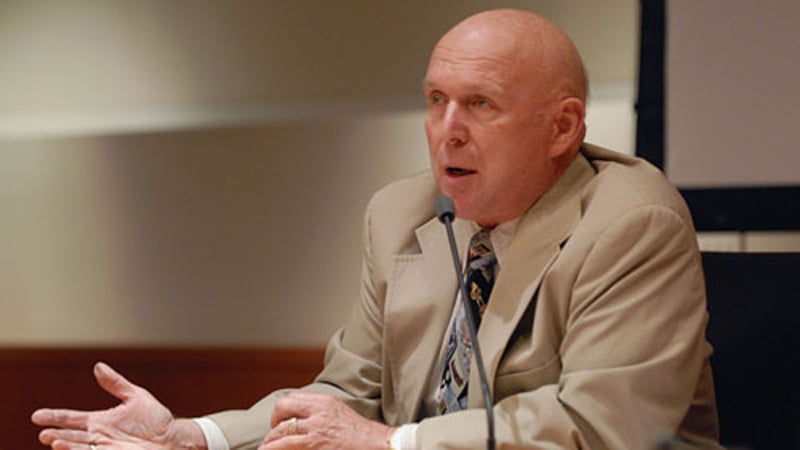
Inspired by the spectacular images and dramatic stories broadcast during the 2006 Winter Games in Torino, Italy, DGA National Vice President Steven Soderbergh suggested an event be organized so that the directors specialize in covering the Olympics might discuss how it is done. On Tuesday, June 20, 2006, the East Coast Special Projects presented “Directing The Olympic Games,” a panel discussion with directors Bucky Gunts, Andy Rosenberg, Bud Greenspan and producer Nancy Beffa in the DGA Boardroom in New York.
“I think my friends here would agree that it is exhilarating and fun to direct Olympic coverage in retrospect, because while you’re doing it, it really isn’t too easy to stop and smell the flowers,” said 17-time Emmy winner and 1993 DGA Lifetime Achievement in Sports Direction Award recipient Doug Wilson, who moderated the evening. Wilson who has covered ten Olympic games added, “It’s a challenge of sleep deprivation, coordination problems and it is highly stressful. However, if you’re lucky enough to get the job, you have the opportunity to be the chronicler of something that will live in perpetuity in sports history.”
Gunts, head of production for NBC’s Olympic coverage and veteran of seven Olympic games, showed a clip of his spectacular broadcast of the opening ceremonies of the 2004 summer games in Athens and said, “One of the great things about the Olympics for me is that the Olympians are special athletes. In this day and age of highly paid professional sports, the Olympians comport themselves in a way that people appreciate and I think it’s part of our job to bring that home and let people see people who work for no other reason than love of the sport.”
Andy Rosenberg, a 14-time Emmy winner and a veteran of seven Olympic games, showed the audience a clip of sprinter Michael Johnson, whom he’d been following with a camera crew as he cruised to two gold medals and a world record during the 1996 summer games in Atlanta, Georgia. A lover of all sports since childhood Rosenberg admitted, “I come to my directing vision as a sports fan and try to put myself in the position of thinking, ‘What’s the most compelling and dramatic story for the person sitting at home?’ Because if it’s dramatic to me, it will probably be to them.”
Bud Greenspan and Nancy Beffa have worked together for three decades. They are renowned for their ability to ferret out the offbeat story in an increasingly competitive arena. One of the secrets to this ability came in Beffa’s admission, “I don’t like sports, but I love human interest stories. They’re everywhere, but you have to look at a different angle, and you have to also know Olympic history and folklore.”
There is no better person on that subject than Greenspan, who is acknowledged as the foremost Olympic historian in the world, is the winner of seven Emmy Awards, the Peabody Award, the 1995 DGA Lifetime Achievement Award in Sports Direction, and was inducted into the U.S. Olympic Hall of Fame as a special contributor in 2004. He also directed such films as 16 Days of Glory, the definitive record of the 1984 Los Angeles Olympics, and Wilma, the true story of American track sprinter Wilma Rudolph, who overcame physical handicaps to win three gold medals in the 1960 Olympics. Greenspan told of getting his start in sports filmmaking when he borrowed twenty-five thousand dollars from his father to make a film about John Davis, an African-American weightlifting champion who was also studying to be an opera singer. After making the film in Helsinki, he found himself unable to sell it. “I didn’t know what I was doing, and Pop was getting a little upset because the money was supposed to be returned,” Greenspan recalled. “I finally heard that the State Department was looking for a vehicle to offset Korean War propaganda from the Soviet Union that said blacks had no opportunities in the United States. They took a look at the film and said, ‘This is just what we need. But we don’t know if we can pay you enough. We can’t pay any more than fifty thousand dollars.’ And I said to myself, ‘This is a good business!’”
The floor was opened to questions from DGA members seeking to pick the brains of the panel of experts. The panel responded to inquiries such as how Rosenberg’s coverage of the race might have differed if a foreign athlete had won instead of Johnson, and how Gunts managed the scores of cameras he had access to for his Athens opening ceremonies. The panel also addressed how to build a reliable crew of camera operators who could deliver the shots you’re looking for, and the changes necessary to accommodate the possibilities of the new HD technologies.
In spite of the way both the world of sports and its ensuing coverage have changed in the nearly half a century since Greenspan first picked up a camera, the consensus of the evening was that the approach these directors took to covering the Olympic games remained true to that old ABC's Wide World of Sports opening of “Spanning the globe to bring you the constant variety of sports... the thrill of victory... and the agony of defeat... the human drama of athletic competition...” Moderator Wilson—who ironically was a longtime director of the series—captured the feelings of the directing panel best when he commented, “The only difference between a between a Broadway show and what we look at in the arena is that in the Broadway show the script’s already been