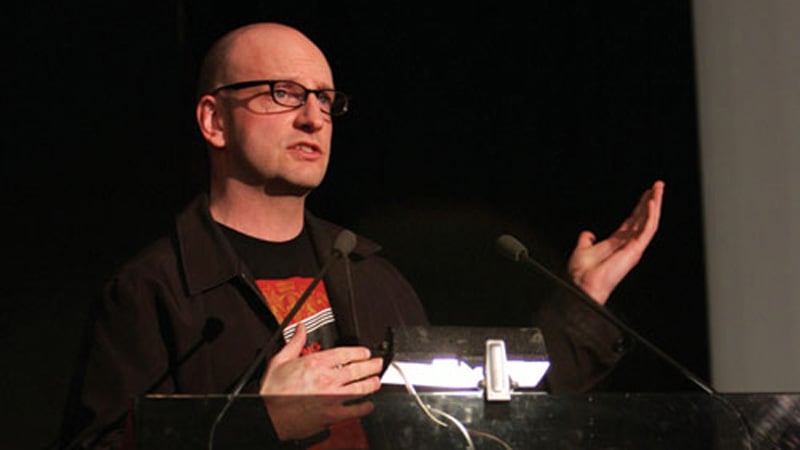
"We hope tonight's event will give you a semi-detailed snapshot of what’s involved in making a low-budget digital feature," DGA National Vice President/E-IDC Co-Chair Steven Soderbergh explained in his welcome to the audience.
IndiGent Films Producer Jake Abraham gave an overview of the process of budgeting low cost digital productions and reminded the participants of the DGA, WGA and SAG Low Budget Sideletters. “The Directors Guild’s LBA allows you to work with DGA Directors, UPMs and ADs who often have a lot of experience with low budget productions and can bring that to the table when you have to work fast,” said Abraham.
Joe Beirne, a producer and consultant on moving image technology with more than 20 years experience, gave a presentation on different digital camera capablities and how footage shot with these cameras looked when the digital files were transferred to film and projected onto a large screen. Brian Taptich, Vice President of Business Development for the company BitTorrent Inc. presented a report on the advantages and future of online distribution.
Following the presentations, Indigent Films co-founder/DGA Director Member Gary Winick (Tadpole and Charlotte's Web), moderated a panel discussion on implementing digital technology on low budget films. Putting the speed of digital technology development in perspective Winick said, “I’m sure everybody here knows that whatever we talk about here tonight, in six months it will all be new and we could have a whole different panel.”
Joining Winick onstage were Abraham, Beirne, Taptich, Ian Calderon, director of Digital Initiatives for the Sundance Institute, and DGA Director Member Maria Maggenti whose latest film Puccini for Beginners was shot digitally on location in New York City.
“It’s wonderful to shoot in New York, but the hardest thing about it has nothing to do with camera and everything to do with sound,” said Maggenti. “You can’t block traffic and you can’t shut everybody up, so the most important thing is to be flexible.”
BitTorrent was described as iTunes meets Napster, combining the server-to-client model of Apple’s music and video service, with the technical efficiencies of peer-to-peer networks. While it seemed primed to be the future of digital distribution, Calderon warned against placing all one’s eggs in a single digital basket.
“Methods of distribution are changing,” said Calderon. “Nobody actually knows what it’s going to be but we’re sure that it’s going to be different.”
While most of the evening's discussion focused on the impact of digital technology on low budget filmmaking, Maggenti expressed some regret that the future of motion pictures seemed to be moving away from the communal experience found in theatres. She also looked at the issue from the practical eye of a filmmaker. “It’s going to make a difference, because if I as a director know that my film is going to be watched on a cell phone or iPod it’s going to change the way I have to shoot it.”