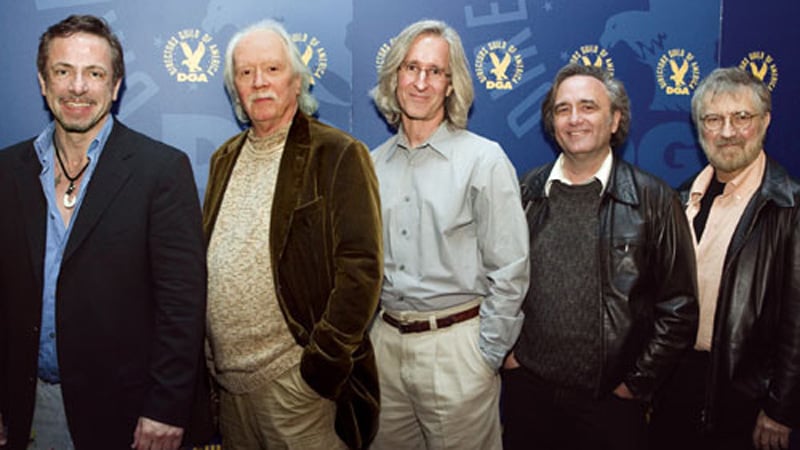
Aficionados of fright films had a post-Halloween treat as four directors who ‘made their bones’ in the genre gathered in the DGA Theatre in Los Angeles to talk about the making of horror movies. The Wednesday, November 9, 2005 event featured John Carpenter (Halloween), Joe Dante (The Howling), Tobe Hooper (The Texas Chainsaw Massacre) and Mick Garris (The Stand) speaking about the present status of the genre, its future and their collaboration on the new horror anthology series for Showtime, Masters of Horror. Novelist and director Clive Barker (Hellraiser) moderated the discussion.
Garris, the architect of the Masters of Horror television series, revealed the impetus behind its creation. “A lot of us have been friends for a long time and we started having these dinners together that we jokingly referred to as ‘The Masters of Horror Dinners,’” said Garris. “The idea was to gather together the people who really know and love the genre, and see what they would do on their own if they were able to develop their material and tell their stories their way. We found that the timing was right and everybody to whom we pitched the show wanted to do it.”
Loosed from the fetters of corporate and studio interference, these directors were finally able to explore more adult-oriented types of stories. However, those who were used to making feature-length films did have to make a few adjustments when converting to the format of a one-hour television anthology. “One of the challenging things about doing this series is you only had 10 days to shoot an hour-long episode, so you really had be prepared,” said Carpenter.
Despite the challenges, one of the main attractions that drew these filmmakers to the series was the guarantee that they could do material they couldn’t do elsewhere for a variety of reasons. Dante took full advantage of that concept to do a show that would probably have been deemed too politically sensitive for network television or feature films. His episode “Homecoming” dealt with Iraq War veterans who come back from the dead as zombies in the ultimate anti-war protest.
“I thought it would be interesting to do something topical,” said Dante. “The nice thing about this show is that they said ‘As long as you don’t have male nudity below the waist, children killing children’ and a couple other things, we had carte blanche. So I thought ‘Why don’t I try to do something I knew I can’t get done on network TV and nobody will do as a feature because it’s too risky?’ So we did a political piece. Because it’s about the Iraq War, it’s sort of fitting that the only program that would touch it is called Masters of Horror. I think it will probably piss off a lot of people, but they’re people whom I’d like to piss off anyway.”
Moderator Barker asked the panel if today’s horror films can be more than what most people assume, just a thrill ride designed to get fifteen-year old boys into movie theatres.
“I hope so,” replied Garris. “The best horror stories before there was film was always allegorical, and the best of any kind of art has more than one level to it. I like all kinds of films, but when I see something like John’s episode ‘Cigarette Burns’ or Joe’s ‘Homecoming’ I get excited all over again.”
Hooper paused in thought for a moment before fielding the question about how much is too much for even a horror director. “I know there are things that I won’t do. I can’t say exactly what, but there are things. But this genre gives us the ability to draw on the dark side of what’s going on in the world,” said Hooper. “I take what I do seriously. The Texas Chainsaw Massacre was an allegory of how bloody those times really were. I like to think in subtext and the more complex it is the better I like it. I really like to parachute into a situation that’s been alive for decades before the film ever started.”
“Sometimes the real subtext is stuff you don’t even know you’re putting into the movie because it’s buried so deep inside you,” added Barker. “There’s stuff I look back on now and realize, ‘that’s what that was all about!’ This is a genre that has allowed two levels of reality to coexist on the screen. One is reality as lived, and the other is something that bubbles up from archetypes and the collective unconscious. One of the reasons I think this genre will never go away is because of the appetite for a confrontation with that other thing that waits in the subconscious.”
“Today’s horror films are suffering because everything is driven by this commercial need to get young kids into the theatre and still have a PG-13 rating,” said Carpenter. “Everything is watered down, and only occasionally you’ll see something that will make you sit up and go ‘Oh my god!’ That’s what horror is supposed to be. If it’s not going to nail them to the back of the theatre then what are you making it for? It’s supposed to make you wake up in the middle of the night sweating.”
Addressing the issue of how films can be watered down by executive interference and preview screening focus groups Dante replied, “The great thing about this series is that we didn’t have to deal with all that. If anybody wanted a current barometer of who these directors are and what they can do, they should look at Masters of Horror. It really reflects who we are probably much better than our last three studio features because this is really what we wanted to do and not what we did to make someone happy.”
The directors also discussed the possibility that modern special effects can desensitize the audience, making it more difficult to shock them visually. “The horror has to derive from the story,” said Carpenter. Garris agreed, recalling a quote he once heard from Carpenter while he was working on The Thing.
“John said, I can run black leader through a projector and have one white frame synced with a loud noise and make you jump. But it won’t scare you and you won’t take it out of the theatre with you. If you can tell a story that gets under your skin, it doesn’t matter how graphically it’s presented, it’s going to live with you and curdle your blood.”