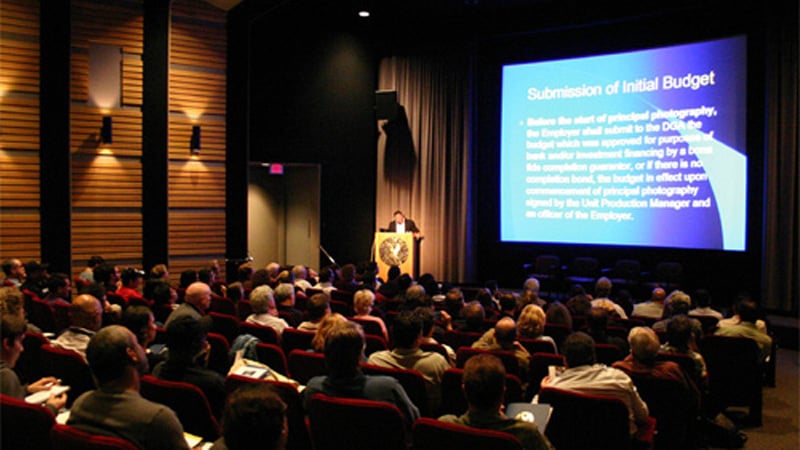
“The subject of this year’s event is credit card filmmaking,” said DGA Member/Special Projects Retreat Sub-Committee Chair Noel Black in his introduction. “One of our guests has made two full-length features for considerably under $10,000. The new advances in filmmaking and the accommodations of the guilds have made it possible to do low-budget and micro-budget films under guild auspices.”
The first panel, “Finding the Right Project” featured Red Roses and Petrol Director Tamar Simon Hoffs, Go Fish Director Rose Troche, and Gary Winick, Director of Tadpole and co-founder of InDigEnt (Independent Digital Entertainment) a company in the vanguard of leveling the financial playing field for low budget movies. IDC member Jamie Babbit, who has had her own experiences with making low budget projects, including her feature film directorial debut But I’m a Cheerleader, moderated the panel.
“I think that the way you choose material is that you love it so much you’re prepared to go to the mat for it,” said Hoffs. “There’s no other way to do movies for no money, but you have to recognize the limitations of your budget very quickly.” She suggested that directors look for projects that lend themselves to their personal directing style. “If you can get away with a few days, and not much money in a lot of locations, then go for that, but I generally look for something more contained.”
Troche joked that it’s even harder to make a credit card film when you don’t have credit cards. “What I love about this kind of filmmaking is when you take away the motivator of money, the primary motivator is the feeling ‘We’re really making a story that should be told.’”
“It also helps to have relationships with people you’ve worked with before,” said Hoffs. “It’s really important to ask for help in finding key crew from people who trust in you. It becomes a combination of calling upon the most experienced people you can get, and being willing to teach newcomers who want to learn how to make movies. It can result in having a really inexpensive and solid crew.”
DGA Assistant Executive Director Jon Larson then presented “Working with Guild Low Budget Agreements,” in which he explained the details of the DGA’s multi-tiered sideletters that allow filmmakers to make low and micro-budgeted projects and still be protected by the Guild. Larson also reviewed similar agreements crafted by the WGA, SAG and IA.
“The Directors Guild really pioneered the concept of the Low Budget Agreement two decades ago,” said Larson. “I’m actually quite proud of the fact that we’ve taken the lead on an initiative that’s really important to all of you and nurtured the very low budget films you want to make, and at the same time offer members very important protections, particularly in the area of creative rights and residuals.”
Immediately following a buffet lunch, the panel discussion “Shooting Bare Bones Style” took place with Cinematographer Andrew Huebscher and Director Gary Winick. Special Projects Committee member Alain Silver, who recently directed the digital feature White Nights, served as moderator. The session opened with clips from White Nights, as well as Winick’s Tadpole and Gary Walkow’s Crashing, (produced by Silver and photographed by Huebscher). Each clip gave the audience concrete examples of just what can be accomplished with imagination and skill in lieu of money. Winick advised prospective directors of digital projects to be very careful in their choice of cinematographer. “These ‘pro-sumer’ cameras really want to work automatically and you have to deal with that manually, as in the case of all that over-exposed stuff you saw in the clip. DV is not as forgiving as film.”
“The cameras are very deceiving because they’re so small that you have the illusion that they’re simple and so automatic that you don’t have to do anything,” agreed Huebscher. “But if you don’t have one setting correct, or accidentally bump something and knock it out of focus, you might not see it because the camera is so tiny, and you won’t notice it until later when you see it on a big screen.”
Both Winick and Huebscher also agreed that a relatively inexpensive way to make a low-budget picture better than the norm is to have a good sound person since audiences are much more likely to forgive uneven visuals than uneven sound.
Winick also explained the business model behind his InDigEnt Films. InDigEnt’s movies are made on a $300K budget, with everybody on the production making the same salary of $100 a day, but compensated on the back end with points in the film. “Everybody owns a piece of the film from dollar one,” said Winick. “So you tell people ‘We’re all in this together, and we’re all going to share in this if it does well,’ — as in the case of Tadpole where we got lucky and there was a bidding war and every point ended up worth $50K.”
“Casting and Working with Actors” was moderated by Special Projects Committee member, Director Victoria Hochberg and featured Hoffs and Director Michael Schultz. Schultz, whose HD feature Woman Thou Art Loosed was shot in 12 days, addressed the problem of not having enough time and money to do a lot of rehearsal with the actors or shoot scenes from as many angles as he would have liked. However, it was his belief that this could actually work in a film’s favor.
“Because you don’t have time to get every angle, or work the actors over and over, they have to come with that emotional level on the first take or the second take because then you’re out of there and on to the next scene. I told them ‘Look, they don’t call me “one-take Schultz” for nothing. We’ll be lucky on this schedule if we get two takes at anything — so come prepared.’ The great thing about casting wonderful actors is you give them their marching orders and they bring the rest.”
“Bare Bones Post” was moderated by Alain Silver and featured DGA AD Paolo Durazzo, who worked as the Director of Photography on White Nights and post production soundman on Crashing; as well as editor Steve Vance, who cut both films. Durazzo and Vance discussed the methods involved in cutting a movie on a desktop computer program. “Filmmakers out there who are trying to make movies for low or no money really have great technologies now to make things as fast and expedient as possible,” said Durazzo. “We’re up to eight gigs now on a flash cards — that’s about ten minutes of footage — and very soon it’s going to be 100 and then 200 gigs. Where we’re headed is really exciting, and I mean in a matter of months! It’s just going to get easier and easier.” Silver was a great advocate of desktop computer editing programs like Apple’s Final Cut Pro explaining, “For a minimal amount of money, you can now do things that a few years ago would have cost more than the budget for my entire film.”
The day ended with an “All Participant” panel moderated by Special Projects Committee member Neal Israel, with Silver, Vance, Durazzo, Huebscher, Hoffs and Schultz taking questions from the audience on a variety of issues ranging from casting, to insurance and completion bonds.
“I think what you’re hearing here today is there’s a revolution going on,” said Israel. “The idea is if you have a project you really want to make, you can go do it. You don’t have to pitch it. It’s much better to walk in with a DVD, put it in a machine and show it to them than to try to have them imagine what you mean.”
Although it was impossible to reveal all the secrets of micro-budget filmmaking in a single day, the overall feeling from those in attendance was that the event left them both encouraged and empowered to follow boldly in the footsteps of these pioneers.