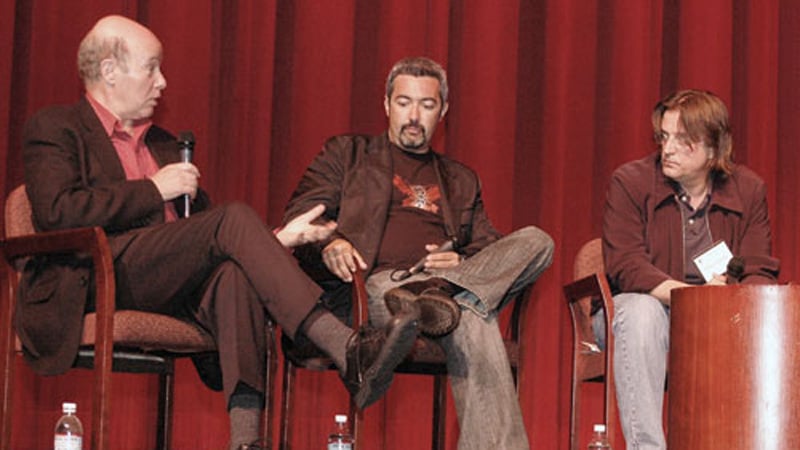
DGA Director-member Richard Schickel, author and longtime film critic for Time magazine, moderated the distinguished panel of directors and producers that included three-time DGA Award-winner Mick Jackson whose credits include HBO's Live From Baghdad; episodic and feature director Brad Silberling (The Lost Boys of the Sudan); Jon Cassar, director and co-executive producer of the series 24; Oscar and DGA-Award nominee Phil Alden Robinson; Director Martin Kunert (Voices of Iraq); Chris Gerolmo, co-creator of the forthcoming Iraq War drama Over There; Michael Tucker, co-director and co-producer of the documentary Gunner Palace; and Dr. Leo Braudy, Professor of English at USC and author of From Chivalry to Terrorism.
Schickel opened the dialogue by pointing out as the nature of terrorism has grown murkier, it has become that much more difficult for filmmakers to capture the essential essence of war in both fiction and non-fiction projects. "Terrorism was once used for a specific and definable political end no matter what one thought of the methods being employed," he said. "But there is no way to define any kind of political terms in the aims of al-Qaeda or the groups with whom they hold allegiance. There is no longer any definable goal."
Cassar believes there is "less news coverage of Iraq than there was of Vietnam" despite the vast increase in the number of news organizations and Tucker remains hugely frustrated by the reticence of the news gatekeepers to beam the reality of what's happening in Iraq into the nation's living rooms.
"There are thousands of hours of footage being shot every single day of the week in Iraq," Tucker emphasized, "but the networks won't let us show it. Nightline isn't interested, even though there are people fighting and dying every day."
Robinson — who memorably covered the Yugoslavian conflict in 1992 on Nightline — echoes the fact that the media, particularly TV, has shirked its responsibility in the failure to adequately cover a war that is no longer popular.
"The corporations that run the media are more interested in the celebrity trials," Robinson charged. "The American public knows a lot more about the Michael Jackson case than they do who is running Iraq. We're part of a much larger media that's universally failed."
But there isn't much more substance to be found in the feature film world, Robinson acknowledged. "The companies that run the movie business have tremendously narrowed the spectrum of stories they're interested in over the past 10 years. It's increasingly hard to get a film made about the real world that treats the subject in an intelligent and honest way."
Jackson understands the attraction for directors to portray scenarios that scare us to death, but feels they should also explore some reasons why the terrorist threat to America has taken root in the first place. "No one seems to be asking the question of why they hate us so much. The answer you often hear back is that they hate our freedoms. But I don't know if that's the entire answer. We never get a look at what the other side is thinking."
Braudy agreed that "what's missing is some sense of the possible legitimacy of the cause of the other side. You never get any evidence on TV or in films that the other side has a valid point of view."
But showing sympathy for, or even anything approaching understanding of, a terrorist remains a dicey issue at best, Cassar found this past season on 24. "We depicted a terrorist family the first 10 or 11 episodes this season, but we had to be very careful. Even at Fox, there are limits to how far you can go."
Gerolmo said Over There will focus on seven young soldiers on the ground in Iraq, their sergeant, and their loved ones at home. He makes no apologies for any perceived inequity from failing to tell the enemy's story as well. "It would be nice to live in a Hollywood in which it were possible to make substantially more complicated and challenging answers to the questions raised by this war, but I have to work in the Hollywood where what I'm doing is possible. That said, I think we fight the fights we can. For example, we declined the assistance of the Department of Defense because they would insist on approving our scripts and we're committed to presenting our stories as realistically and honestly as we can."
Kunert suspects that the genre-izing of terrorism-themed projects is unfortunately inevitable. "We had the WWII genre, the Cold War genre, and then 9/11 struck. After 9/11, you couldn't put anything about terrorism on TV because it would frighten people too much. But in a few years people will be more comfortable with the concept of terrorism, as sick as it sounds. And then in 20 years they'll look upon it with a certain amount of nostalgia because an even greater fear will have come out and they will be even more scared of that."
The larger question of what the future has in store for directors making movies and television about terrorism and what it hath wrought on the American psyche was summed up by Jackson as a tendency in entertainment to simplify complex issues into more palatable good-vs.-evil bite-size chunks. "We like to transform them into westerns, good guys and bad guys."
Schickel suspects that a part of the difficulty of effectively exploring the more pressing issues that accompany combat and insurgency may lie in the very form of narrative filmmaking. "I've always had the feeling that film is a great medium for exploring emotions but not a great medium for exploring ideas," he noted, "particularly ideas that are as difficult to define as the ones raised by films that reflect the terrifying threat we now all live under."
—Ray Richmond