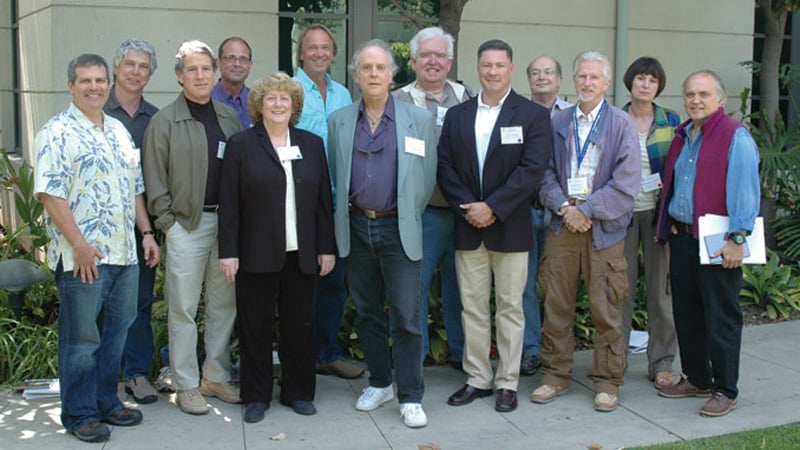
On Saturday, April 16, 2005, seventy-one DGA members participated in a seminar at Sony Pictures Imageworks visual effects facility in Culver City, California. “The Aviator: A Three-Part Case Study of the Life of a Shot” gave these participants the opportunity to witness firsthand just how visual effects (VFX) shots are created using Martin Scorsese’s DGA Award-nominated film as the blackboard. Coordinated by DGA Special Projects, the tour was the brainchild of the DGA’s AD/UPM VFX/Digital Technology Committee.
“What we’re trying to do in our committee is take the mystery out of the word ‘digital’,” said Committee Co-Chair UPM Brian Frankish. “The idea was to create an event that would keep our members up to speed with technology that’s happening in visual imagery today that supports the storytelling of a director. But there’s a big difference between hands-on experience and having someone talking about it in the DGA theatre.”
“We wanted to give the DGA members an opportunity to see the ‘assembly line’,” said Committee Chair, UPM Susan Zwerman. “We really want to thank Sony Pictures Imageworks and its employees for their participation. Their efforts helped make this event a reality.”
Following a welcome by Sony Pictures Imageworks Executive Director of Technical Training and Artist Development, Sande Scoredos, DGA Assistant Executive Director Jon Larson addressed the participating Directors, UPMs and ADs. “It’s no secret the digital landscape is impacting the way our members do their jobs; from Directors dealing with the challenges of maintaining the integrity of their vision amidst an explosion of new tools to choose from, to UPMs budgeting the myriad processes that come with those tools while creating the production environment, to our ADs, expertly finessing the ever-more complex schedule required to deliver these illusions. That's why the DGA is committed to providing programs that offer our members the currency to be stronger, more versatile filmmakers.”
The seminar was broken into sections. Part one: “Pre-Visualization of the Script and Its Application to Visual Effects,” featured DGA Director-members, Academy Award® winning VFX Supervisor Rob Legato and VFX Producer Ron Ames discussing the scene of The Aviator where they recreate an aerial dogfight sequence from Howard Hughes’ WWI adventure Hells Angels. Using the starting point of a description in a shooting script, Legato gave the participants a rundown on how the VFX Supervisor and Producer work with a director and use computer models to visualize how a VFX shot can be accomplished.
“Once we were pleased with our result, we showed the director the cut scene, complete with music and sound effects to help him contextualize our thoughts as well as his own. In essence we now made it ‘direct-able.’ It became possible for Martin Scorsese to make specific suggestions and see the sequence in some comprehensible form before we committed it to film.”
In part two, the team of Digital Producer Eric Scott, VFX Supervisor Pete Travers and Computer Graphics Supervisor Dave Seager gave the audience a presentation on the personnel involved in creating VFX. Their slideshow unveiled who the people are in the long list of VFX crew names on the credits of many films, what they do, and how the different departments all work together.
“This gave you a picture of the whole flow so you had something concrete to think about,” said DGA Director-member Robert Young. “You could see the steps and it wasn’t a mystery anymore. I thought they did a brilliant job. I had never done a blue-screen shot until my last film, Human Error. Although I read books and talked to people, had I been able to do something like this before making my film, I think I would have been more prepared.”
Next, the participants took a tour of the Imageworks facility with stops in modeling, animation, Lighting/Compositing, 3D screening and the machine room that contained machines capable of storing 60 terabytes of memory and is being expanded to hold 100. Director Bill Crain, found it all fascinating. “Once you see what the process takes and how it works, if you’re about to make a film you will realize what the possibilities are. Going through those laboratories step-by-step allowed us to do just that.”
A favorite part of the tour was the Imageworks training room where the participants got to sit at computer consoles and experience hands-on the work involved in creating a visual effect. “That was the point of the field trip,” said Frankish. “I wanted Directors, UPMs and ADs to have an opportunity to touch a keyboard, move a pixel and realize what it takes. The demo Sony put together had them digitally flying a big camera-plane through a squadron of WWI fighters. You were instructed how to place the camera where you wanted it, change the point of view of the camera, and see everything in the background of that POV readjusted in the 3D environment accordingly. It was an amazing demonstration.”
The final presentation focused on the miniature compositing of the scene where Scorsese and his VFX team recreated the July 7, 1946 crash of Hughes’ XF-11 spy-plane into a Beverly Hills home. New Deal Studios’ Matthew Gratzner, who built the miniatures used in the sequence, joined Legato, Ames, Travers, Seager, and Scott to discuss how it was done.
“They did a great deal of this movie with physical miniatures,” said DGA Associate Director-member Dan Fendel. “They went to Beverly Hills where the crash occurred, photographed the actual houses, built miniature versions of them and put a miniature airplane — or pieces of it — through those. They were able to get things like close-ups of the tile roofs rippling like a deck of cards as the wing slices through. Rob Legato told us, ‘We could have done it flashier, but we preferred to do it the way it really was, based on all the newsreel footage.’ I think the important lesson from this is that miniatures aren’t dead yet. The common impression is that they do everything these days with computers, but there are instances where miniatures make more sense.”
The seminar culminated in a session where DGA members were able to ask questions of the VFX experts. Then after a luncheon, everyone was invited to a recap screening of The Aviator where they were able to see the separate pieces they’d viewed, seamlessly integrated into the final production. Most of the participants agreed that it was an extremely beneficial outing.
“We didn’t try to do the VFX from an entire movie because that would have been too much,” said Zwerman. “We just did the detail of a couple of shots from beginning to end and really got into the nitty-gritty of that detail. To me that’s what was valuable about this excursion because it was what the members really wanted.”
Director Young agreed. “I think it’s important to penetrate the mysteries of this business, whether it’s in production or VFX, or even understanding the system of residuals and our healthcare benefits. Events like the one we just had and other things that are being done at the Guild are enormously valuable in helping us professionally to become sharper and gain a better understanding of what our needs are and what our rights are too. I think it was a wonderful day.”