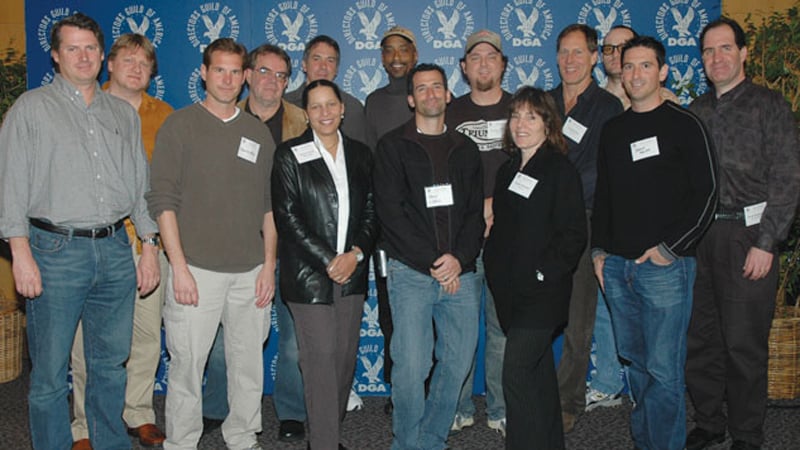
The DGA’s Reality Television Committee hosted a brunch on March 19 in Los Angeles. During the event, Guild members working in the genre learned about the DGA’s efforts to increase employment opportunities and met with their peers. DGA Associate National Executive Director Warren Adler and DGA Assistant Executive Director Rodney Mitchell presented an overview of the Guild’s new Reality Television Agreements provided for broadcast on the Network, Pay TV, Syndication and Basic Cable.
“We wanted to pass on the message that organizing reality TV is at the top of the Guild’s 2005 agenda,” said Adler in his opening remarks. “We’ve convinced the networks and the studios that we understand the nature of Reality TV and that there’s not one set of rules that can work for all shows in the genre.”
Adler’s comments were followed by a Q&A session led by Mitchell, one of the chief negotiators of the new Reality Television Agreements. “We recognize that each reality show is very different,” said Mitchell, “and we’re committed to creating agreements that demonstrate our willingness to be flexible in respect to salary, staffing, and other contract terms and conditions.”
According to Mitchell and Adler, the DGA has been witnessing a new level of cooperation from the various producing companies and the networks, thanks to the Guild’s agreements. The Guild has signed 22 new Reality TV shows and initiated conversations with many more. “As the marketplace for Reality shows gets more competitive, producers are more interested in using our members’ talent on their shows,” said Adler. “We are aggressively working to open a dialogue with the shows and producers that haven’t yet stepped up to the plate.”
Members present at the event were pleasantly surprised to learn about the nature of the agreements. “I have to say I’m really encouraged by what I’m hearing here,” said David Parks. “I primarily work as a showrunner myself and I’ve been doing a lot of basic cable work. It’s great to know that becoming DGA doesn’t mean I have to change the number of people I hire and if it’s negotiable, that’s really going to help.”
Mitchell also spoke about the importance of Guild members standing together and refusing to work for non-Guild shows. He mentioned that one production company was compelled to reach an agreement with the Guild after at least three directors refused to direct its Reality show using non-Guild titles. Ultimately the Guild was able to create an agreement to cover two directors and several stage managers on the project. “This example underscores the importance of members working with the Guild, providing valuable information to us so that we can effect agreements,” said Mitchell.
Adler emphasized the way in which DGA members can help Guild staff and committee members make strides in the genre. “You can help by letting us know when you hear of new projects. The earlier we hear of a new show, the better our chances are of signing the show to a Guild agreement. Let us know what works and what doesn’t work in our dealings with companies and on your particular shows especially in regards to staffing.”
Reality Television Committee member Danny Salles pointed out how members could assist in the process by making it on a more personal level. “I think that what we’ve all got to do here is to give it a try. If you’re on a job interview, talk about the Guild. Break the ice. That’s how this whole process is going to start snowballing.”
Key Points of the Model Reality Television Agreement for Network, Pay TV, Syndications and Basic Cable
In recognition of the special and unique circumstances and conditions that are present in the production of reality television programs, the Guild will negotiate special terms and conditions that are suited to the needs of this genre.
The Guild understands that each individual reality program or series is different and will require discussion regarding the minimum terms and conditions of employment for the DGA-covered personnel employed working on the program. In this context, the Guild will agree to develop special agreements with the producers tailored to fit the specific circumstances of the program.
The new agreements are particularly flexible in regard to staffing. For instance, when a Director or Executive Producer does not edit a program for initial broadcast, the assignment of an AD to editing shall be at the discretion of the company. Another example is the required assignment of Associate Directors and/or Stage Managers only when there are Guild duties to be performed on the set or in the field.
The provisions of the Basic Agreement (BA) and Freelance Live and Tape Television (FLTTA) currently cover DGA Reality TV shows made for Network, Pay TV and Syndication. The current Pension and Health contribution rates and credits provisions in the BA and FLTTA will remain unchanged.
DGA shows made for basic cable are done under the FLTTA Sideletter #6 which requires — in the case of shows that fit under the All-Other Programming rubric — only that producers hire DGA members when there are Guild functions to be performed and that they pay Pension and Health contributions on our members’ negotiated salaries. The actual salaries, working conditions, credits and residuals of our members are completely negotiable in this arena.
Definition of Reality Shows
A reality series or special is defined as an “unscripted” entertainment program that depicts actual people and with one or more of the following components:
- the program’s premise, circumstances or situations are manipulated for the purpose of creating the program;
- the program uses contrived, manipulated or staged elements, including re-enactments or highly stylized production or editorial devices;
- the program may or may not include a prize and/or a competition. Examples include: Survivor, Big Brother, Fear Factor, The Bachelor, The Simple Life, Crime and Punishment
- this definition would not apply to variety programs like Star Search or American Idol, to traditional quiz and game shows, or to programs like Entertainment Tonight which are covered by special agreements.