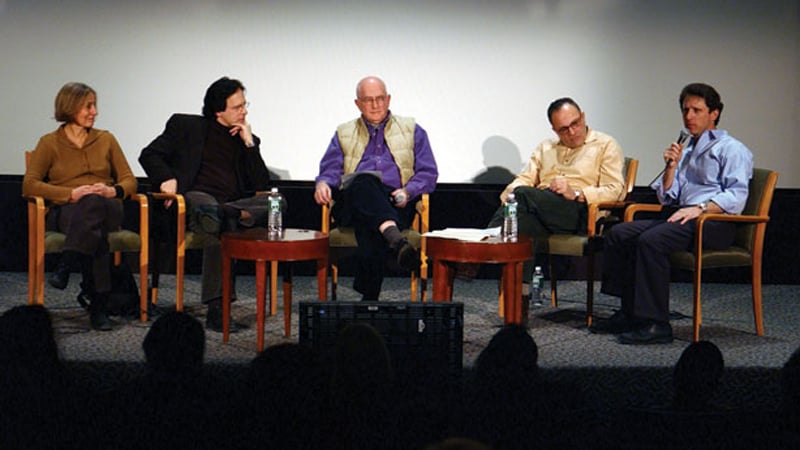
The universal difficulty the shows seemed to present to their directors was that of juggling the great number of characters and mass of information presented in each episode in such a way that an audience will follow the story, while maintaining the show's energy. Makris noted the complexity of following five characters talking about ten, but also the phenomena that, if one follows the ratings, more people tune into the second half of the show than the first. "If I missed the first two minutes of the show I wouldn't know what was going on," Prinzi added, "but I don't think audiences have to understand, totally. I think they get enough from the behavior of the perps." "The dialogue helps you in those squad room scenes," Chopra noted. "Since they're working together in a group, they're passing ideas to each other."
With all four shows shot in New York City, the directors spoke at length about the great impact the city itself had on their experience of the show, fifty percent of which is shot on location. "The energy and sense of urgency that's in the city is in these shows because you're shooting on the streets of New York," Chopra, who grew up in New York, said. "I think that's why these shows are so terrific. Other shows that are supposed to take place in New York but are shot elsewhere are completely lacking that reality, humor, energy and craziness that New York has." "It's a constant animal that is shaping how we shoot the shows," Prinzi said, taking into account how operating in New York can affect one's shooting time if there's a company move across town, for example.
Another common theme was the lack of creative control a director has in episodic television. The ability of the director to comment on the script varies from show to show (i.e. show runner to show runner), and each director has found his/her own way of dealing with the system, like planting an idea in the star's head, which then gets communicated to the executive producer. "Your heart does get broken every show," Prinzi said of postproduction. "I've been 19 minutes over on a show before, and when you pull 19 minutes out of a show, where everything is planned and layered, it's quite difficult. The complexity of the story, it shapes the show into more of a talking than visual show." When an audience member felt the pacing of the show had changed over time, Penn put forth that in 1991 the show ran around 48 minutes. Now, however, it is down to 42, and it has become increasingly difficult to fit all the information necessary, with nuance and coloring.
"Directing a television episode is like jumping on a train going 90 miles per hour," Sherin observed. "You try to avoid getting your arm torn from its socket. All the leading roles of the show are cast already. The bible is written, the actors know a hell of a lot about what they're doing—they've done it—so the director has to find his place within the scope of that design. I see it as being somewhere in the middle of the totem pole." No matter where on the totem pole these directors have found themselves, each seemed to find the experience of directing for the longest running police-show, and second longest running drama, in the history of television, tremendously rewarding experiences.
- Rob Feld