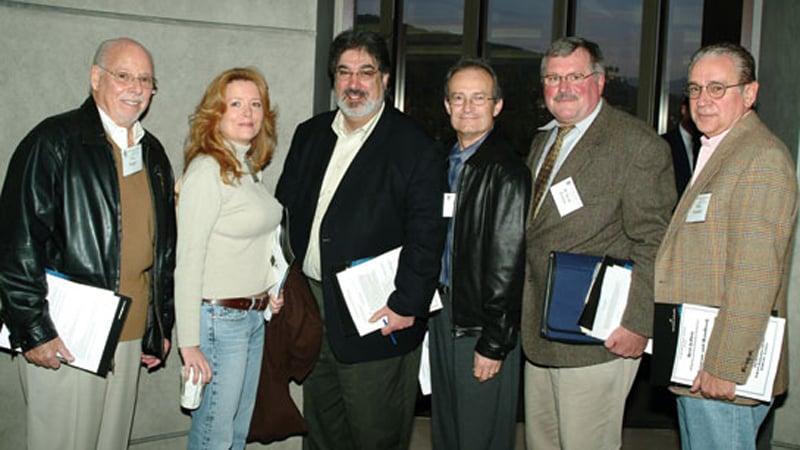
Participants were given a handbook containing sample schedules, budgets and forms, and heard a panel of experts made up of Mike Papadaki, VP Marketing and Sales at the post production company Consolidated Film Industries of Hollywood (CFI); Marc Solomon, Executive VP Post Production, Warner Bros. Pictures; Russell Paris, Sr. VP Post Production Columbia Pictures; and Paul Haggar, Executive VP Post Production, who has been at Paramount Pictures for 54 years and in post-production 35 years. The panel was moderated by Mentor Committee member D. Scott Easton.
"Post has always been considered a cosmetic feature, that we in production looked at as a sort of step-child that we had to put up with," said Easton. "But in the 21st Century it has become a necessity for UPMs to become involved in the post production department and to communicate with them in terms of our pre- planning."
Warner Brothers' Solomon was the first to speak of the revolution ushered in by the use of the technology called Avid. "There was a time that everyday at 2:30, at least at Warner Brothers, we would be screening dailies. Now no one goes to dailies. It's available on their computers. Avid created software, with our guidance, that transmits through a central server in Warner Brothers. Users dial in their passwords and get high qualities dailies on their desktop. It has fast forward, frame-by-frame, and you can have a TV monitor connected so you can see it on a bigger screen. For the UPM/Line-producing world, it's a whole new game in terms of cost and schedule, because all of our budgets now require some kind of digital transmission budget. We've graduated from the whole film world, fully grown into the digital world."
Paramount's Haggar spoke of the frustration he sometimes has in getting filmmakers to realize they need to stop the post process and release the film. "I will give everybody lots of room to make changes, because I can make up for it in other ways. The problem with what is happening today is they want you to go through previews. Then the dollar sign is wide open. They think the dollar sign can buy time, but it can't. My biggest frustration is being able to convince them that the movie is finished, that you can't do it anymore. They hate to hear that but they go along with it because I know how to get it into the theater."
According to Columbia's Paris, a UPM's knowledge of a director's working style is crucial to formulating a post production budget and schedule. "You learn the way the filmmaker you're working with works and you build that into the budget. There are things that we can't predict, but if there's a particular method of the director working, that has to be factored in. If there's a release date that's crunching that style, you have to factor that in. Whether it's going to be more overtime, more humanity employed on that in the post process, that has to be factored in. The trick is communication and being on the same page for critical assumption about the way your movie is going to get made."
Looking towards the future, CFI's Papadaki was a fan of new technology like the new Genesis Camera from Panavision. "It's a digital camera and it uses all of the existing Panavision lenses. A lot of the other cameras have a backlit problem that blows out, they have solved that. I think that one thing alone, especially in the one-hour television is going to make a huge difference. From there, obviously it will spread to the commercials and the theatrical and so forth. My reason for mentioning it is there's a transition coming down the road. I think that's something that's really kind of important to all of us to be aware of that one fact that this is definitely on the horizon."
After the panel answered questions from the DGA members present, Western AD/UPM/TC Council Chair Kim Kurumada thanked them and said, "One of the things that we're trying to do here with these seminars is to bring in experts, like this panel before you so you have first hand exposure to various segments of the industry and various companies in the industry. We'll continue to do that and I hope that the panelists let their companies know that we're receptive to that. The Mentor Committee is focusing on an ongoing education, so we appreciate it very much."