SHOT TO REMEMBER
Jurassic Jeopardy
Colin Trevorrow’s 2015 feature, Jurassic World, brought Michael Crichton’s test-tube dinosaurs back to wreak havoc again on hapless hubris-filled humans. In this article, Trevorrow describes how he created a nighthmarish scene that sets the tone for the continuation of the highly popular franchise that began with Steven Spielberg’s now iconic 1993 feature, Jurassic Park.
By Rob Feld
 In Colin Trevorrow’s handling of Jurassic World, a dream through the eyes of a child turns into a nightmare. Breaking away from their grownup minders, teenage Zach (Nick Robinson) and younger brother Gray (Ty Simpkins) steal a glass “gyrosphere” vehicle and go off-roading through the Jurassic World theme park, gliding freely amidst the smaller dinosaurs. Unbeknownst to them an “Indominus Rex” — a genetically modified monster of a dinosaur that kills for fun — has escaped its pen and is terrorizing the park. As they stop to marvel at four herbivore Ankylosauri in the tropical forest, they are discovered by the Indominous, who kills the group before turning its attention to the kids cowering in their glass ball. “This ride that is meant to make you feel free, running with the dinosaurs, reveals itself to be a cage,” says Trevorrow.
Shot single camera in 78 days in Hawaii, on 35mm film that would be converted to 3D for its theatrical release, Trevorrow’s discipline was to create everything practically, save for the CG dinosaurs. For this Indominus encounter, this meant no CG environments, natural light, and putting the kids in a remote controlled gyrosphere built from scratch with spinning glass, that could be shaken upside down on a gimbal.
“As a 38-year-old man directing like a 14-year-old kid who had seen Jurassic Park in the theater, my lack of understanding of what I couldn’t do probably led this to being the craziest of the three movies. I also stuck most to the grammar of Jurassic Park in this one — a certain elegance and a heavy camera, gliding in that Spielbergian way, with a lot of pans and camera movements revealing things in a 3D space.”
Trevorrow broke the attack scene into three segments with visual representations familiar to children, now writ large with the Indominus. “I started with pinball, as the kids get bounced around between the dinosaurs in their ball. Second is a cat with a ball of yarn, which is how the Indominus plays with them. The third step is a snake unlocking its jaw to fit something into its mouth that it shouldn’t be able to swallow — dinosaurs can’t do that, but this one can.”
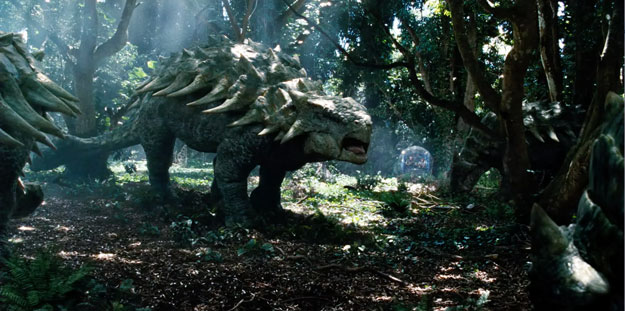
This shot is a table-setter to show the dinosaurs’ size. Everything except the CG dinosaurs is real. The gyrosphere was controlled remotely on a track with an S-curve, and on a rig that allowed it to spin 360°. We could counter its movement with the camera on a 50’ Technocrane. We always tried to add little pieces of dinosaur in the frame to create depth, like in the right corner. Because this was shot on 35mm (Kodak Vision3) film, the hot highlights on the top of the CG dinosaur's head are almost blown out, which you wouldn’t do if it was shot digitally — you'd have to match whatever the light was doing in the digital frame. But playing off the dynamic range of film, the way they replicated the specular Hawaiian sunlight hitting the wet skin of the dinosaurs, was a huge advantage in this movie.
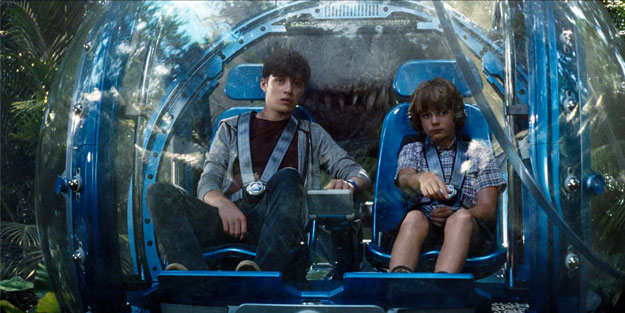
We push in slowly and crane up as the Indominus Rex appears behind them, then cut into a matching rise in the reverse angle. I love switching to dinosaur POVs and becoming the animal, watching as these kids get smaller and smaller in the frame, realizing how screwed they are. All the reflections of the environment in the glass are real except the dinosaur, which we laid in. We took plates of everything, shot on the same lenses as whatever the plate was being composited with, instead of using an array. DP John Schwartzman tuned our Panavision H-Series lenses, which are spherical lenses that captured these really creamy skin tones with these beautiful aberrations in them. This is probably a 50mm lens, here.
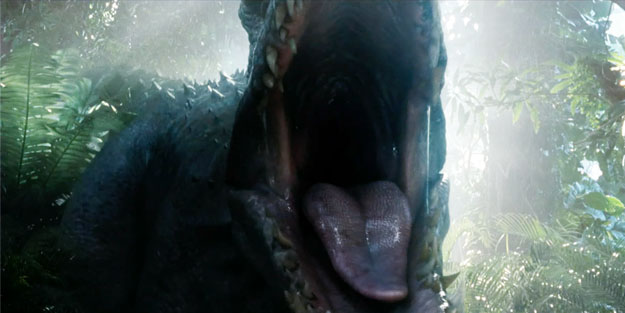
This is a plate shot in the kids’ POV, filmed through the gyrosphere glass and into the sun, as the Indominus roars at them. This image is through the eyes of a child — not what it actually is, but what his nightmare would look like. I love how its mouth breaks the frame — it’s massive. We shot spherically and released in 2:1, so the dinosaurs are very tall. It's why Steven shot Jurassic Park in 1:85, but I wanted to have more scope. Score kicks in briefly here. Score was deployed in moments when the stakes changed dramatically — for the worse and then suddenly when they had a chance. There’s none in the middle of the scene. The greatest suspense is awkward silence and only the SFX of what's happening inside and outside the glass.
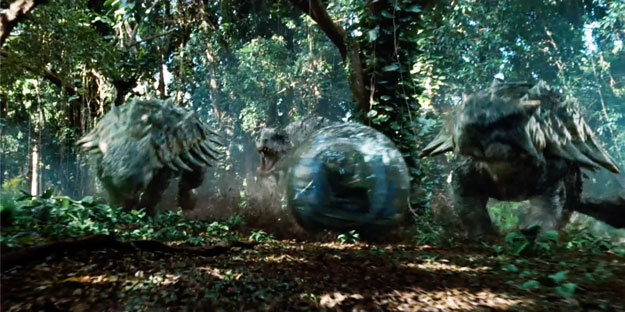
We’re pulling back on the Technocrane to widen out, probably on a 75mm lens. We did a lot of long wide angles when dinosaurs were in the frame. The gyrosphere is purely digital here because it’s moving so fast as it gets pinballed around, so this would've been a plate that we grabbed on day two. I just remember the loud rumbling of this stampede — their trip has turned from a dream into a nightmare. I dig how dirty this shot is. You're seeing little pieces of what's happening because we’re not framing it flawlessly. We didn’t really clean up the location — dead leaves, mud, and all — like we just happened to be here while this is going down. The Hawaiian sunlight gave this movie a really rich look. We just put a little bit of smoke in there and the whole thing came alive.
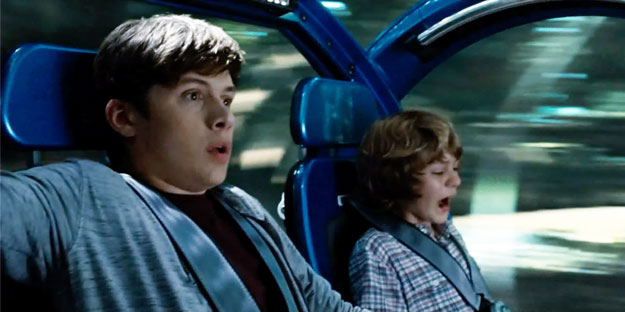
This was on location so we could get the changing reflections and shadows as we spun the gyrosphere on the dolly as fast as we could send them. Then we shot a 360° plate on the same lens and sped it up behind them — we had little blue cards behind their hair. The little kid screaming moves your eye to that third of the frame; it makes you feel like you're in it with them. Because you’re watching his face, it creates much more depth with the things spinning around. We gave them eyelines and I’d roar at them, which isn’t really scary, so they just had to feel it. Being spun upside down in the ball was inherently scary so I think we had enough to get a fear that felt real. Children are very good at being scared. They're scared all the time. They know that feeling better than anything.
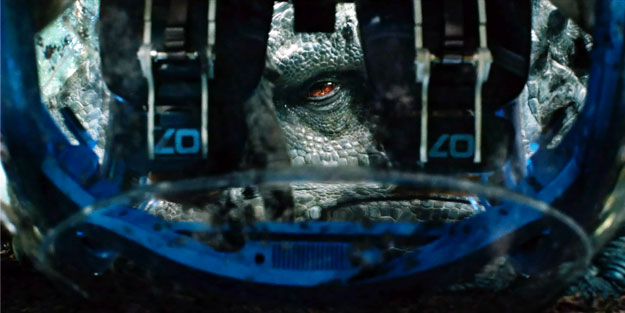
The kids are now inverted in the gyrosphere with the Indominus peering at them, like food inside packaging. We shot this in the jungle with the kids upside down, then laid in the animal. You get the size of the head and teeth as it raises out of frame. The light pings in the dinosaurs’ eyes are core to these movies. I'm very deliberate about where they get placed. You can define whether a dinosaur is wistful or angry or happy depending on where you put that eye ping. We would experiment to find the best spot. You know it when you hit it. When you design the dinosaurs with that extended brow, you get a shadow over the top third of the eye, which makes it look angrier. Here, we added curiosity to its sense of malice. I also love the barrel distortion they created where the glass curves. ILM was at the top of their game on this film.
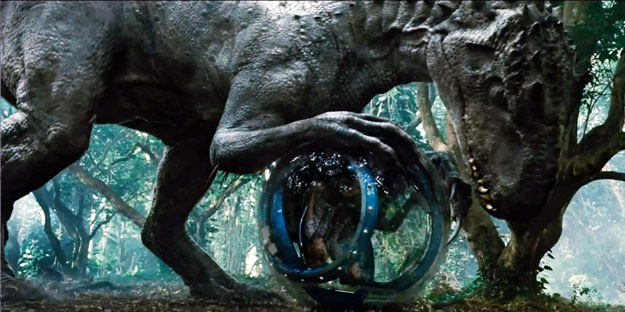
This grove of trees was an unbelievable location in Kualoa Ranch, very close to where the original visitor center of Jurassic Park was shot. The Indominus doesn’t fit into the frame. It’s all aided by the amount of sunlight pumping into the depth of that environment, which allows the foreground to have some really deep blacks in it. We shot with the gyrosphere there as a reference but had the kids upside down on a gimbal on a stage in New Orleans, and then laid it in. We could do anything with the gyrosphere on the stage. The camera is always moving. If it was ever static, Steven would have have written to me, “Why are these people just standing around? What’s happening?”
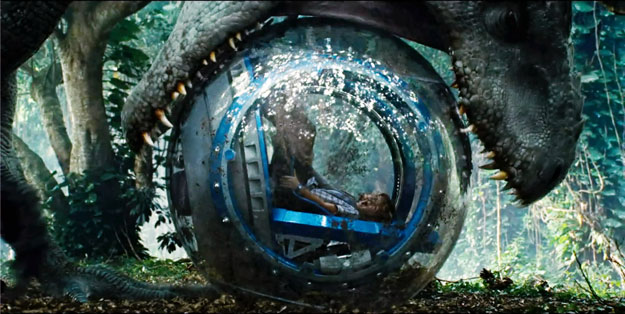
The gyrosphere isn’t moving so we were on location for this. Again, you barely see the Indominus here. Anytime you can see all of it, it would suddenly start to feel small. We were usually on 65 to 85 mm lenses on the dinosaurs, or 50mm for big wides — anything wider, they started to look snouty. We would always compress to make people feel closer to them. It’s a movie about corporations eating our dreams so I color timed with a bluish-green hue — cooler than the original Jurassic Park — but I actually put a little bit of warmth back into the 4K that you can see now.
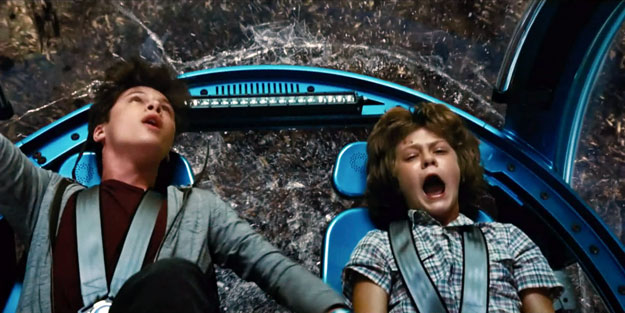
We’re on the gimbal as the Indominus smashes the gyrosphere into the ground and the glass shatters — which was ILM’s amazing work and really sold the idea. The plate we shot brings the camera way up and all the way back down really fast, it should be almost vertigo-inducing. Ty Simpkins was genuinely horrified. The dappled sunlight is gone, and you feel like the shadow of Indominous’s mouth is over the whole thing. Very scary.
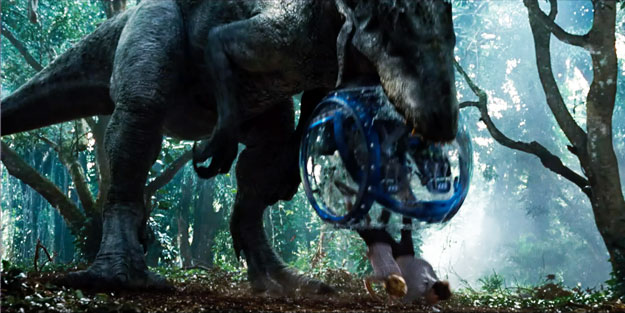
This was on location. The underside of Indominus is all black and his eyes are in shadow. I think that embracing the darkness was a big part of what made this work. If it was perfectly lit, I would probably find it unbelievable. We had the gyrosphere lifted up and our doubles were able to fall right out of it and hit the ground. It’s a one-second shot. Steven would say, "If you cut to the next scare fast enough, they'll never see your footprints in the snow." So, we cut into continuous movement of the ball smashing back down on the real kids, and you don’t have time to register that maybe these are stunt doubles. There's a fast, emotional brother-protecting-brother moment here, keeping it on story, even in action.
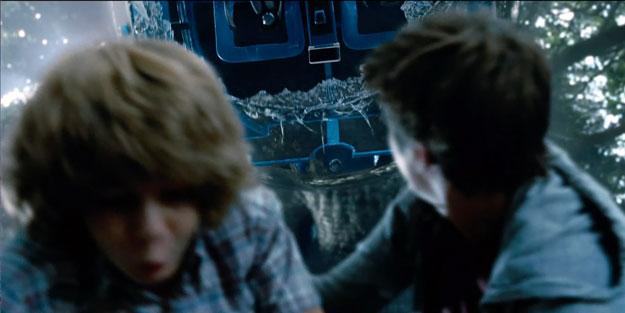
Because the film was going to be converted to 3D, I shot in a way that would allow you to choose where you were going to look and examine in the frame. Overall, it’s a pretty deep-focused movie so that the 3D experience could be as immersive as possible. In this shot we were handheld with our guys up on a platform so we could get under them. They fall out of focus — again, allowing the shots to be imperfect was important. The gyrosphere is CG now but ILM had the references to make it look perfect. It’s crucial to have something real that VFX are able to use as a lighting reference.
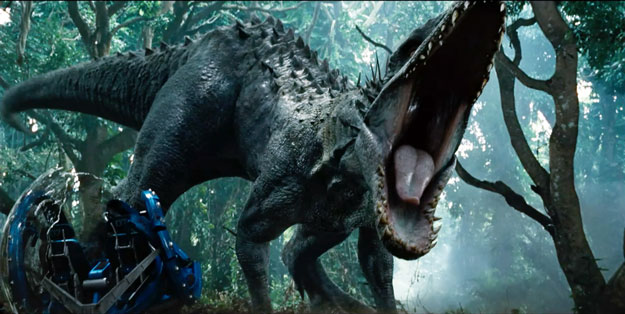
Zach helps his brother and the kids run out of frame as Indominus smashes the gyrosphere and roars after them. I remember Nick starting to take care of Ty and making him feel more comfortable. So, what was happening with the characters was happening with the actors. This is one of those shots that could have looked like a composite but Tim Alexander, our visual effects supervisor, would drop rectangular greens behind the actors, even though we were on location. They’re running with their hair and rustling clothes and he didn’t want to have to rotoscope them. It made all the difference to have the same light on them and the plates. In every moment, our mission was to have the only VFX element be the dinosaurs. Everything else was practical, which is what made it work.
SCREENPULLS: Universal Studios and Amblin Entertainment.
Glatter portrait by Stefanie Keenan