SHOT TO REMEMBER
The Kill Shot
Lesli Linka Glatter’s work on the Showtime series Homeland, garnered her five Primetime Emmy nominations for Outstanding Directing for a Drama Series and six DGA Award nominations, taking home the Guild’s Outstanding Directorial Achievement in Dramatic Series Award for her episodes Prisoners of War” (2020) and “From A to B and Back Again” (2015). In this article, Glatter revisits a scene that illustrates what she loves about the series.
By Rob Feld
 In Lesli Linka Glatter’s DGA Award-winning episode of Homeland, “From A to B and Back Again,” CIA agent Carrie Mathison (Claire Danes) continue her quest to take out terrorist leader Haissam Haqqani (Numan Acar). While stationed in Kabul, Carrie ordered a drone strike on Haqqani that, due to faulty intelligence, killed a wedding party but not its intended target. Now station chief in Islamabad, Carrie and her drone team track Haqqani’s nephew Aayan (Suraj Sharma) — a Pakistani medical student whom Carrie turned into an asset — to a mountain meeting with Haqqani.
In the scene Glatter chooses to revisit, Carrie watches from the Islamabad ops room as Haqqani emerges from his caravan with a surprise for Carrie’s eye-in-the-sky: he is holding captive ex-director of the CIA and Carrie’s mentor Saul Berenson (Mandy Patinkin). For Carrie to finally kill Haqqani and redeem the wedding strike, she would also have to kill Saul — and, in doing so, witness the destruction of her own humanity. She teeters between one compromised redemption and another, before balking and sparing her soul.
“This scene was all about multiple ways of seeing the same event simultaneously,” Glatter says. “It was essential to see the huge visual picture to establish us in the macro geopolitical environment, as well as the micro, internal, personal, and character-driven worlds. Those two juxtapositions created the style of Homeland.”
Everything in Glatter’s design and execution of Homeland is meant to bathe its audience in complexity, unease, and perpetual irresolution, reflecting both Carrie’s internal struggle and the war on terror. “My favorite Homeland scenes were when people had completely opposing views and they're both right,” she says. “We created a level of tension and anxiety under everything. Within scenes we would mix up handheld, steadicam, studio mode, handheld on a dolly, easy rig, so you always feel slightly uneasy; the ground is not solid, but always realistically-real and never exaggerated. Where is the truth in this world? Point of view was essential. Whose eyes are we seeing the world through? When is it objective or subjective? Knowing where Carrie was at all times was core, for sure — and sometimes we were only in her point of view — but all told, Homeland was about reflecting many points of view at once.”
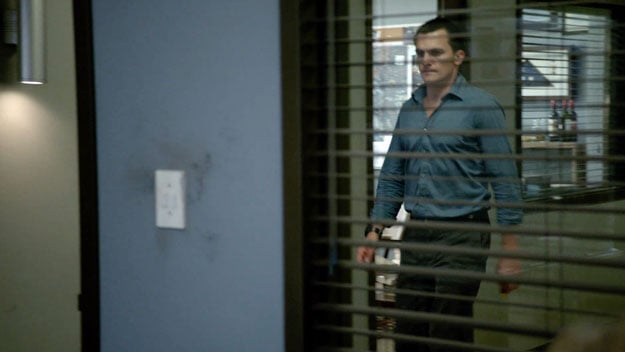
Quinn finds out Saul didn't get on a plane and was supposed to be long gone by now. We're on steadicam as he goes to investigate. Everything is built to create that level of tension but not tell you what to feel. Our composer, Sean Callery, created a low, tonal and sophisticated score here, creating tension but never pushing the story. For our American embassy set and CIA operation center in Islamabad, we took over a huge art center in Cape Town. This is a work-a-day world. We shopped for wardrobe at Men’s Warehouse, as the characters would. Everything was realistically real — not without taste, but it's not a fashion show.
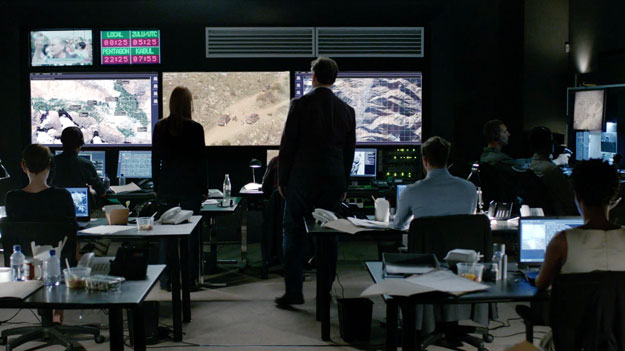
This is the ops room. Carrie’s eye-in-the-sky is tracking Aayan, hoping he will lead her to his uncle, Haissam Haqqani. Her assistant chief-of-station, Redmond, steps beside her as trucks approach Aayan. There’s a lot of tension and the drone operators are ready to fire when she calls it. As our schedule laid out, we hadn’t done the helicopter shoots for the drone footage yet so the actors are staring at greenscreens, with our 1st AD, Nick Heckstall-Smith, reading the stage description. The intention of the ops room was to feel real, but I wanted it to have a sense of design and drama. Its color palette is cool blues — you’re supposed to be objective when you’re running an operation — while the exterior they’re watching has a warmth. I liked that juxtaposition. Carrie is not being objective in this situation, so it all reflects her inner battles. I would typically use really wide lenses to see the world and then go in tight — so it would be very normal to shoot a 21mm or even 14mm lens and then jump to a 200mm. It was very much about whether you were inside the psyche of the character, or you were in the world of the location.
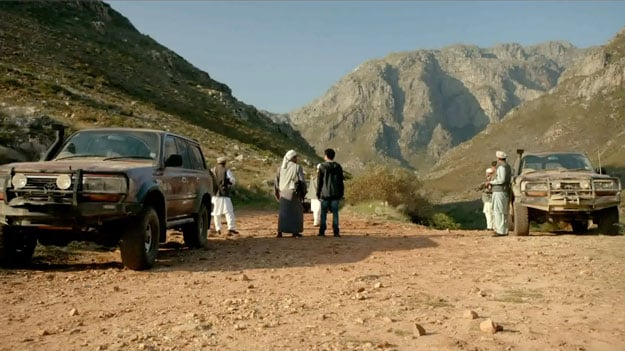
Haqqani’s men meet Aayan and wait for Haqqani. It’s important to be with the characters here — not just eye-in-the-sky — because of the simultaneous perspectives the show brings. Everyone has a reason for doing what they do. No one sees themselves as a bad guy. We were shooting full episodes in nine days and had a day to shoot this, the helicopter shots, and the leadup scene of Aayan’s journey at this remote location. I typically shot with two digital Arriflex cameras — I think we had some little REDs for tight interiors, too.
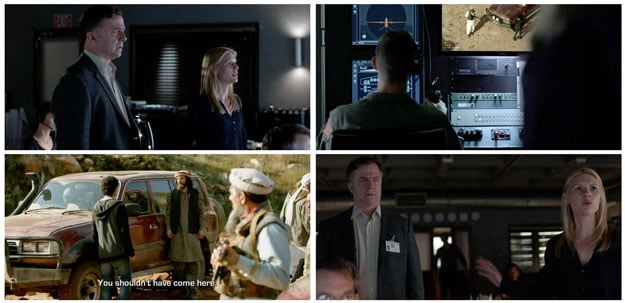
These four shots cut between simultaneous action and perspectives, as Haqqani arrives and Carrie orders the drone operator to arm a missile. Editing was all about what you wanted to be on, when. In the second, Carrie and Redmond are in the foreground, with Quinn entering in the background, to layer the frame and keep it messy. Cameras are handheld. Everything they're doing is a little dirty, flying by the seat of their pants and making quick decisions. It’s on a longer lens, so everything feels compressed — they’re all overlapping each other. The third is probably a 35mm lens; slightly messy and soft focus with Haqqani’s guys in the foreground. I like to embrace the reflections in the car windows and of the monitors in people’s glasses because that’s how life is. In the fourth shot, you have Quinn entering in silhouette, setting up the increasing intensity of decisions being made as the power shifts from Carrie to Haqqani, who knows he’s being targeted but also holds Saul.
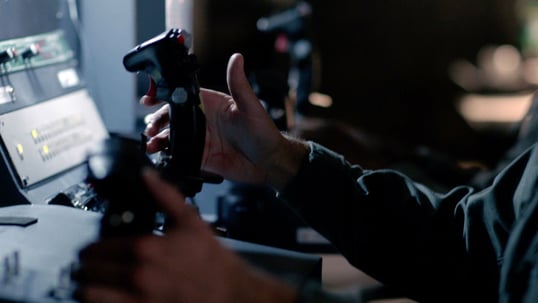
The drone operator is ready to fire but holds as they realize Haqqani has Saul with him. The camera swings up to the operator from the joystick so you connect the human to the action. A lot of these operators have PTSD because it feels like they’re playing a video game, but they’re actually killing a lot of people. So, it’s not a macro shot of the joystick but a wider, layered image with reflections and computers, so you see context. To get their best performances, we started the day shooting wide angles toward the actors, then did the closeups. With this kind of situation, you have to go all the way around the room, but you don't want to do it twice, so you're going to have to shoot out directions. And that's hard because you want to protect and save the dramatic performances. There's a lot of footage for each moment, because it's all about point of view and making choices.
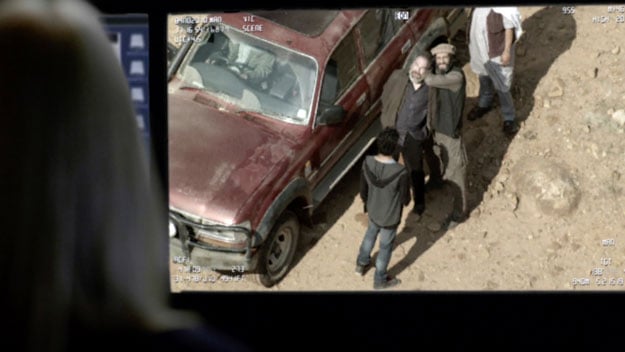
Haqqani holds Saul to the drone to say, "You think you've got me, motherfuckers? You do not," and Aayan realizes Carrie set him up. It’s very dramatic. I went up in the helicopter to direct when the drone would be zooming in and out for the drama of the scene — it’s Carrie’s POV from the sky. We did it last because the ground had to be clear of the crew. We were all running with equipment to get it out of there — whoever was left, hid in a truck or brush or tree, wherever. The location was one way in and one way out, very remote. It was incredibly windy, which is really scary in a helicopter, especially in this saddle area between mountains. The monitor kept going out and communications were bad, but we’d been through the scene already and the actors knew what to do. We got through the scene one-and-a-half times before they demanded we bring the helicopter down for safety. It was stressful, just praying that we got the scene, but we did!
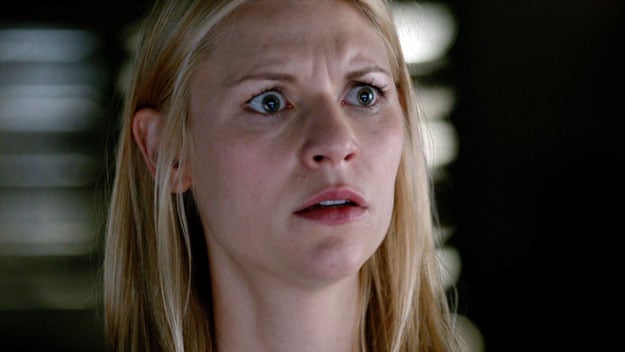
Claire Danes is extraordinary. She opens her mouth and speaks the truth. This is a particularly dramatic scene because she is on a mission to get Haqqani and in the split second when Saul steps out, she's weighing what to do. She knows if she drops fire on Saul — her father-like figure — her soul is gone. You could play the whole scene on Claire’s face, and you would get the story. She was acting to an X on the greenscreen because we hadn’t been able to do the helicopter day yet, so our wonderful AD, Sunday Stevens, is going, “And he pulls Saul out of the car …” And as she sees Haqqani shoot Aayan, she slammed two pieces of wood together for the gunshot. Claire saw it all in her head, and you feel the horror.
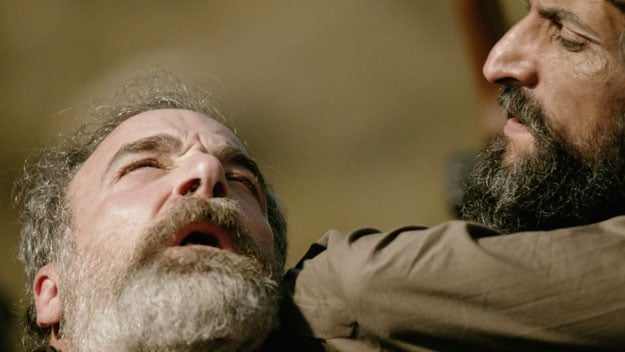
Haqqani holds Saul so the drone can see him. I shot this in a wide angle as well as from the helicopter, but to me, this long lens shot with these two powerful men — Saul without his glasses being completely manhandled — was it. They're almost falling out of the frame. I wanted it that tight, that messy, and it would have been fine with me had Haqqani dropped out of the frame — which he kind of did and then came back in. It made it feel realistically-real. We shoot a lot of footage for each moment, because it's all about point of view and often it’s a tough decision as to where one needs to be to see the scene.
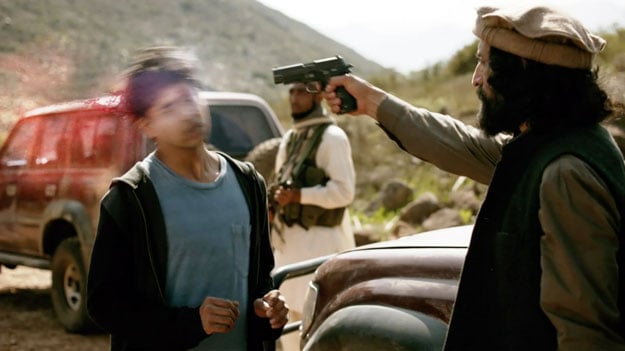
Haqqani kisses his nephew and sends him on his journey. The shot should feel horrifying because it's so unexpected after the kiss. The blood is CG because putting squibs on any actor’s head would be way too dangerous. Suraj is an intuitive actor and his reaction felt real every time. In Life of Pi, his first film, he acted against a CG tiger the whole movie.
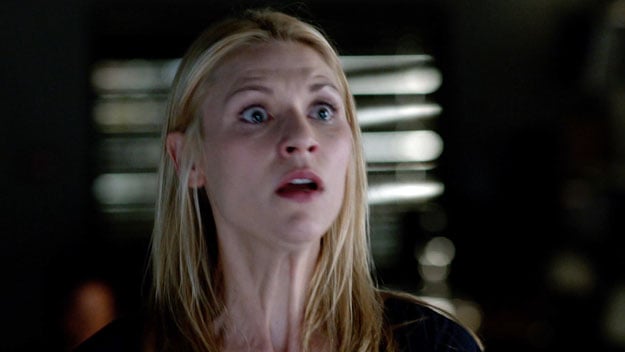
Carrie is horrified. She’d used Aayan and had made the decision to take them all out — as we’ve seen her do with many others — but by capturing Saul, Haqqani switches the power dynamic and it’s now his move. There's so many layers to this scene. Tracking the power shifts was why it was so important to sometimes be down on the ground with Haqqani and not just in Carrie’s drone point of view. This is where the background score stops. You can’t be scared of the silence because, juxtaposed with the sound, the human breath, it creates tension.
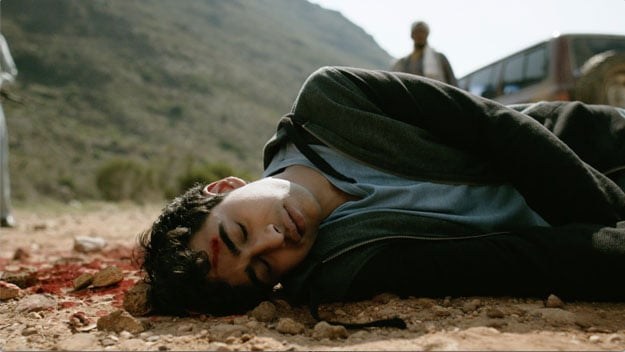
I wanted to be there with Aayan, low, on his level. We're not looking down on him. I’m probably on a sandbag here. We did a lot of very still handheld so that there’s still some human breath in the shot. It’s a horrible moment, how this young medical student meets his end. You have the mountains and the guys in soft focus behind him. Nothing is clean. I wanted that layering of moral and political ambiguity. Nothing is ever comfortable or resolved in Homeland.
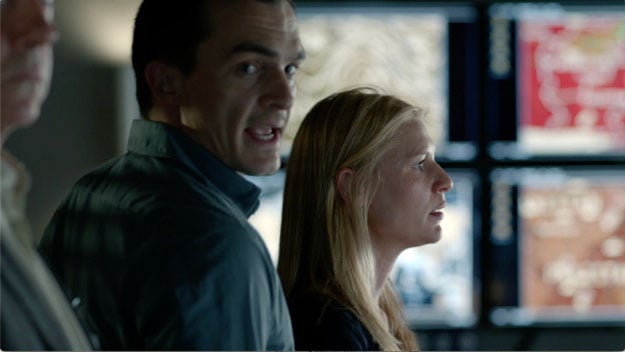
After the horror of Aayan’s killing, Haqqani gives the drone a great look of, “Fuck you, bitch.” Carrie gives the order to take the shot, but Quinn contradicts it because Saul is in the car with Haqqani. Again, it’s a layered frame on a long lens, complicating things and compressing all the elements of control we think we have: Carrie, Quinn, and Redmond; maps and drones and ways of spying. But at the end of the day, it's about human beings. Who’s in control? I played around with focus here because she’s the one saying, “do it,” and Quinn is saying, “don’t,” and the poor drone guy is like, "Who do I follow, here?" She’s in profile and we get Quinn as he turns — it’s an almost intimate blocking juxtaposed with the incredibly high stakes.
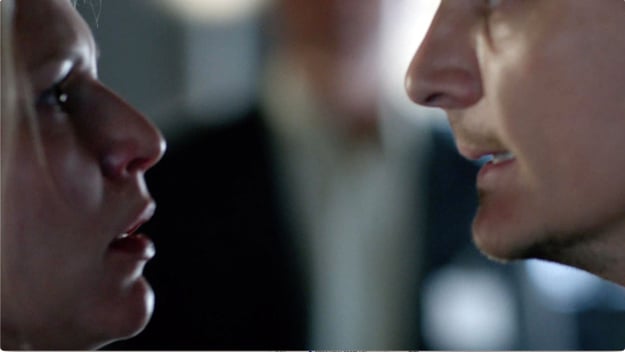
This is so intimate, as Quinn grabs Carrie — he knows that if she drops fire on Saul, her father-like figure, her soul is gone. It's like they barely can be in the same frame. It's about the space in between them as well as the characters. They’ve both done terrible things in the name of good and they get each other. This is a handheld shot on a very long lens, so the frame is changing, really going with the action. I don't mind that there's a buzz in this kind of situation because it makes it feel real and in the moment. Then, Carrie comes back to herself. Quinn goes for humanity and at the end of the day, so does she. But without him, she would have probably dropped the bomb … or would she?
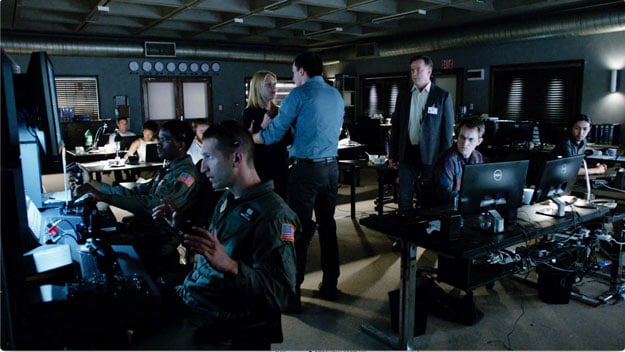
We go back to a wide shot just for a few seconds to breathe, with Carrie and Quinn nose to nose. Carrie pulls back because of Saul but loses Haqqani. It’s so mixed emotionally, which is why it’s important to cut to this wide, with everyone on pins and needles. I was in Cape Town with editing happening in the U.S., with a 12-hour time difference and a five-second delay doing all-night sessions with this episode’s amazing editor Michael Ruscio, which wasn’t fun. I wanted his take on where we needed to be so that each moment landed. Do we want to be down on the ground when Saul is revealed or with Carrie watching it? There’s lots of quick cuts because we’re attempting to track the emotional connections between all the characters. The whole scene could have been on Carrie and her POV, but it wouldn't have landed as strongly if you didn't feel Haqqani as a human being.
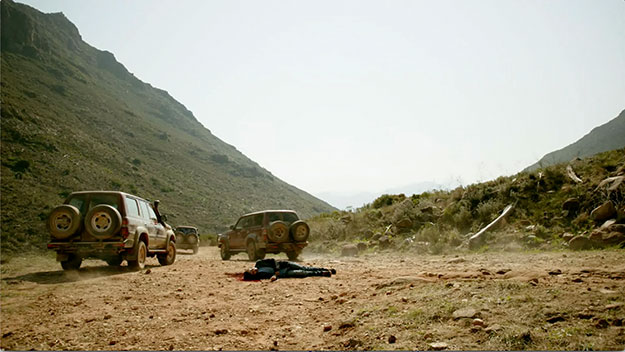
This is the human tragedy, that this young medical student, because of all the surrounding circumstances, is lying dead in the middle of the mountains with the politics of the world circling around him. The story of his life is the human toll of geopolitical events, and it's tragic.
SCREENPULLS: Twentieth Century Fox Home Entertainment.
Glatter portrait by Howard Wise